Water Shortages (Cambridge International IGCSE Geography)
Water Shortages and Management
Spec point —
3.6.2· Explain why there are water shortages in some area and demonstrate that careful management is required to ensure future supplies
Water shortages (deficit)
-
Many areas of the world have water shortages (deficits)
-
Water deficit can be due to:
-
Low supply:
- Lack of precipitation
- High levels of evaporation
- Poor water management
- *Drought
- Pollution
-
High demand:
- Increasing population
- Industry
- Agriculture
-
A combination of low supply and high demand
-
-
Areas with the greatest water-deficit include:
- Australia
- North, East and South Africa
- Middle East
- Southwest USA
- East Brazil, parts of Argentina and Chile
- India
-
These tend to be areas around the Tropic of Cancer and Tropic of Capricorn
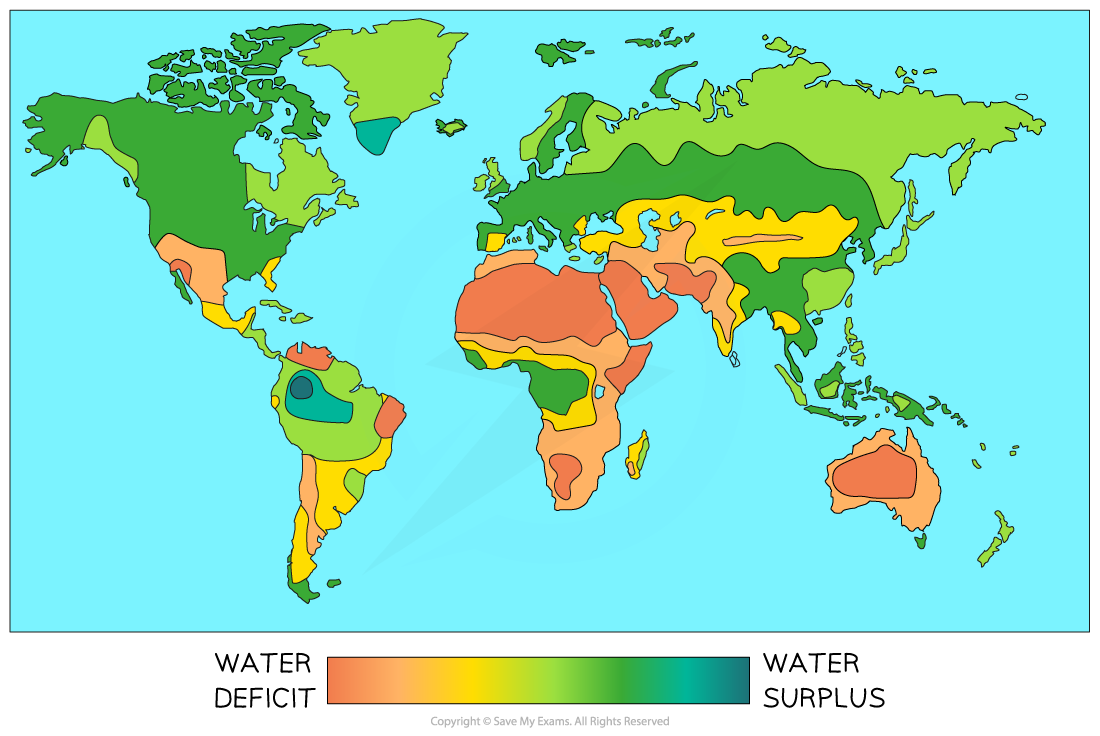
Water surplus and deficit
-
There are different levels of water shortage:
- Water stress occurs when the supply of water is below 1700 m3 a year per person
- Water scarcity is when the supply is below 1000 m³ a year per person
-
There are two types of water scarcity:
- Physical water scarcity— when physical access to water is limited due to the climate conditions of the area
- **Economic water scarcity—**when a population does not have the money to utilise the available water resources
-
The UN** Millennium Development Goals (MDG)** included Goal 7
blockquote "Halve by 2015 the proportion of the population without sustainable access to safe drinking water and basic sanitation."
-
This goal was not met but access to clean water has improved
-
In 2020, 74% of the world's population now have access to clean water supplies
-
In some areas, there may be water supply, but this is not potable
- UNICEF estimates 2.2 billion people do not have access to potable (clean drinking) water
- Around 4.2 billion people do not have access to safely managed sanitation services
-
Water scarcity is expected to increase across the world due to:
- increasing population
- development increasing demand
- climate change increasing aridity
- pollution
Causes of water shortage
-
Many of these areas have a deficit due to low precipitation throughout the year or drought
-
Demand is greater than supply in some countries due to increasing population, industry and agriculture
-
In some areas, rivers flow through many countries
-
This leads to issues with water abstraction and other activities
-
The upstream country may:
- take large amounts of water from the river for agriculture, industry or domestic use, leaving less for the country further downstream
- build dams or alter river flow, which impacts discharge downstream
- reduce water quality by introducing pollution to the river
-
-
Higher temperatures may lead to increased evaporation and transpiration, reducing the amount of water available
-
The type of land use
- Agriculture leads to increased water consumption
-
In some countries, there is a disparity in water supply between areas
- China has severe water shortages in the north but water is more available in the south
-
Conflict
- Many of the LEDCs who have struggled to meet the MDG are experiencing conflict
Impacts of water shortage
-
There are many impacts of water shortages, including:
-
Death and illness due to waterborne diseases such as cholera and dysentery
-
Potential for conflicts over water supply, particularly where countries share a river basin
-
Children in rural areas in LEDCs often miss out on school as they are responsible for collecting water (they may have to walk miles to the nearest water source)
-
Lack of food due to:
- Crops cannot be irrigated so yields are lower
- Livestock dies due to lack of water
-
Damaged ecosystems and loss of habitats
-
Delayed economic development because water is not available for industry
-
Managing water supply
- There are many ways in which water supply can be managed but this is easier in MEDCs, where the money to implement these schemes is available
Industry
- Most water in MEDCs is used for industry
- Some of this water could be recycled and used again within the process to reduce consumption
Agriculture
- Drip irrigation, which delivers water to the roots of plants
- Irrigation leads to 40% of the water used being lost to evaporation and poor management
- Drip irrigation reduces this loss significantly
Domestic
-
Water-efficient appliances
-
Rainwater collection
-
Use of grey water for washing cars and watering plants
-
Low-flush toilets and water-saving shower heads
-
Water companies fixing leaks and improving efficiency
-
In LEDCs, water management is more difficult due to a lack of funding
-
The involvement of non-governmental organisations (NGOs), such as Water Aid, helps to fund projects
-
Appropriate technology is essential to manage water in LEDCs; they include:
- wells
- gravity-fed systems where water is piped from a spring or river higher up a valley
- boreholes use a hand pump to bring water to the surface
- rainwater collection from roofs
- drip irrigation
- drought-resistant crops
Exam Hint Remember when interpreting maps to pay close attention to the key and title.
In the above example, the map shows the surplus and deficit of water supply on a sliding scale. Areas of greatest water surplus are dark blue and areas of greatest water deficit are dark orange.
Case Study: Spain
Spec point —
3.6.2· Water supply in a country or area
-
The average precipitation in southeast Spain is approximately 365 mm a year
-
Most precipitation occurs in winter
-
The area is one of the driest in Europe
-
Agriculture uses 80% of the water available
- 147,000 hectares of land require irrigation
-
Regular droughts mean the supply of water is further reduced
-
There is a water deficit as demand exceeds supply
-
Tourism increases the problem because:
- Water parks and golf courses use significant quantities of water
- An average tourist uses between 450 and 800 litres per day
- An average Spaniard uses 127 litres per day
Tagus-Segura Project
- Completed in 1978
- Over 60% of the water flowing into the Tagus is transferred
- A 286 km pipeline that connects four Spanish river basins: Tagus, Jucar, Segura and Guadiana
- The aim was to supply Alicante, Murcia and Cartagena in the southeast to reduce the water deficit
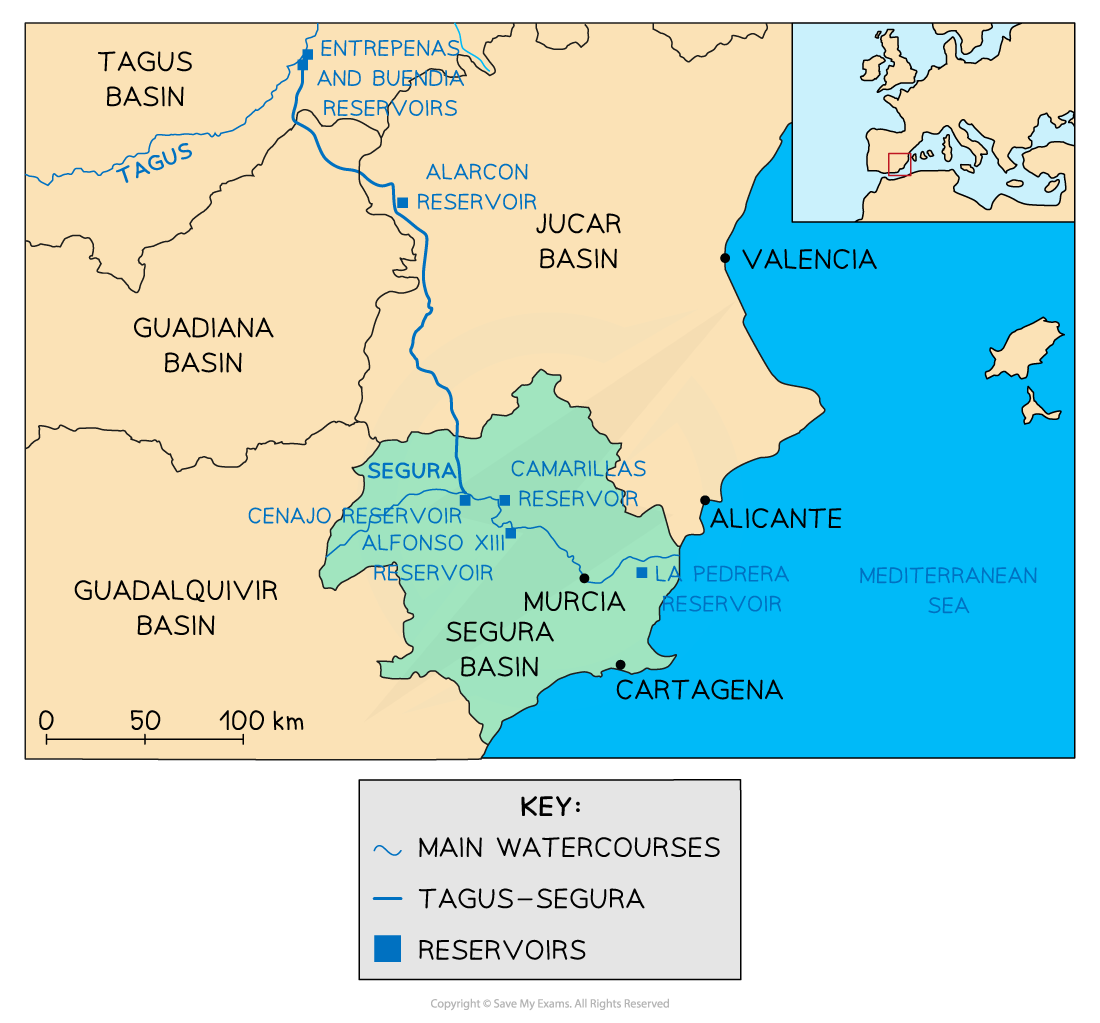
Map showing the Tagus-Segura project
Issues
- Much of the water transferred went to the tourist and leisure users, not to small-scale farmers
- Water consumption in the southeast increased due to an increase in supply
- It is estimated that 15% of the transferred water is being illegally used by leisure users such as golf courses
- Large commercial farms are benefitting more than small-scale farmers
Ebro project
-
A second water transfer project was proposed in 2001 to transfer water from the River Ebro
-
This project was abandoned due to the
- failure and issues with the Tagus-Segura project
- cost
- threat to the Ebro Delta, as the scheme would have disrupted sediment flow to the delta
-
Spain has now moved to utilising desalination plants to meet the demand for water
Was this revision note helpful?
Build on this topic