Urban Growth (Cambridge International IGCSE Geography)
Reasons for Rapid Urban Growth
Spec point —
1.7.1
Urbanisation
-
More people now live in towns and cities than in rural areas
-
Urbanisation varies across the globe and is defined as the increase in the percentage of a population living in urban areas
-
Urban settlements differ from rural ones in terms of:
- Way of life: faster-paced
- Size: larger
- Density of buildings and people: compact and high
- Economy and employment: finance, service, and manufacturing
-
MEDCs show the highest levels of urbanisation, with the lowest levels in Africa and SE Asia
-
The world population doubled between 1950 and 2015, but the urban population more than tripled due to:
- The decline of industry in developed countries as the industry moved overseas to emerging countries (cheaper workforce, incentives, tax breaks, etc)
- This led to industrial growth in emerging countries and 'pulled' people from rural regions to urban areas, with the hope of a better life and employment
-
High rates of urbanisation occur in LEDCs because:
- Most new economic development is concentrated in the big cities
- Push-pull factors lead to high rates of rural-to-urban migration
- Cities are experiencing higher levels of natural increase in population
Exam Hint Natural increase does not include inward migration of people to a place, just the number of births vs number of deaths. E.g. In one street there were 5 new migrants, 10 births and 2 deaths. The natural increase is 8 people because the migrants chose to move there. If they then had children, then those children would be included in the natural increase rate.
Factors affecting the rate of urbanisation
-
The main factors affecting the rate of urbanisation are:
-
Speed of economic development
- Economic growth drives urbanisation
- The faster the growth of secondary and tertiary employment sectors, the faster the growth of urbanisation
-
Rate of population growth
- Economic growth needs a supply of labour
- This demand can be met in two ways:
-
-
Rates of urbanisation are lower in MEDCs as a higher percentage of the population already lives in towns and cities
-
In 1900, there were just 2 'millionaire'' cities (London and Paris); by 2018, this had grown to 512
-
As the growth of cities continues, the term mega city is used to describe cities with more than 10 million people:
- In 1970, there were only 4
- By 2000, there were 15
- In 2018, that rose to 33, with Tokyo having close to 37.3 million people
-
Due to modern transport and communication, urban areas are sprawling into rural regions to create conurbations, further adding to the growth of urban areas
Causes of rapid urban growth
-
Natural increase
- Accounts for roughly 60% of urban population growth
- Due to decreased death rates and higher birth rates
-
Urban pull factors
- Higher wages
- Pace and excitement
- Improved education and healthcare
- Better job opportunities
- Public utilities: water, gas, electricity, etc.
- Government support
-
Rural-urban migration
- Accounts for 40% of urban growth
- Due to rural push factors along with urban pull factors
- Natural hazards
- Poor basic services health, water, education
-
Rural push factors
- Limited healthcare and education
- Mechanisation of farming
- Lack of opportunities
- Lack of government support or investment
- Hard and monotonous lifestyle
- Unreliable food supplies/famine
-
Rural reclassification
- Due to urban sprawl, some rural regions are being reclassified as urban
- Rural villages becoming dormitory settlements
Urbanisation pathway
- The differences between LEDCs and MEDCs can be shown as a pathway over time
- Countries become more urban as they develop economically
- As they move through the stages, the pace begins to slow and begins to flatten out or decline as counter-urbanisation gains speed
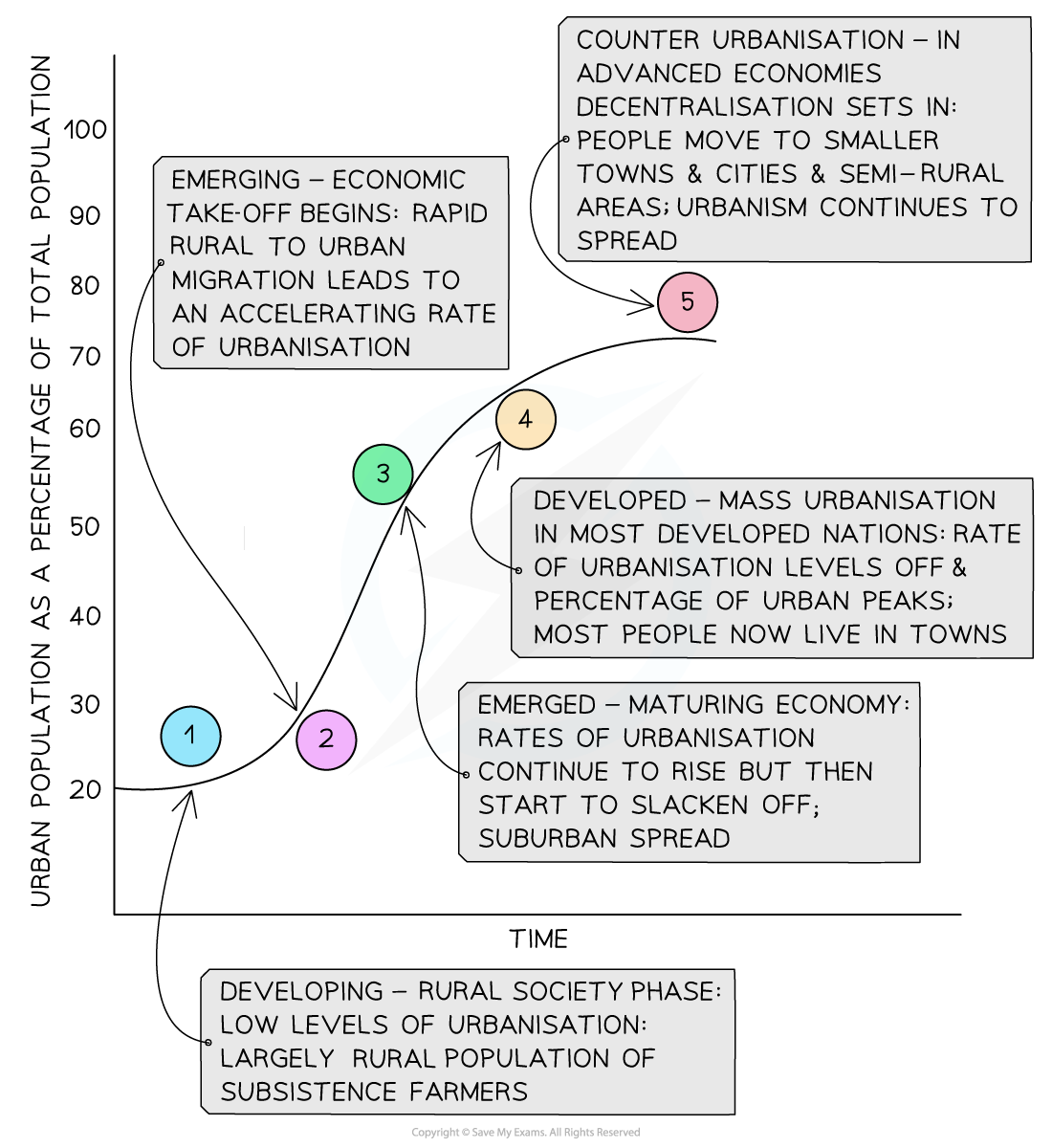
Urbanisation pathway
Urban process timeline
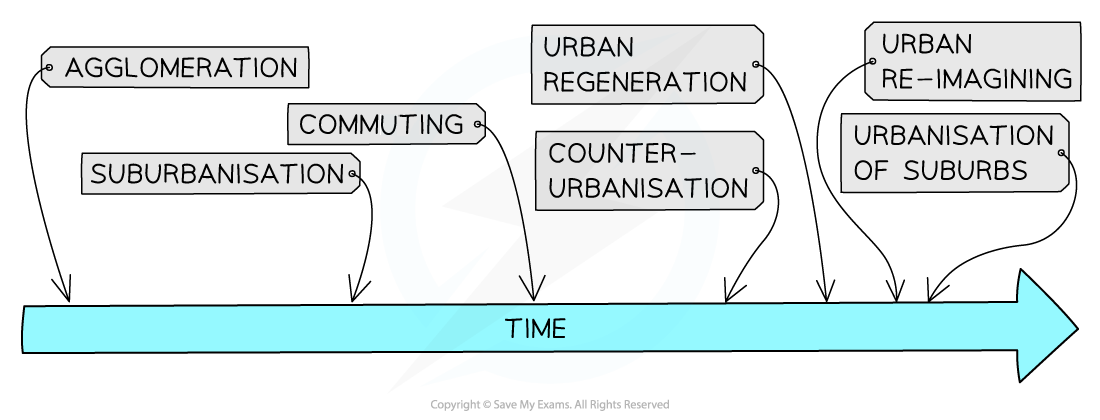
Urban process timeline
-
Urban settlements first appear as a result of agglomeration
- People gather together in one area to sell goods and live
- Small trading posts and villages began to develop
-
As towns grow, they expand outwards through a process known as suburbanisation
- This adds to the built-up area, but the building densities are generally lower than in the older parts of the town
- The new suburbs are made up of mostly houses but also include places of employment and services
-
Urban settlements continue to prosper and grow, and people move out of the town or city altogether and commute to work
- These are called dormitory settlements because many residents only sleep there.
- They continue to have links with the town or city they have left
- They still make use of urban services, shops, education, and healthcare
Counter-urbanisation
-
This is the movement of people from an urban area into the surrounding rural region
-
Causes include:
- Mobility and accessibility: higher personal car ownership, increase in public transport and road development making easier access to rural areas
- Increased wealth: making housing and travel more affordable
- Agricultural decline (mechanisation and merger of farms) creates the availability of more land for housing, forcing agricultural workers to leave the area
- Green belt: people need to go further out to get the rural life they are looking for
- Second homes and early retirement have increased the movement of people from the city to the countryside
Urban regeneration and reimagining
-
Urban regeneration and urban reimaging are different
-
Urban regeneration is the investment of capital in the revival of old, urban areas by either improving what is there or clearing it away and rebuilding
-
Over time, older parts of urban areas would begin to suffer a decline
-
Factories would move elsewhere, resulting in job loss
-
Quality of life and housing become poorer, people move away
-
Urban blight **sets in
-
The area needs to be 'brought back to life' = urban regeneration -** Urban reimaging is changing the image and reputation of an urban area and the way people view it
-
Focusing on a new identity/function
-
Changing the quality and appearance of the built-up area
-
Good opportunity for brownfield site development
-
London Docklands was completely redeveloped and regenerated
-
London Docklands had new industries, more executive services, homes, entertainment, and leisure, making it the new 'cool' place to be
-
-
Together, urban regeneration and urban re-imaging = rebranding
-
These processes add to the continued growth of urban regions
Megacities
- These are urban regions with over 10 million residents
- In 2007, more people lived in an urban environment than a rural one
- By 2050, it is thought that more than two-thirds (7 billion) of the world population will live in urban areas
- This scaling up of the urban environment is the fastest in human history
- The largest growth of megacities is seen in Asia
Reasons for growth
-
Four main factors:
-
Economic development
- Encourages population growth, which leads to the desirability of goods and services
- All megacities act as service centres within the formal economic sector
- However, megacities in LEDCs are also important manufacturing centres (Mumbai in India or Dhaka in Bangladesh), with thousands working in the informal economy
-
Population growth
- Young people are drawn to live in megacities with their vibrancy, fast pace and opportunities
- There is also ‘internal growth’ where people who have moved into the cities have children, so sustaining population growth (Mexico City, Mumbai, Pearl River Delta in China)
-
Economies of scale
- It's cheaper to provide goods and services in one place than spread across several cities
- Financial savings for local governments in respect of infrastructure provision
- Communication and transport are centralised, making savings in time and money
-
Multiplier effect
- As a city prospers, it acts as a beacon to people and businesses
- This encourages inward investment
- This leads to yet more development and growth
- Generating further need for skills and labour and job growth
- This cycle multiplies the positive effects and growth continues (San Francisco and the digital development)
World cities
-
Megacities have a powerful attraction for people and businesses
-
They are **influential cores with large peripheries
-
World or global cities can be any size but exert particular** influences **around the globe
-
They are considered prestigious, with status and power
-
They are critical hubs in the global economy
-
The three top (alpha) world** cities are London, New York, and Tokyo
-
These are the financial centres of the world, each with smaller networks of world cities feeding into them
-
There are only four world cities in the Southern Hemisphere:
- Sydney
- Rio de Janeiro
- Sao Paulo
- Buenos Aires
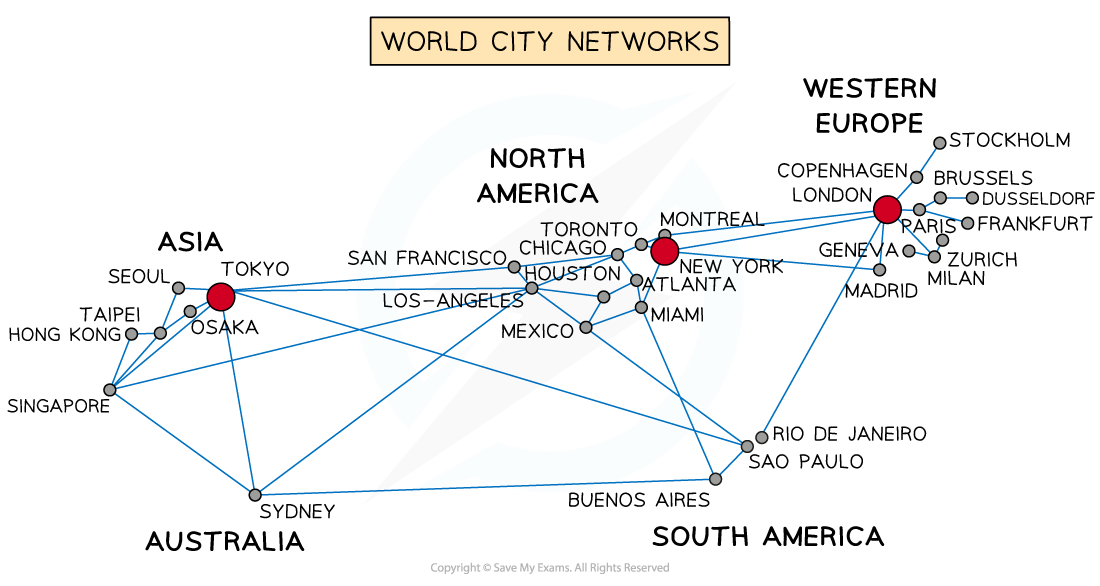
Diagram showing the world city network
Worked Example Identify the meaning of the term counter-urbanisation.
[1 Mark]
A Increasing proportion of people living in urban areas B Population movement from one country to another C Increasing population growth on the edge of urban areas D Population movement from urban areas to the countryside
- Answer is D: population movement from urban areas to the countryside
Was this revision note helpful?
Build on this topic