Repeat Units & Monomers (Cambridge International A-Level Chemistry)
Exam board Cambridge International · A-LevelUpdated 2026-07-02
Deducing the Repeat Unit of a Condensation Polymer
Repeat units for condensation polymers
-
Remember we can tell the type of polymerisation by identifying the linking between the monomers
- If a chain of carbon atoms is present, the polymer is an addition polymer
- If there is an ester link, the polymer is a polyester (formed by condensation polymerisation)
Example polyester structure
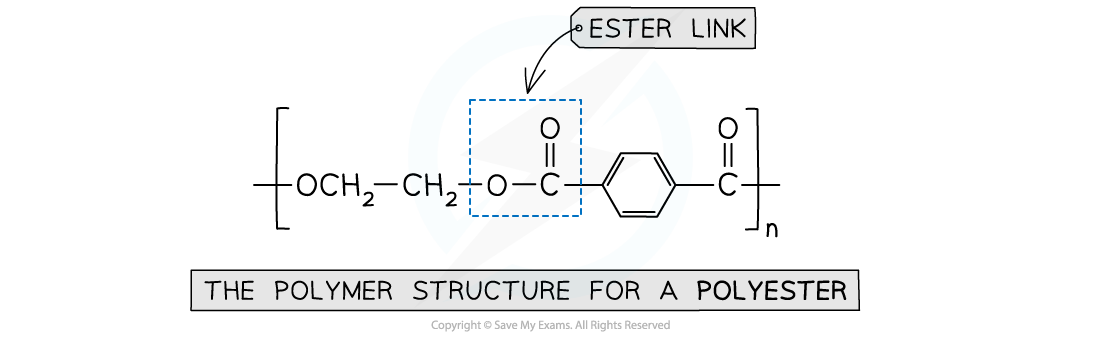
Polyesters contain the ester link
- If there is an amide link, the polymer is a polyamide (formed by condensation polymerisation)
Example polyamide structure
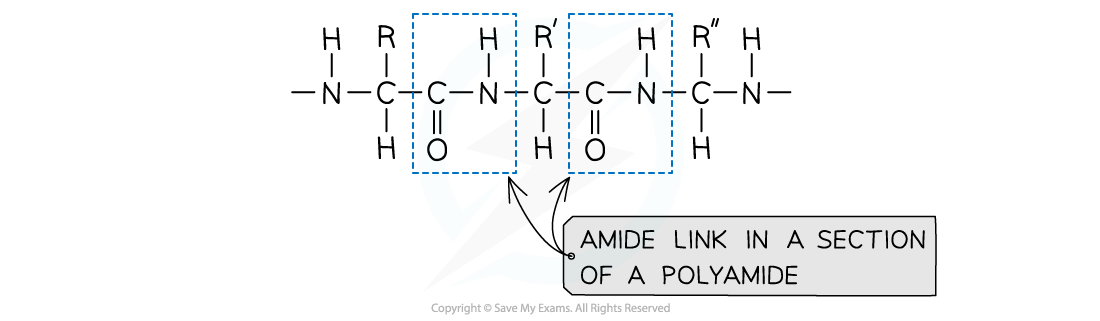
Polyamides contain the amide or peptide link
-
In condensation polymerisation, the monomers either contain:
- 2 monomers each with the same functional group, such as a diamine with a dicarboxylic acid or
- One single monomer that has both of the functional groups needed for polymerisation, such as an aminocarboxylic acid
Exam Hint
Remember: in condensation polymerisation, a small molecule is expelled as a result of the 2 monomers joining together.
When a dioic acid and diamine polymerise, a water molecule is expelled
- OH from acid and H from the amine
When a dioyl chloride and diamine are polymerised, a hydrochloric acid molecule is expelled
- Cl from the chloride and H from the amine
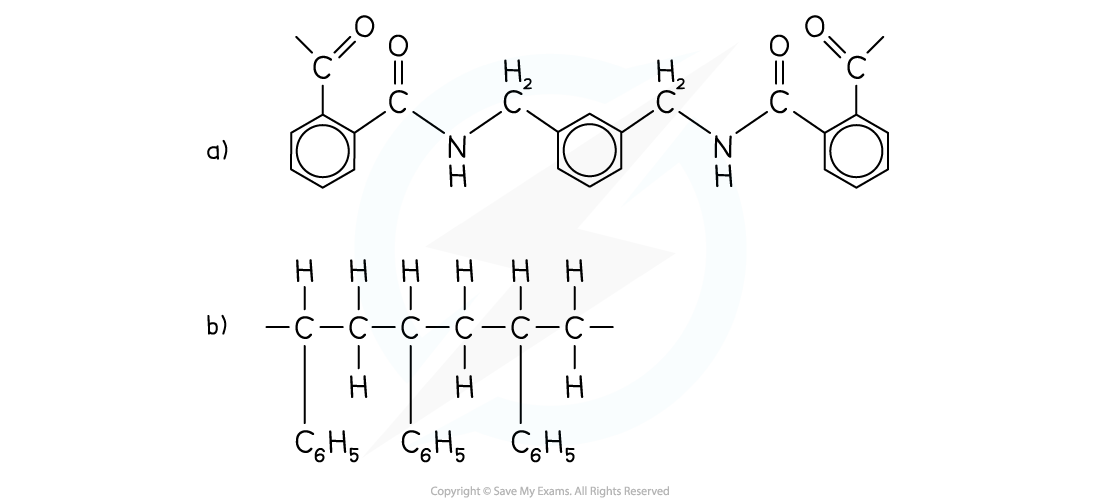
Worked Example Draw the repeating unit and identify the monomers used to make the following polymers
Answer:
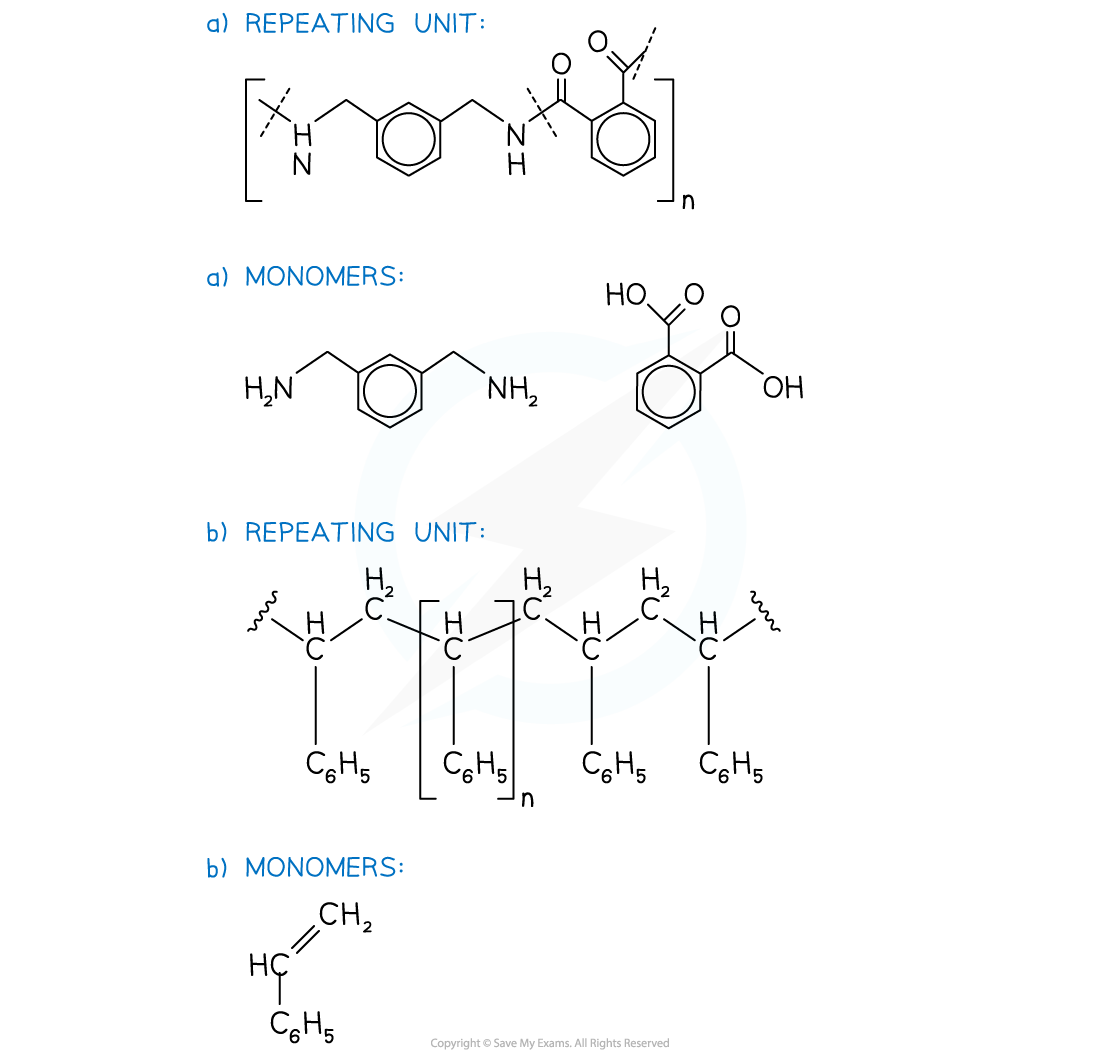
Identifying Monomers in Condensation Polymers
- When a section of polymer is presented, the monomers can be identified by considering the small molecules expelled from the monomers
- If a water molecule is expelled, the -OH must have been from an acid group
- The hydrogen atom may be from an amine group of a monomer.
- If the molecule was hydrochloric acid (HCl), a dioyl chloride monomer may have been used
Was this revision note helpful?
Build on this topic