Ionisation Energy Trends (Cambridge International A-Level Chemistry)
Trends in Ionisation Energy
Spec point —
1.4.2
-
Ionisation energies show periodicity, a recurring trend across each period of the Periodic Table
-
As you move left to right across a period, first ionisation energy generally increases
-
This trend is linked to the electronic configuration of elements:
- Group 1 metals (e.g. Na) have low first ionisation energies because they have a single outer electron that is easy to remove
- Noble gases (e.g. Ne, Ar) have very high ionisation energies due to their full outer shells and strong nuclear attraction
-
-
There are four factors that affect ionisation energy
- Nuclear charge
- Distance from the nucleus
- Electron shielding
- Spin-pair repulsion
Nuclear charge (number of protons)
- As atomic number increases, so does the positive charge of the nucleus
- A higher nuclear charge creates a stronger electrostatic attraction between the nucleus and outer electrons
- Therefore more energy is required to remove the electron means a higher ionisation energy
Distance from the nucleus (atomic radius)
- Outer electrons that are further from the nucleus experience weaker attraction
- The greater the distance, the easier it is to remove the electron
- Ionisation energy decreases with increased distance from the nucleus
Electron shielding (inner shell & sub-shell repulsion)
-
Electrons in inner shells repel electrons in outer shells and partially block the attraction of the nucleus
- This is known as the shielding effect
-
More inner electron shells means greater shielding and therefore a lower ionisation energy
-
Inner sub-shells also shield, so a 3p electron is shielded by the 3s electrons and is higher in energy than a 3s electron
-
This explains the small drop from magnesium to aluminium:
- Mg's outer electron is removed from a 3s sub-shell
- Al's outer electron is removed from a 3p sub-shell, which is higher in energy as it is shielded by the 3s electrons
- Less energy is needed to remove Al's outer electron, so its first ionisation energy is lower than Mg's
Spin-pair repulsion (electron–electron repulsion)
-
In orbitals that contain two electrons, the electrons experience repulsion due to their like charges
-
This repulsion slightly reduces the energy needed to remove one of the electrons
-
This explains small drops in ionisation energy across a period, such as:
- Oxygen vs nitrogen (O’s paired 2p electrons are easier to remove)
- Sulfur vs phosphorus (S's paired 3p electrons are easier to remove)
Ionisation Energy & the Periodic Table
Spec point —
1.4.3
-
Across a period:
- first ionisation energy increases due to higher nuclear charge and same shielding
-
Down a group:
- first ionisation energy decreases due to greater atomic radius and more shielding
Graph of first ionisation energies from H to Na
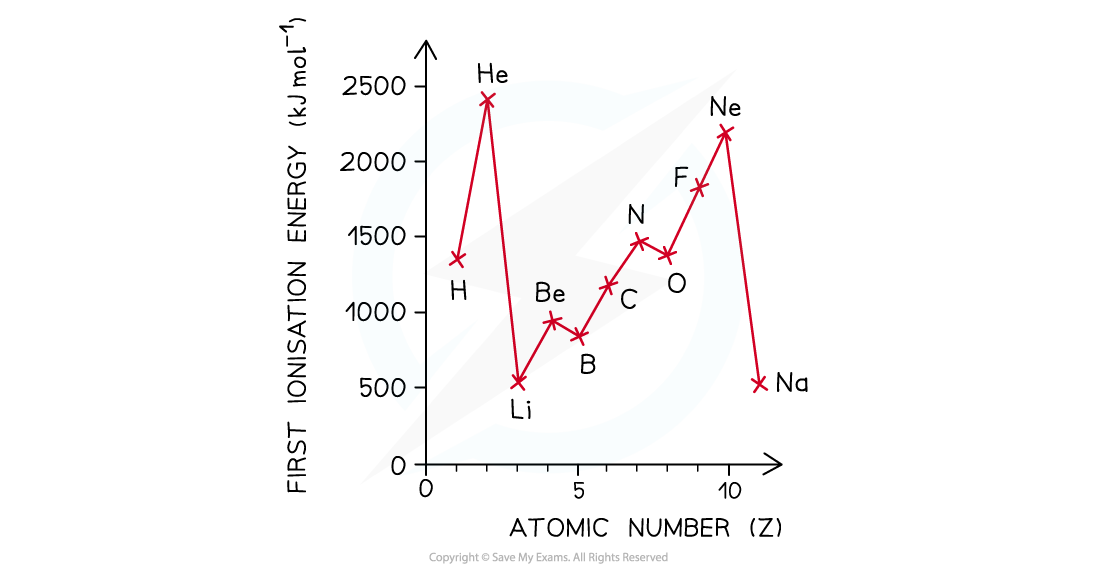
There are ionisation energy trends within periods and groups
Ionisation energy across a period
-
Across a period, ionisation energy increases because:
- Nuclear charge increases, pulling electrons closer
- Atomic radius decreases, reducing the distance to outer electrons
- Shielding stays roughly constant, since electrons are added to the same shell
- Outer electrons are held more tightly, so more energy is needed to remove them
Dips in the trend
-
There is a slight decrease in IE1 between beryllium and boron as the fifth electron in boron is in the 2p subshell, which is further away from the nucleus than the 2s subshell of beryllium
- Beryllium has a first ionisation energy of 900 kJ mol-1 as its electron configuration is 1s22s2
- Boron has a first ionisation energy of 799 kJ mol-1 as its electron configuration is 1s22s22px1
-
There is a slight decrease in IE1 between nitrogen and oxygen due to spin-pair repulsion in the 2px orbital of oxygen
- Nitrogen has a first ionisation energy of 1400 kJ mol-1 as its electron configuration is 1s2 2s2 2px1 2py1 2pz1
- Oxygen has a first ionisation energy of 1310 kJ mol-1 as its electron configuration is 1s2 2s2 2px2 2py1 2pz1
- In oxygen, there are 2 electrons in the 2px orbital, so the repulsion between those electrons makes it slightly easier for one of those electrons to be removed
Ionisation energy down a group
-
The ionisation energy down a group decreases due to the following factors:
- The number of protons in the atom is increased, so the nuclear charge increases
- But, the atomic radius of the atoms increases as you add more shells of electrons, making the atoms bigger
- So, the distance between the nucleus and outer electron increases as you descend the group
- The shielding by inner shell electrons increases as there are more shells of electrons
- These factors outweigh the increased nuclear charge, meaning it becomes easier to remove the outer electron as you descend a group
- So, the ionisation energy decreases
Table summarising ionisation energy trends across a period & down a group
| Across a period: Ionisation energy increases | Down a group: Ionisation energy decreases |
|---|---|
| Increase in nuclear charge | Increase in nuclear charge |
| The same number of shells | Increased number of shells |
| Distance from the outer electron to the nucleus decreases | Distance from the outer electron to the nucleus increases |
| Shielding remains relatively constant | Shielding increases |
| Decreased atomic / ionic radius | Increased atomic / ionic radius |
| The attraction between the outer electron and the nucleus gets stronger so the outer electron is harder to remove | The attraction between the outer electron and the nucleus gets weaker so the outer electron is easier to remove |
Successive Ionisation Energies of an Element
Spec point —
1.4.4
-
Successive ionisation energies of an element increase
-
This is because once the outer electron is removed, the atom becomes a positive ion, making further electron removal more difficult
-
As more electrons are removed:
- Shielding decreases
- The proton-to-electron ratio increases
- Attraction between nucleus and remaining electrons increases
-
The increase is not constant, it depends on the electronic configuration
-
Taking calcium as an example:
Table showing the successive ionisation energies of calcium table
| Electronic Configuration | 1s22s22p63s23p64s1 | 1s22s22p63s23p6 | 1s22s22p63s23p5 | 1s22s22p63s23p4 |
|---|---|---|---|---|
| IE | First | Second | Third | Fourth |
| IE (kJ mol-1) | 590 | 1150 | 4940 | 6480 |
Successive ionisation energies of calcium
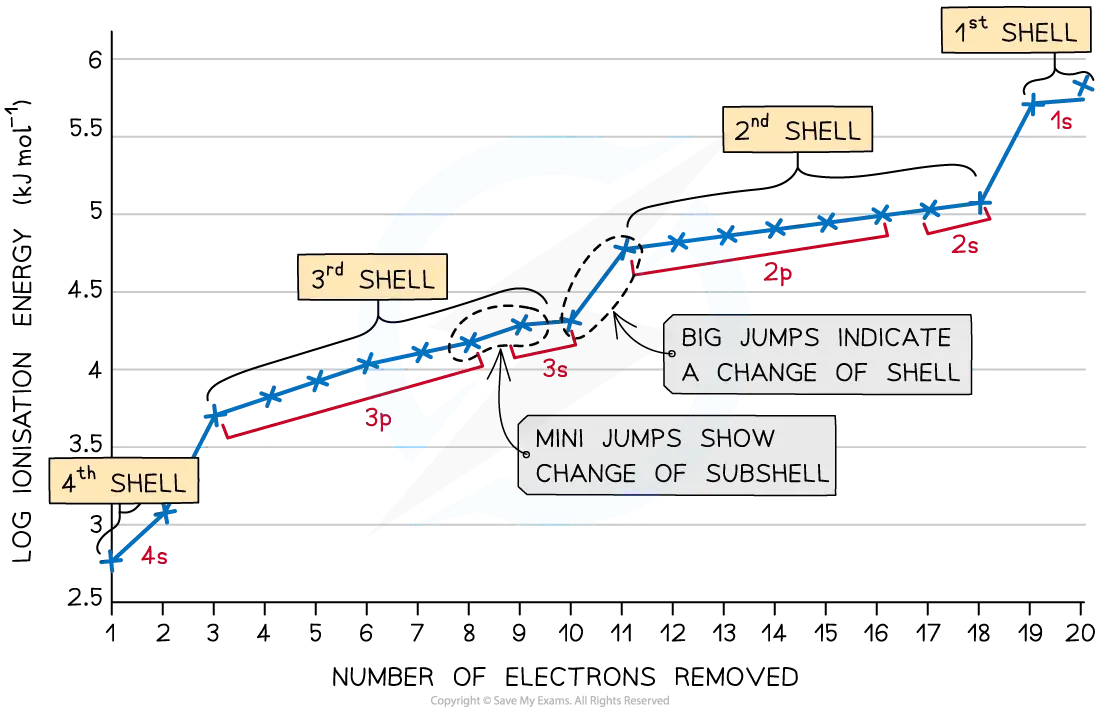
Graph to show the successive ionisation energies for the element calcium
- The first ionisation energy is relatively low due to spin-pair repulsion in the 4s orbital
- The second electron is harder to remove because this repulsion is no longer present
- The third ionisation energy increases sharply as the electron is removed from the 3p subshell, which is closer to the nucleus
- The fourth electron is more difficult to remove because it is taken from an increasingly positive ion, so the attraction to the nucleus is greater
- Successive ionisation energies always increase because electrons are being removed from an increasingly positive ion
- A large jump in ionisation energy indicates a change in shell, while smaller jumps reflect changes within the same shell or subshell
Using successive ionisation data
- Helps predict or confirm electronic configuration.
- Identifies the number of outer-shell electrons.
- Indicates the group number by locating the position of a significant jump in ionisation energy.
- Commonly applied to elements like sodium (Na), magnesium (Mg), and aluminium (Al) to deduce their place in the Periodic Table.
Successive ionisation energies table
| Element | Atomic Number | Ionisation Energy (kJ mol-1) | |||
|---|---|---|---|---|---|
| First | Second | Third | Fourth | ||
| Na | 11 | 494 | 4560 | 6940 | 9540 |
| Mg | 12 | 736 | 1450 | 7740 | 10500 |
| Al | 13 | 577 | 1820 | 2740 | 11600 |
Sodium
-
A large increase between the first and second ionisation energies shows that the first electron is much easier to remove than the second
-
This first electron is in the 3s subshell
- This is the outermost shell
- This electron experiences less nuclear attraction due to shielding and distance from the nucleus
-
This suggests Na has one valence electron, so it belongs to Group 1
-
The jump corresponds to removing the next electron from the 2p subshell, which is closer to the nucleus and more strongly held
- Na: 1s2 2s2 2p6 3s1
Magnesium
-
A large increase between the second and third ionisation energies shows that the first two electrons are easier to remove than the third
-
These two electrons are in the 3s subshell
- This is the outermost shell
- These two electrons experience less nuclear attraction due to shielding and distance from the nucleus
-
This suggests Mg has two valence electrons, so it belongs to Group 2
-
The jump corresponds to removing the next electron from the 2p subshell, which is held more tightly
- Mg: 1s2 2s2 2p6 3s2
Aluminium
-
A large increase between the third and fourth ionisation energies shows that the first three electrons are easier to remove
-
These three electrons are in the 3s and 3p subshells
- These are part of the outermost shell
- These three electrons experience less nuclear attraction due to shielding and distance from the nucleus
-
This suggests Al has three valence electrons, so it belongs to Group 13 (Group III)
-
The jump corresponds to removing the next electron from the 2p subshell, which is closer to the nucleus and more strongly held
- Al: 1s2 2s2 2p6 3s23p1
Exam Hint
- It is easy to remove electrons from a full orbital as they undergo spin-pair repulsion.
- It gets more difficult to remove electrons from principal quantum shells that get closer to the nucleus as there is less shielding and an increase in attractive forces between the electrons and nuclear charge.
Was this revision note helpful?
Build on this topic