Predicting & Deducing the Type of Polymerisation (Cambridge International A-Level Chemistry)
Predicting Type of Polymerisation
- When a set of monomers is given in an exam question, the type of polymerisation can be determined
- Firstly, it’s important to identify the key functional groups in the monomers
Addition polymerisation
- If the monomer/s contain a C=C double bond, they will polymerise through addition polymerisation
- The double bond can open up in order to add more monomers on either side of the starting monomer
- This type of polymerisation makes (poly)alkenes
Addition polymerisation using one monomer
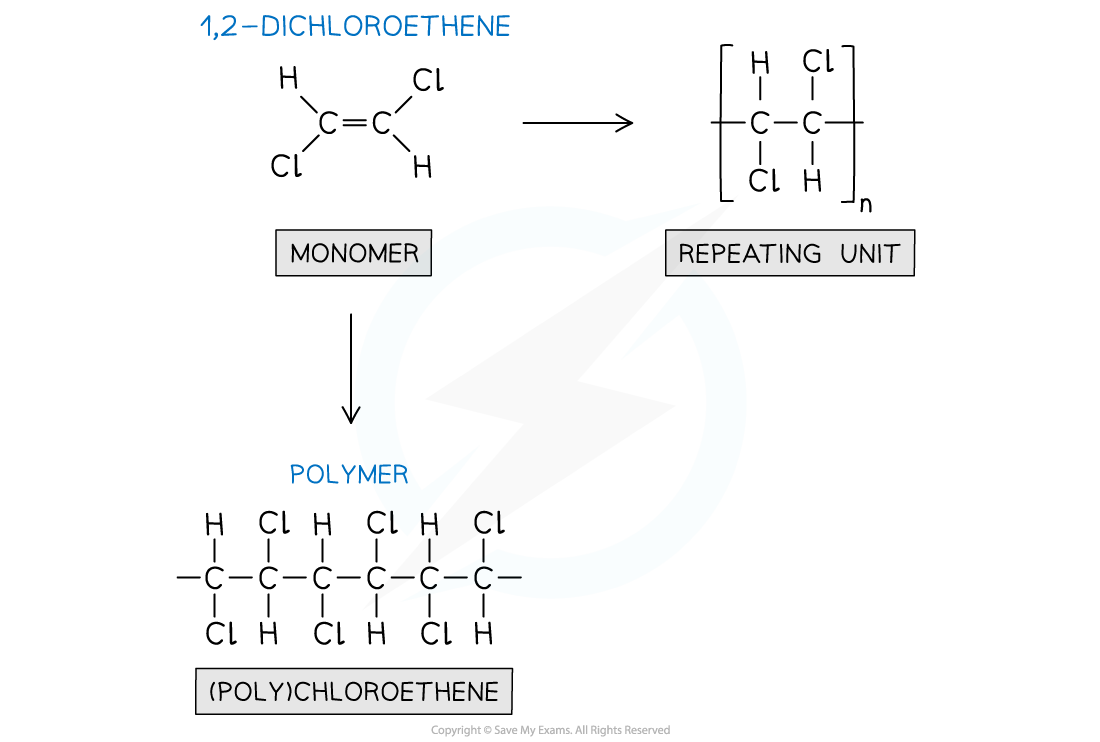
During addition polymerisation of one alkene monomer, a (poly)alkene is formed
- (Poly)alkenes can be produced if there are 2 or more alkene monomers as well
- When more than one monomer is used for addition polymerisation, the resulting product is known as a copolymer
Addition polymerisation using more than one monomer
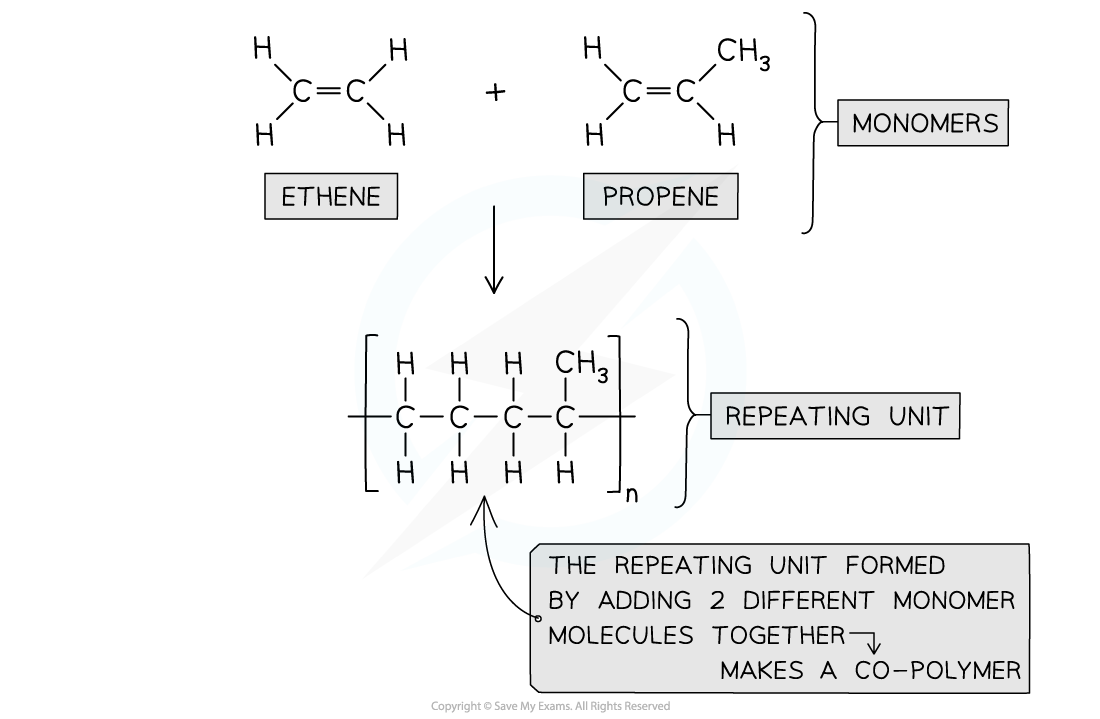
Addition polymerization can also use two or more different alkene monomers forming a co-polymer
Condensation polymerisation
- Condensation polymerisation makes polyamides and polyesters
- When looking to identify this type of polymerisation, there are some key functional groups to be aware of
Monomers for condensation polymers table
| Polyamide monomers | Polyester monomers | Molecule expelled as a result of condensation polymerisation |
|---|---|---|
| Acyl chlorides (–COCl) Amines (–NH2) | Acyl chlorides (–COCl) Alcohols (–OH) | Hydrochloric acid (HCl) |
| Carboxylic acids (–COOH) Amines (–NH2) | Carboxylic acids (–COOH) Alcohols (–OH) | Water (H2O) |
| Aminocarboxylic acids (H2N–CHR–COOH) | Hydroxycarboxylic acids (HO–R–COOH) | Water (H2O) |
Exam Hint
As well as the functional groups to be aware of, know that a small molecule is expelled when the polymer is formed
Identify 2 functional groups that can react together to produce either a polyamide or a polyester
There are instances where both of the functional groups are on the same monomer molecule
- For example, amino acid molecules contain an amine group (-NH2) and a carboxylic acid group (-COOH) which means that they can polymerise to produce a polyamide
Deducing Type of Polymerisation
- The type of polymerisation can be determined by considering the structure of the polymer backbone
Identifying addition polymerisation
-
The polymer backbone of an addition polymer does not contain functional groups
-
The backbone of the polymer is generally a chain of carbon atoms
-
There may be sidechains branching off from the backbone
-
Some examples of side chains include:
- Benzene rings
- Nitrile groups (-CN)
- Halogen atoms (-F / -Cl / -Br / -I)
Identifying addition polymers
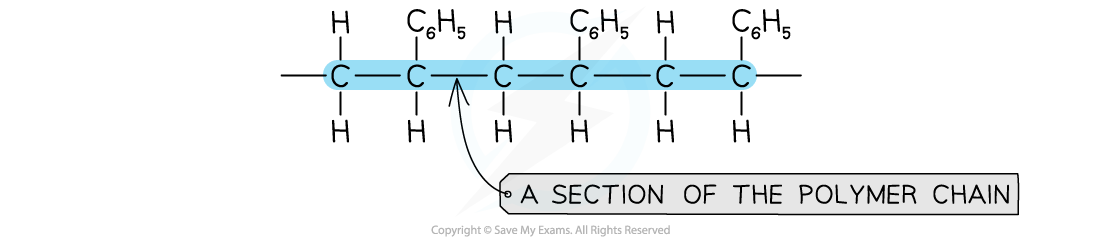
Addition polymers are identified using the plain carbon chain as the polymer backbone
Identifying condensation polymerisation
- A condensation polymer can be identified by functional groups on the polymer backbone
- The backbone of polyesters contains ester links (-COO-)
- The backbone of polyamides contains amide / peptide links (-CONH-)
Identifying condensation polymers
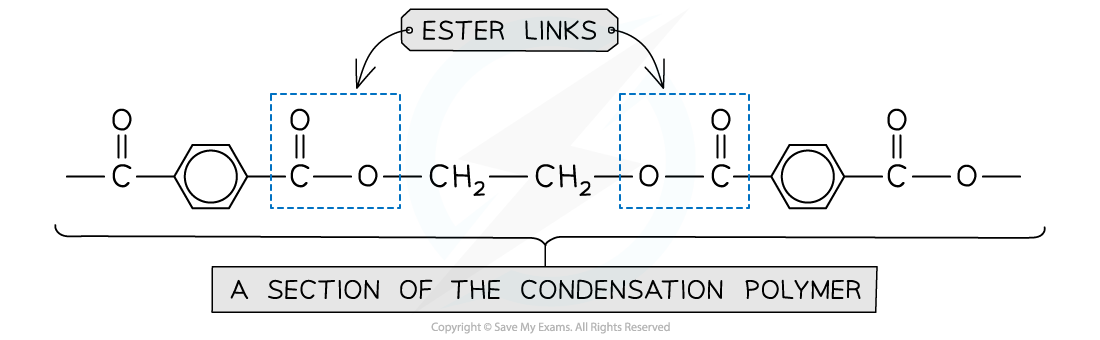
Condensation polymers are identified using functional groups that form part of the polymer backbone, e.g. ester links in polyesters and amide / peptide links in polyamides
Exam Hint
Different sections of polymer chains may be formed using various types of polymerisation
In an exam, you may be given a section of a polymer and asked to determine the type of polymerisation used to form that section
Firstly, look at the polymer backbone
- If there are functional groups along the backbone, that section was made using condensation polymerisation
- If there are no functional groups along the backbone, addition polymerisation was used
Was this revision note helpful?
Build on this topic