Exchange Rates (Edexcel IGCSE Economics)
Foreign Exchange Rates
Spec point —
2.1.1d
-
An exchange rate is the price of one currency in terms of another e.g. £1 = €1.18
- International currencies are just like products that can be bought and sold on the global foreign exchange market (FOREX)
- Increased demand for a currency in the FOREX market will increase its price or exchange rate, whereas increased supply of a currency to FOREX will decrease its price
-
The Central Bank of a country will choose the exchange rate system that is used in determining the value of that nation's currency
- Floating exchange rate systems allow the forces of demand and supply to determine the rate of exchange (price) of a currency
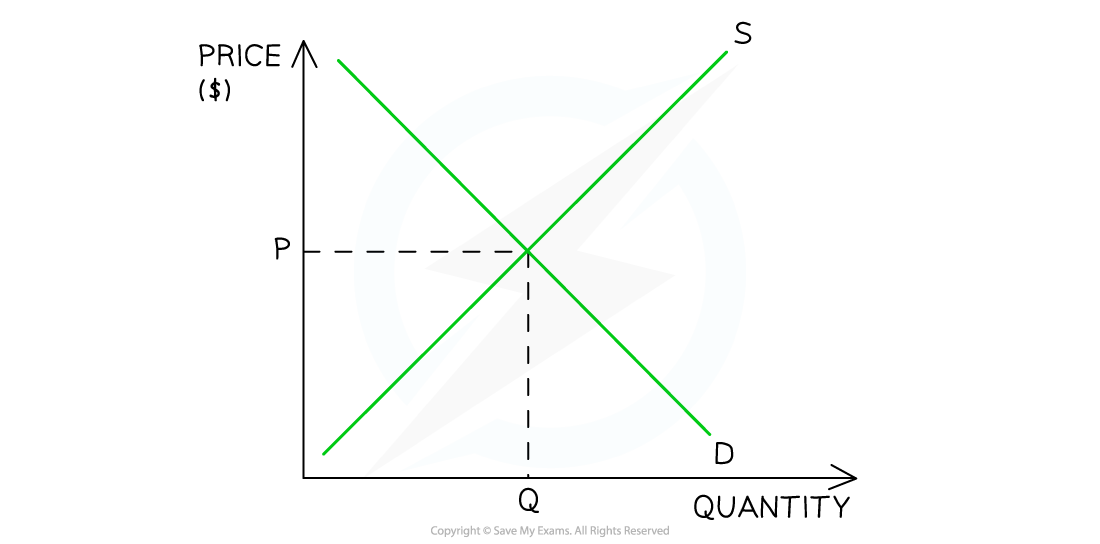
The exchange rate is determined by the interaction of demand and supply for a currency. Currency markets work on the same principles as product markets
Graph analysis
- The graph shows the market for UK£ in terms of US$
- The market for UK pounds is in equilibrium, where D£= S£
- Q UK pounds are received for a price of P dollars
- The equilibrium exchange rate is found at P1Q1
- There is no excess supply of pounds
- There is no excess demand for pounds
Worked Example Marsha is a currency trader who buys and sells currency in order to make a profit. Currently, she is holding €200,000 and expects that the Pound Sterling (£) will appreciate against the € in the next few months.
At present, £1 = €1.10
- Calculate the quantity of Pounds Marsha will receive for €200,000 if she exchanges her Euros for Pounds. [1]
- The Pound depreciates against the Euro by 10%. Fearing further depreciation, Marsha changes her Pounds back to Euros. Calculate the loss she has made to the nearest whole number. [3]
Step 1: Calculate the quantity of Pounds received for €200,000
[1]
Step 2: Calculate the new exchange rate
£1= (€1.10 x 0.9) = €0.99 [1]
Step 3: Use the above value to calculate the new amount of Euros
£181,818.18 x 0.99 = £179,999.9982
Step 4: Round to two decimal places
£180,000 [1]
Step 5: Calculate the loss
£200,000–£180,000 = £20,000 loss. [1]
Factors Affecting Demand of Currency
Spec point —
2.2.3b
Factors Affecting the Demand for Currency
-
Under a floating exchange rate system, a change in demand for a currency will affect the exchange rate
- A rise in one exchange rate against another is an appreciation (or revaluation)
- A fall in one exchange rate against another is a depreciation (or devaluation)
Relative interest rates set by the Central Bank
- These influence the flow of hot money between countries. If the UK's central bank increases its interest rate, then demand for £'s by foreign investors increases as they desire to move money into the UK to take advantage of those higher interest rates
Speculation
- The vast majority of currency trades are speculative. Speculation occurs when traders buy a currency in the expectation that it will be worth more in the short to medium term, at which point they will sell it to realise a profit
Demand for exports
- If the demand for exports of goods and services in the UK rises, foreign consumers will exchange their currency into UK £ to pay for these exports
- This increases the demand for the £ in the foreign exchange market
Factors Affecting Supply of Currency
Spec point —
2.2.3b
Relative interest rates in foreign countries
- If the UK decreases its interest rate, then the supply of £s increases as investors sell their £s in favour of other currencies, and the £ depreciates
Speculation
- If there is an expectation that foreign currency will be worth more in the short to medium term, traders will supply their £s to demand the other currency
- This increases supply leading to a depreciation
Demand for imports
- If the **demand for imports **of goods and services into the UK rises, domestic consumers exchange their £ for foreign currencies to pay for these imports
- This increases the supply of** £** in the foreign exchange market, which will cause the £ to depreciate
Exam Hint When drawing currency diagrams, pay careful attention to the labelling of the axes. It is clearest to label the Y axis along the lines of "price of X currency in terms of Y currency"
Was this revision note helpful?
Build on this topic