Costs, Revenues & Profit (Edexcel IGCSE Economics)
Different Types of Costs
Spec point —
1.2.3a
- In preparing goods/services for sale, firms incur a range of costs. These costs can be be broken into different categories
Fixed costs (FC)
-
These are costs that do not change as the level of output changes
-
These have to be paid whether output is zero or 5000
- E.g. Building rent, management salaries, insurance, bank loan repayments
-
Variable costs (VC)
-
These are costs that vary directly with output
-
These increase as output increases and vice versa
- E.g. Raw material costs, wages of workers directly involved in production
-
Total costs (TC)
- These are the sum of the fixed + total variable costs
Cost calculations and cost graphs
- Based on the above definitions, we can calculate several different types of costs
Exam Hint In your exams, the word total is often left out of the formula for average total cost. This means that AC and ATC have the same meaning
Example calculations using a variable cost of $60 per unit
| Output (Q) | TFC | TVC =\ 60 \mathrm{x} \mathrm{Q}$ | **TC = ** | **AC = ** |
|---|---|---|---|---|
| 0 | 200 | - | 200 | - |
| 1 | 200 | 60 | 260 | 260 |
| 2 | 200 | 120 | 320 | 160 |
| 3 | 200 | 180 | 380 | 126.67 |
| 4 | 200 | 240 | 440 | 110 |
| 5 | 200 | 300 | 500 | 100 |
| 6 | 200 | 360 | 560 | 93.33 |
| 7 | 200 | 420 | 620 | 88.57 |
| 8 | 200 | 480 | 680 | 85 |
Worked Example A firm manufactures books and has the following total monthly costs:
Type of cost Cost Raw materials $4000 Rent $1000 Loan repayments $1200 Electricity (depends on output) $900 Calculate total variable costs per month (2 marks)
Step 1: Calculate the variable costs
Variable costs = Raw materials + electricity
= $4000 + $900 (1)
= $4900 (1)
When calculating variable costs, only include costs that vary / change as output changes.
A Graphical Representation of Costs
Spec point —
1.2.3a
Types of Costs
| Type of Cost | Diagram | Explanation |
|---|---|---|
| Fixed cost (FC) | 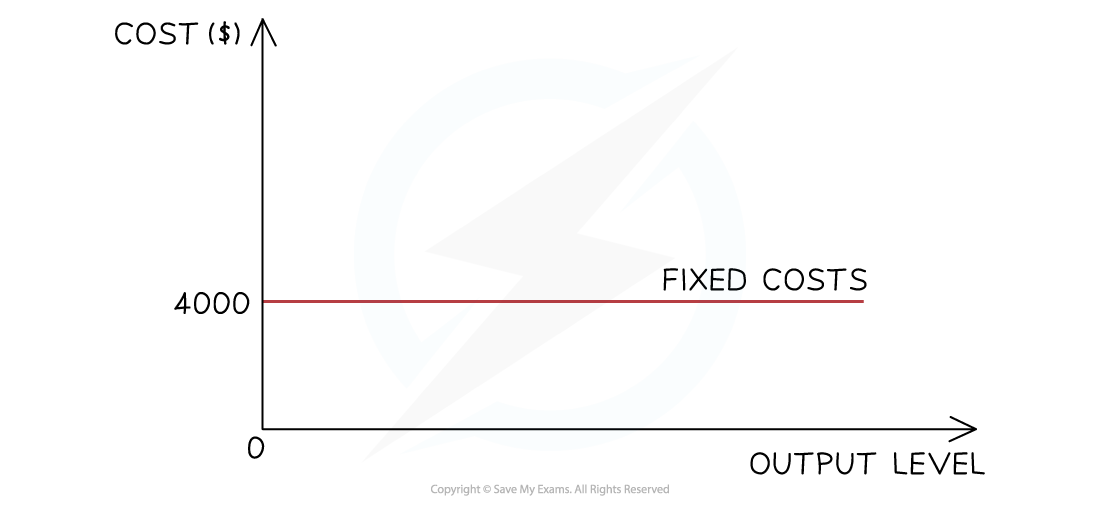 | - The firm has to pay its fixed costs, which do not change, irrespective of whether the output is 0 or 100,000 units - The fixed costs for this firm are $4,000 |
| Variable cost (VC) | 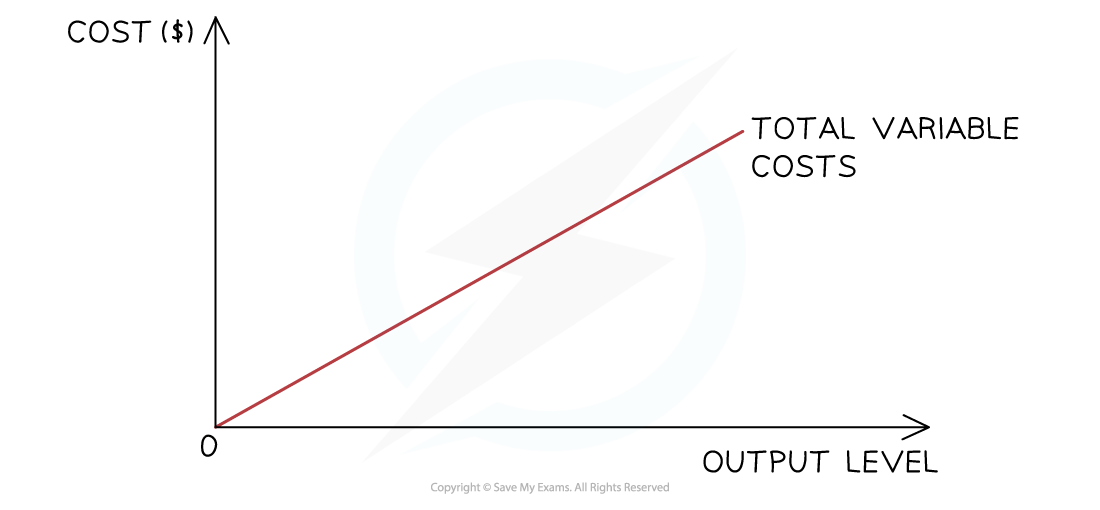 | - The variable costs initially rise proportionally with output - At some point, the firm will benefit from a purchasing economy of scale and the rise will no longer be proportional |
| Total cost (TC) | 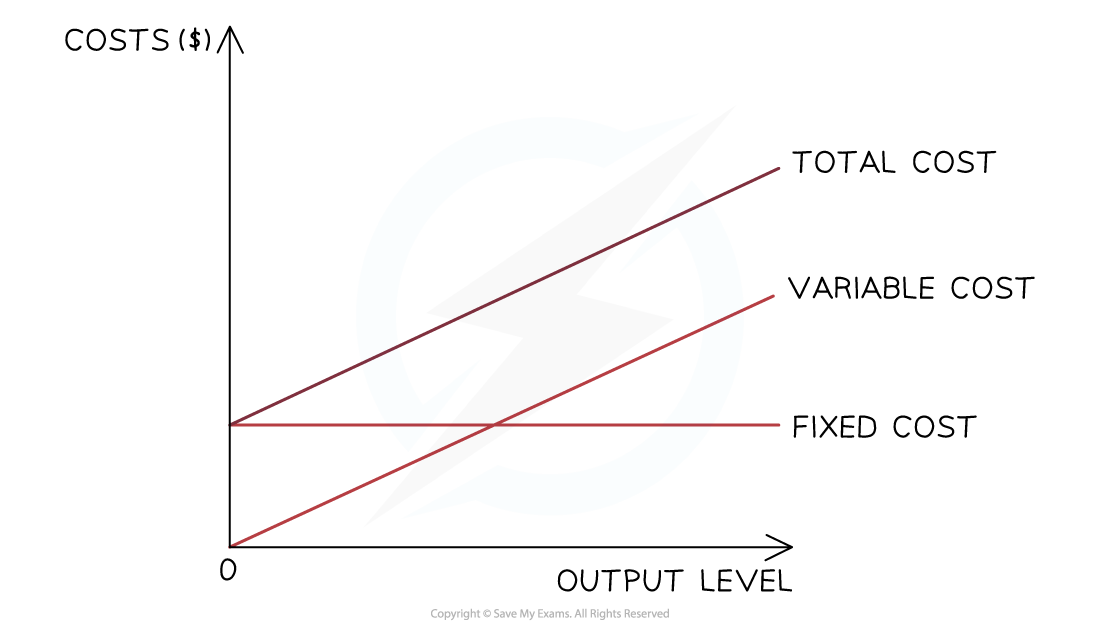 | - The total cost is the sum of the variable and fixed costs - The total costs cannot be zero, as all firms have some level of fixed costs, even if they produce zero output |
| Average total cost (AC) | 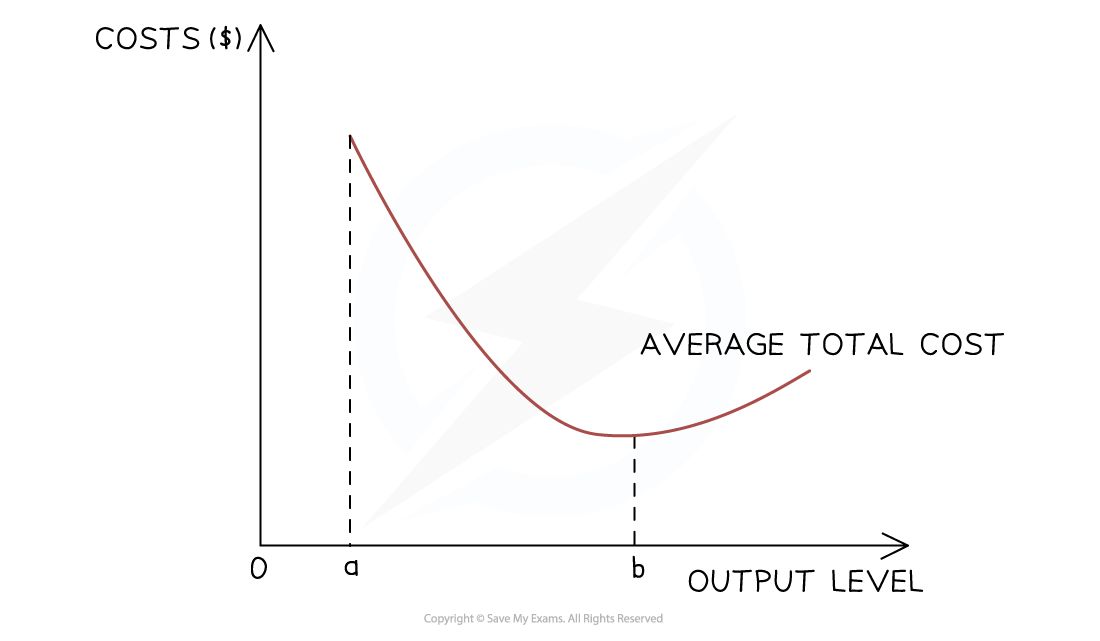 | - As a firm grows, it is able to increase its scale of output generating efficiencies that lower its average total costs (AC) of production - These efficiencies are called economies of scale - As a firm continues to increase its scale of output, it will reach a point where its average total costs (AC) will start to increase - The reasons for the increase in average costs are called diseconomies of scale |
Revenue
Spec point —
1.1.4g
- Total revenue is the total value of all sales a firm generates
- Average revenue is the overall revenue per unit. Average revenue is the technical economic name for "price"
Revenue Calculation Example
| P ($) | Q | **TR ** | **AR ** |
|---|---|---|---|
| 8 | 1 | 8 | 8 |
| 7 | 2 | 14 | 7 |
| 6 | 3 | 18 | 6 |
| 5 | 4 | 20 | 5 |
| 4 | 5 | 20 | 4 |
| 3 | 6 | 18 | 3 |
| 2 | 7 | 14 | 2 |
| 1 | 8 | 8 | 1 |
- Average revenue information is especially useful to a firm selling multiple products (e.g. supermarkets) or a firm that sells the same item at different prices (e.g. rail tickets are usually priced differently for different types of commuters such as pensioners or children)
- The value in the AR column is identical to the value in the P column
Profit
Spec point —
1.1.2c
-
Profit = total revenue (TR) - total costs (TC)
-
Breakeven occurs when TR = TC This is the point at which the firm has generated enough revenue to cover all of its costs
- No loss is made, but no profit is generated yet either
-
Profit occurs when TR > TC
-
A loss occurs when TR < TC
Profit Calculation Example
| Output | TR (£) | TC (£) | Profit (TR - TC) |
|---|---|---|---|
| 5 | 150 | 70 | 80 |
| 6 | 180 | 96 | 84 |
| 7 | 210 | 210 | 0 |
| 8 | 240 | 260 | -20 |
Worked Example A business sells 50 pairs of shoes. Variable costs are $5 per pair of shoes and fixed costs are $100. Customers pay $100. Which one of the following equals $5000? (1)
- A. Average Revenue
- B. Total Costs
- C. Profit
- D. Total Revenue
The correct answer is:D. Total revenue
TR = Price x Quantity
TR = $100 X 50 = $ 5000
Explanation:
A. Average Revenue is not correct because TR/Q = $500/50 = $100
B. Total Costs is not correct because TC = TFC + TVC = 100 + (5X50) = $350
C. Profit is not correct because TR - TC = $5000 - $350 = $4650
Was this revision note helpful?
Build on this topic