Government Intervention to Redistribute Income (Edexcel IGCSE Economics)
Methods to Redistribute Income
Spec point —
2.1.1f
-
Government intervention aims to reduce inequality and poverty through:
- Progressive taxation
- Using benefit payments to increase income of the poorest households
- Investing in education and healthcare
-
Some countries have a stronger focus on the redistribution of income than others
- E.g Nordic countries like Norway and Sweden focus on taxing higher income earners, providing benefits payments and investing into education and healthcare, leading to lower inequality and poverty
-
The aim of governments is not to have an equal distribution of income but rather a more fair or equitable distribution of income
-
A blend of policies is the most effective way to tackle poverty and inequality
Progressive Taxation
Spec point —
2.1.1f
-
Tax systems can be classified as progressive or regressive
-
A progressive tax system redistributes income from those with higher income to those with lower income
- As income rises, a larger percentage of income is paid in tax (called the marginal tax rate)
-
Most countries have a mix of progressive (direct taxation) and regressive (indirect taxation) taxes in place
-
The benefits of a good progressive tax system are sometimes lost to society because the high number of regressive (indirect) taxes worsens income inequality
- E.g High VAT rate
An explanation of tax systems
| System | Explanation |
|---|---|
Progressive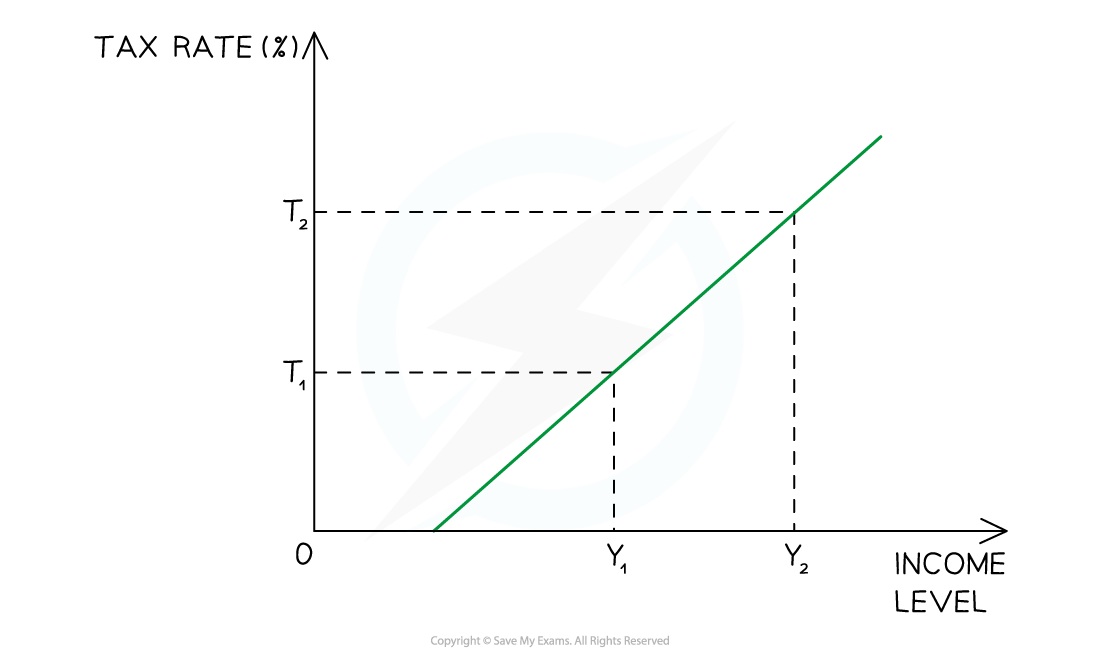 | - As income rises, a larger percentage of income is paid in tax - In the diagram, when personal income rises from Y1 to Y2, the tax rate rises from TR1 to TR2 |
Regressive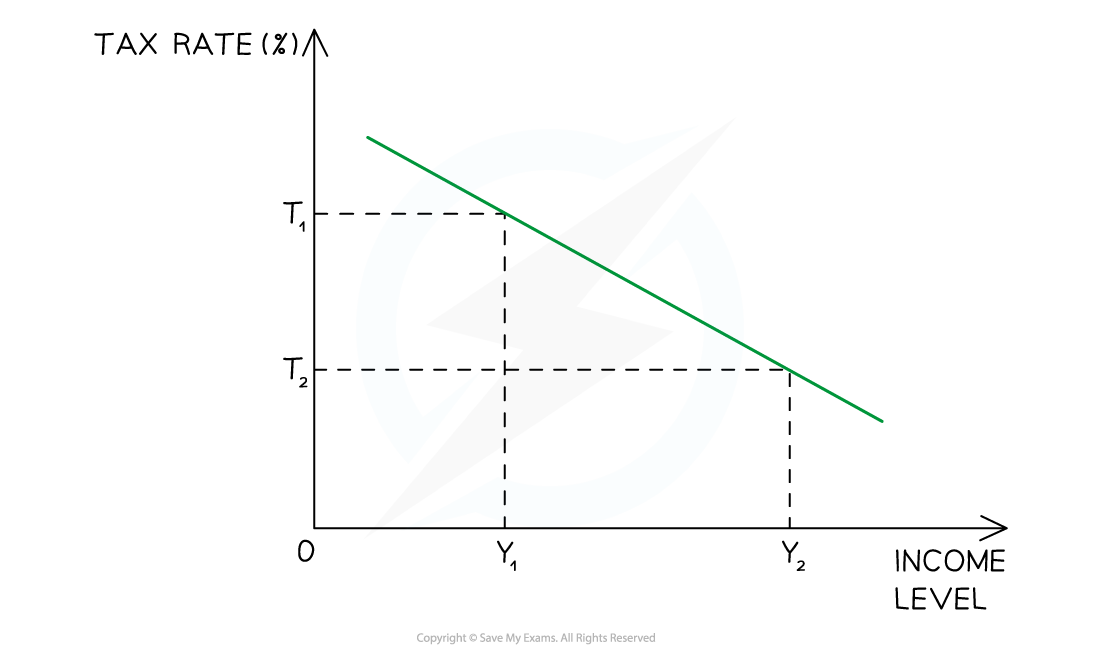 | - As income rises, a smaller percentage of income is paid in tax - In the diagram, when personal income rises from Y1 to Y2, the tax rate falls from TR1 to TR2 - All indirect taxes are regressive - In the USA, Federal income tax is progressive but almost all State taxes are regressive (the bottom 20% of income earners pay as much as 6x the percentage of their income as the top 20%) |
-
Progressive tax systems are built around the idea of marginal tax rates
- The calculation of an individual's personal income tax requires several calculations
- Using this system, a salary of £60,000 would attract a tax bill of £11,500, calculated as follows:
Calculating a tax bill using the UK progressive tax rates from 2022
| Tax Band | Taxable Income | Tax Rate | Tax Paid on £60,000 |
|---|---|---|---|
| Personal Allowance | Up to £12,500 | 0% | 0 |
| Basic Rate | £12,500 to £50,000 | 20% | £37, 500 at 20% = £7,500 |
| Higher Rate | £50,00 to £150,000 | 40% | £10,000 at 40% = £4,000 |
| Additional Rate | Over £150,000 | 45% | 0 |
| Total Tax Paid on £60,000 | £7,500 + £4,000 = £11,500 |
- Once the tax revenue is received by the government, redistribution often starts with the provision of free education and healthcare
- Many governments use tax revenues to provide multiple levels of financial support to poor households, including disability payments, heating subsidies, travel subsidies, etc
An evaluation of progressive taxes
| Advantage | Disadvantage |
|---|---|
| - Reduces income inequality - Higher earners pay a larger percentage of their income, which can help reduce the gap between rich and poor - Increases revenue for public services - Can generate more revenue for essential public services like education, healthcare, and infrastructure - Fairness perception - People with higher incomes have a greater ability to pay, so progressive taxes are often seen as fairer | - Potential disincentive to work - High taxes on higher incomes may discourage people from working harder or longer - Complexity and compliance costs - Progressive tax systems can be complicated and expensive to administer - Tax avoidance and evasion - High-income individuals may seek to exploit loopholes or move their money to lower-tax jurisdictions, reducing the effectiveness of the tax system - Impact on investment - Progressive taxes on capital gains and dividends can deter investment, which might slow economic growth and innovation |
Worked Example The table below shows rates of taxation for country X
Income ($ per year) Rate of Income Tax 1–10,000 5% 10,001–18,000 10% 18,001–35,000 20% 35,001 and over 30% This is an example of what type of taxation system?
- A. Sales tax
- B. Corporation tax
- C. Progressive tax
- D. Indirect tax
Answer: C. Progressive tax The table shows that as income rises, a larger percentage of income is paid in tax
A is incorrect as sales tax is one specific figure e.g. 20%
B is incorrect, as corporation tax is one specific figure, e.g. 17%
D is incorrect as an indirect tax is one specific figure, e.g.VAT of 20%
Benefit Payments
Spec point —
2.1.1f
-
Benefit payments are usually given to the poorest and most vulnerable in society
- They include unemployment and disability payments, pension payments, heating discounts, public transport subsidies, child benefits, etc
- E.g In Denmark, social welfare is high compared to other countries. Income is transferred to low income households through unemployment benefits and housing assistance
An evaluation of benefit payments
| Advantages | Disadvantages |
|---|---|
| - Benefit payments reduce inequality and poverty by directly transferring income to households with low incomes - Benefit payments enable households with low incomes to afford basic necessities such as food and shelter. This reduces poverty - Child benefit payments can empower mothers to re-enter the workforce | - High levels of benefit payments can act as a disincentive to work - E.g Some European countries with high social welfare payments may be less motivated to actively seek employment - Many families may become dependent on benefit payments - There is a high opportunity cost* of spending on benefit payments - Benefit payments may be perceived as unfair by households that do not qualify for such assistance - The need to pay benefits may create a high burden of taxation on the working population |
Investment in Education & Healthcare
Spec point —
1.1.6d
Investment in Education and Healthcare
-
Investing in education and healthcare is a supply-side policy
- It increases the potential output of the country (shifts the production possibility frontier outwards)
- Education helps to reduce inequality and poverty by providing individuals with the necessary skills and knowledge to access better employment opportunities
- Healthcare leads to a healthier workforce that is more productive
An evaluation of investment in education and healthcare
| Advantages | Disadvantages |
|---|---|
| - Higher levels of education and healthcare contribute to increased human capital and greater productivity - This leads to higher output and, as a result, higher levels of income - Higher levels of education facilitate greater occupational mobility - By acquiring skills needed for jobs, individuals can break the **poverty cycle **and contribute to economic growth | - There is a** high cost** and an opportunity cost of spending on education and health care - There is a time lag involved between investing in education and healthcare and seeing the future benefits - A blend of policies (investment in education and benefit payments) may be the most effective way to tackle poverty and inequality |
Exam Hint In paper 2, you will often be asked to evaluate how progressive taxes, benefit payments or investment in education and healthcare will impact inequality or poverty in a given scenario.
Make sure you have a balanced argument and consider the impact on multiple stakeholders (high- and low-income households, producers and government). Also, consider that a blend of policies may be the most effective way to tackle poverty and inequality
Was this revision note helpful?
Build on this topic