Factors Influencing the Demand for Labour (Edexcel IGCSE Economics)
The Demand for Labour is a Derived Demand
Spec point —
1.2.5a
-
The labour market is composed of sellers of labour (households) and buyers of labour (firms)
- Workers supply their labour, and firms demand labour to produce an output
-
The demand for labour is a derived demand
-
This means the level of labour demand depends on the demand for goods and services
- If demand for goods and services increases, then demand for labour will increase, and vice versa
- E.g. As the demand for technology devices increases, technology firms require more skilled labour to design, manufacture and market the tech products
-
The Demand Curve for Labour
Spec point —
1.2.5e
- There is an inverse relationship between wage rate and the quantity of labour demanded
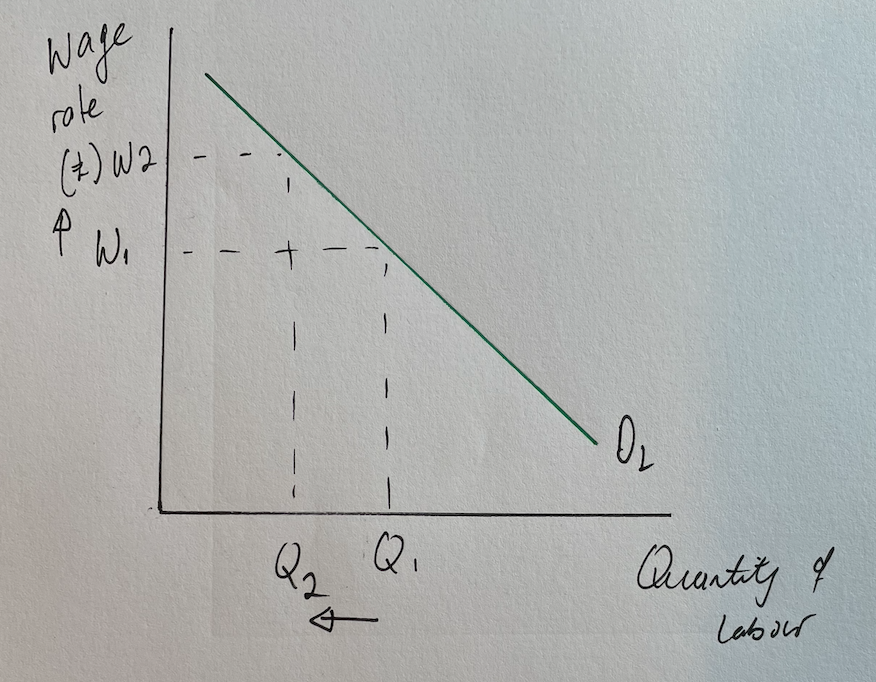
As wages rise, the quantity demanded of labour falls
Diagram analysis
-
The demand curve for Labour (DL) shows that firms demand more labour as the wage rate decreases, which results in a downward sloping demand curve
- If the wage rate increases (W1 to W2), then the demand for labour falls (Q1 to Q2)
Factors That Influence the Demand for Labour
Spec point —
1.2.5a
-
If the wage rate is the only factor that changes, there will be a movement along the demand curve for labour
-
However, a range of factors can shift the entire demand curve for labour to the left or right Factors that Influence the Demand for Labour
- When the demand curve for labour shifts to the left, it indicates that fewer workers are employed at each wage rate
- When the demand curve for labour shifts to the right, it indicates that more workers are employed at each wage rate
| Factor | Explanation |
|---|---|
| The price of the product being produced | - If the selling price of the product increases, then the firm will be incentivised to supply more, and the firm's demand for labour will increase - The demand for labour curve will shift right |
| The demand for the final product | - As demand for labour is a derived demand, when an economy is booming, demand for most goods and services will rise, and the demand for labour will increase - The demand curve for labour will shift right - Conversely, when an economy is in a recession, demand for most goods and services will fall, and the demand for labour will decrease - The demand curve for labour will shift left |
| The ability to substitute capital (machinery) for labour | - Firms will constantly evaluate if it will be possible and more cost effective to switch production from using labour to capital (machinery) - If it is more cost effective, then demand for labour will decrease - The demand curve for labour will shift left |
| The productivity of labour | - If the productivity of labour increases (possibly through training), this will lower average costs, and firms will likely demand more labour - The demand curve for labour will shift right |
An Increase in Demand for Labour
Spec point —
1.2.5e
Example: An Increase in Demand for Labour
- An increase in online shopping has led to an increase in demand for labour to deliver goods
Increase in demand for labour due to the increased demand generated by online shopping
Diagram analysis
-
Due to the increases in e-commerce, online companies have experienced high demand for goods
-
This had led to a demand for labour to deliver these goods
- There is a shift in demand for labour from DL → D1
- The wage remains unchanged at W1, but the demand has increased from Q to Q1 workers
A Decrease in Demand for Labour
Spec point —
1.2.5e
Example: A Decrease in Demand for Labour
- Clothing manufacturers in countries like Bangladesh and Vietnam have been investing in automated production to reduce the demand for labour in order to save on labour costs
Decrease in demand for labour as machinery replaces labour
Diagram analysis
-
Due to the ability to substitute capital for labour, there has been a fall in demand for labour to make clothes
- There is a shift in demand for labour from D → D2
- The wage remains unchanged at W1, but the demand has decreased from Q to Q2 workers
Was this revision note helpful?
Build on this topic