Factors Influencing the Supply of Labour (Edexcel IGCSE Economics)
The Supply Curve for Labour
Spec point —
1.2.5e
-
The supply curve for labour (SL) shows the relationship between the wage rate and number of workers willing to work in an occupation
- The SL shows that more labour is supplied as the wage rate increases, which results in an upward sloping supply curve
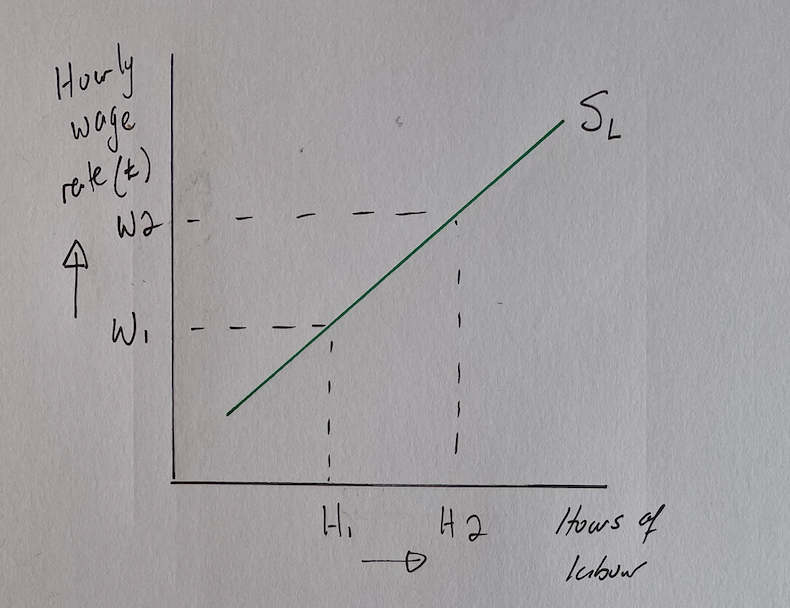
*There is a positive relationship between supply of labour and wage rate *
Diagram analysis
-
The hourly wage rate increases from W1to W2
- There is an incentive for workers to supply more labour from Q1to Q2
-
There is a positive relationship between market supply of labour and wage rate
- The higher the wage rate, the higher the supply of labour in that occupation (and vice versa)
Factors that Influence the Supply of Labour
Spec point —
1.2.5b
-
There are numerous factors that influence the amount of labour supplied to a particular industry
- The supply curve shows the market supply of labour, not the individual supply of labour
Factors Influencing the Supply Of Labour
| Factor | Explanation |
|---|---|
| Population size | - A larger population means more people are potentially available for work - E.g. India's growing population has led to increase in supply of labour |
| Age distribution of the population | - More developed countries, such as Japan, have an ageing population that reduces labour supply - Less developed countries often have a more youthful population, increasing supply of labour |
| Migration | - Policies that increase the **net migration rate **increase the supply of labour to certain industries - E.g. In 2022, 36% of Singapore's labour force were migrants |
| Participation rate | - This is the number of people willing to work within the working age group. This can change depending on - Amount of** female participation** - Changes to retirement age - School leaving age |
| School-leaving age | - A rise in the **school leaving age **can lead to a reduction in the supply of labour and vice versa - E.g. There has been a decline in school leavers in South Korea, which has led to concern for future labour supply |
| Skills and qualifications | - The level of skills and qualifications generally undertaken can increase the supply of available workers for** specific industries** - E.g. The more medical graduates, the greater the labour supply of nurses and doctors - However, if school leaving age tends to be very low, workers are likely to be more unskilled |
| Mobility of labour | - Geographical mobility of labour is the ease with which workers can move from one geographical area to another in order to secure employment - It can depend on family ties, being able to secure/afford accommodation in an unknown location, cost of moving or quality of transport links - Occupational mobility of labour is the ability of a worker to change occupations when they lose a job - If their skill base is transferable between different occupations, then their occupational mobility is high |
An Increase in the Supply of Labour
Spec point —
1.2.5e
Example: An increase in the Supply of Labour
- Changes to any of the factors affecting the supply of labour shifts the entire supply curve (as opposed to a movement along the supply curve)
Changes in the supply of labour
Diagram analysis
-
India's growing population has led to an increase in the supply of labour
- More people are now available to work
-
This caused a shift in supply from S to S1
- The wage rate remains unchanged at W1 but the supply has increased from Q to Q1
A Decrease in the Supply of Labour
Spec point —
1.2.5e
Example: A Decrease in the Supply of Labour
- Changes to any of the factors of supply of labour shifts the entire supply curve (as opposed to a movement along the supply curve)
Decrease in supply of labour due to changes in population
Diagram analysis
-
The UK raised the school leaving age from 16 to 18, which has led to a decrease in the supply of labour
- This caused a shift in supply from S to S2
-
The wage rate remains unchanged at W1 but the supply has decreased from Q to Q2
Worked Example Which one of the following would lead to a decrease in the supply of labour? (1)
- A. Policies to increase net migration
- B. Increase in the retirement age from 65 to 67
- C. Increase in demand for final product
- D. A shrinking population
The only correct answer is:D. A shrinking population
Explanation
A fall in population decreases the supply of labour
- A is not correct because this would lead to an increase in the supply of labour
- B is not correct because this would lead to an increase in the supply of labour as people will retire at a later age, staying in the labour market
- C is not correct because this would lead to an increase in the demand for labour
Was this revision note helpful?
Build on this topic