Classify Metals & Non-Metals (Edexcel IGCSE Chemistry)
Guided lessons are live for this note
Work through it step by step — key points, depth layers, a worked example and self-checks.
Spec point — understand how to use electrical conductivity and the acid-base character of oxides to classify elements as metals or non-metals
Properties of metals and non-metals
- We can use properties such as electrical conductivity and acid-base character to classify elements as metals or non-metals
Properties of metals and non-metals
| Property | Metals | Non-metals |
|---|---|---|
| Electron arrangement | 1-3 outer shell electrons | 4-7 outer shell electrons |
| Bonding | Metallic bonding due to loss of electrons | Covalent by sharing of outer shell electrons |
| Electrical conductivity | Good conductor of electricity | Poor conductors of electricity |
| Type of oxide | Basic oxides | Acidic oxides (some are neutral) |
| Reaction with acids | Many react with acids | Usually do not react with acids |
| Physical characteristics | - Usually lustrous (shiny) - Solid at room temperature (excluding mercury) - Malleable, can be bent and shaped - High melting and boiling point | - Dull, non-reflective - Different states at room temperature - Flaky, brittle - Low melting and boiling points |
Metals & Non-Metals in the Periodic Table
Spec point — identify an element as a metal or a non-metal according to its position in the Periodic Table
Metals and non-metals in the periodic table
- The location of the metals and non-metals shows a clear pattern when highlighted on a periodic table Another thing that is striking, is that you can see that the vast majority of elements are metals
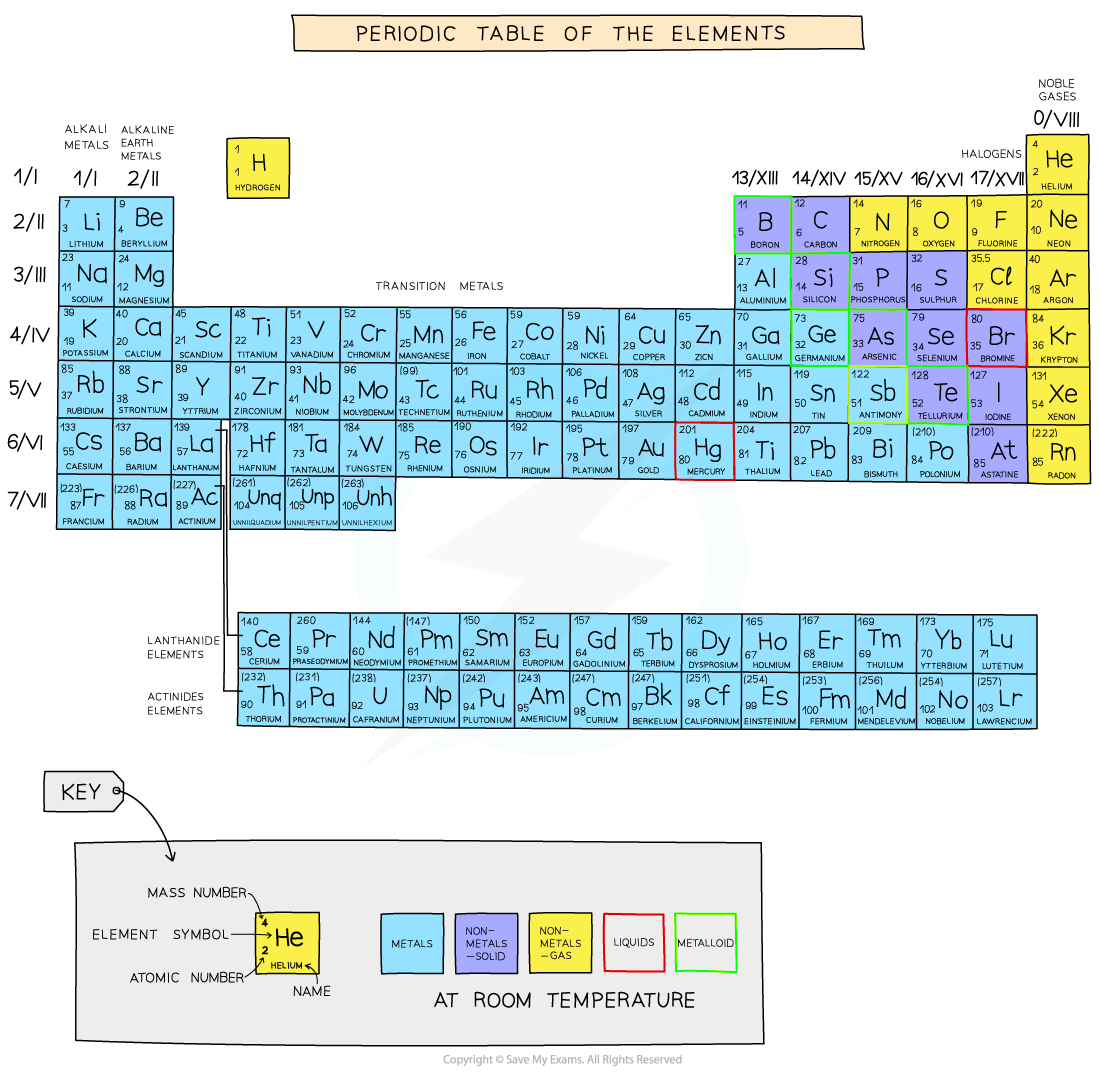
Metals are on the left of the Periodic Table and non-metals on the right
Exam Hint A zig-zag line between the blue and purple elements separates the metals on the left, from the non-metals on the right.
Elements which border the line are hard to classify as they have characteristics of both sides, so the term semi-metal or metalloid is used.
Was this revision note helpful?
Build on this topic