Metallic Bonding (Edexcel IGCSE Chemistry)
Guided lessons are live for this note
Work through it step by step — key points, depth layers, a worked example and self-checks.
Spec point — know how to represent a metallic lattice by a 2-D diagram understand metallic bonding in terms of electrostatic attractions
Metallic bonding
-
Metals consist of giant structures of atoms arranged in a regular pattern
-
Within the metal lattice, the atoms lose their outer electrons and become positively charged metal ions
- The outer electrons no longer belong to any specific metal atom and are said to be delocalised
- This means they can move freely between the positive metal ions and act like a “sea of electrons”
-
The metallic bond is the strong force of attraction between the positive metal ions and the delocalised electrons
-
This type of bonding occurs in metals and metal alloys, which are mixtures of metal
Metallic bonding
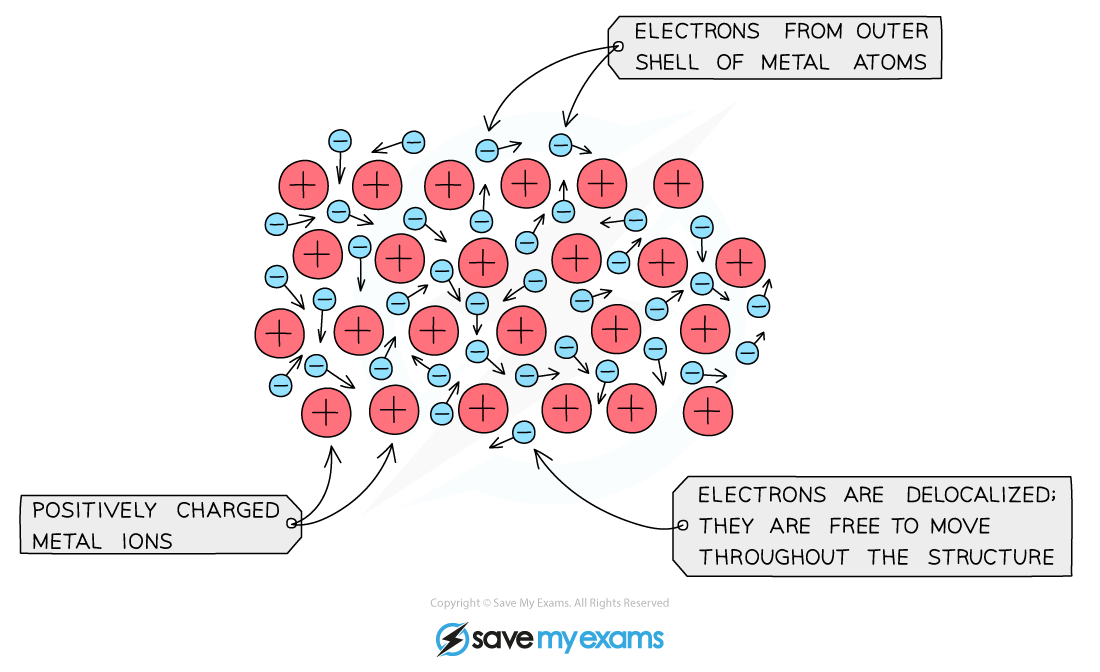
Metallic bonds exist between positive metal ions and delocalised electrons
Explaining the Properties of Metals
Spec point — explain typical physical properties of metals, including electrical conductivity and malleability
What are the properties of metals?
-
Most metals have high melting and boiling points
- There are strong electrostatic forces of attraction between the positive metal ions and the negative delocalised electrons within the metal lattice structure
- These needs lots of energy to be broken
-
Metals conduct electricity
- There are delocalised electrons available to move and carry charge
-
Most metals are malleable
- This means they can be hammered into shape
- This is because the atoms/ions are arranged in layers which can slide over each other when a force is applied
The malleability of metals
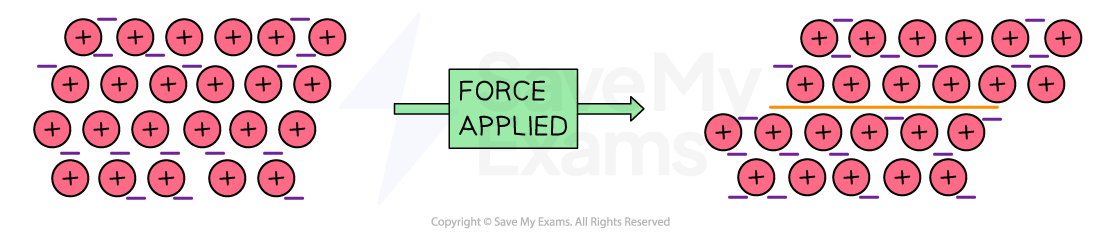
The atoms are able to slide over each other as they are arranged in layers
Exam Hint It's very important you are able to explain these three properties and use the correct terminology.
For example, you must refer to atoms/ions in your answer for malleability, not just particles.
Was this revision note helpful?
Build on this topic