The Three States of Matter (Edexcel IGCSE Chemistry)
Guided lessons are live for this note
Work through it step by step — key points, depth layers, a worked example and self-checks.
Spec point — Understand the three states of matter in terms of the arrangement, movement & energy of the particles
States of matter
-
The three states of matter are solids, liquids and gases
-
A substance can usually exist in all three states, dependent on temperature (and pressure)
-
State changes occur at the melting point (solid to liquid, liquid to solid) and at the boiling point (liquid to gas and gas to liquid)
- Melting and freezing occur at the melting point
- Boiling and condensing take place at the boiling point
-
Individual atoms themselves do not share the same properties as bulk matter
-
The three states of matter can be represented by a simple model
- In this model, the particles are represented by small solid spheres
Summary of the properties of the three states of matter
| Solid | Liquid | Gas | |
|---|---|---|---|
| Diagram |  | 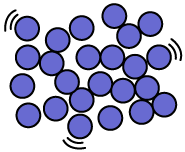 | 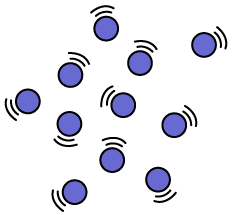 |
| Arrangement of particles | Regular arrangement | Randomly arranged | Randomly arranged |
| Movement of particles | Vibrate about a fixed position | Move around each other | Move quickly in all directions |
| Closeness of particles | Very close | Close | Far apart |
Interconversion Between the States of Matter
Spec point — Understand the interconversions between the three states of matter in terms of:
- the names of the interconversions
- how they are achieved
- the changes in arrangement, movement & energy of the particles
Changing states of matter
-
The amount of energy needed to change state from solid to liquid and from liquid to gas depends on the strength of the forces between the particles
-
The stronger the forces between the particles, the more energy that is needed to overcome them
-
Therefore, the stronger the forces between the particles the higher the melting point and boiling point of the substance
-
Changing states is a physical change
- The particles themselves remain the same, it is just the forces between the particles which change
Melting
- Melting is when a solid changes into a liquid
- Heat / thermal energy absorbed by the particles is transformed into kinetic energy
- This causes the particles to vibrate more and start to move / flow
- Melting happens at a specific temperature, known as the melting point (m.p.)
Boiling / evaporation
-
Boiling and evaporation are both when a liquid changes into a gas
- However, there is a key difference between boiling and evaporation
-
In boiling, heat / thermal energy causes bubbles of gas to form inside the liquid, allowing for liquid particles to escape from the surface and within the liquid
-
Boiling happens at a specific temperature, known as the boiling point (b.p.)
-
Evaporation occurs over a range of temperatures
- It can happen at temperatures below the boiling point of the liquid
-
Evaporation occurs only at the surface of liquids where high energy particles can escape from the liquid's surface at low temperatures
-
The larger the surface area and the warmer the liquid surface, the more quickly a liquid can evaporate
Freezing
-
Freezing is when a liquid changes into a solid
-
This is the reverse of melting and occurs at the same temperature as melting
- So, the melting point and freezing point of a pure substance are the same
- For example, water freezes and melts at 0 ºC
-
Freezing needs a significant decrease in temperature (or loss of thermal energy) and occurs at a specific temperature
Condensation
- Condensation occurs when a gas changes into a liquid on cooling and takes place over a range of temperatures
- When a gas is cooled its particles lose energy and when they bump into each other they lack the energy to bounce away again, instead, they group together to form a liquid
Sublimation
- When a solid changes directly into a gas
- This happens to only a few solids, such as iodine or solid carbon dioxide
- The reverse reaction also happens and is called desublimation or deposition
Changing states of matter
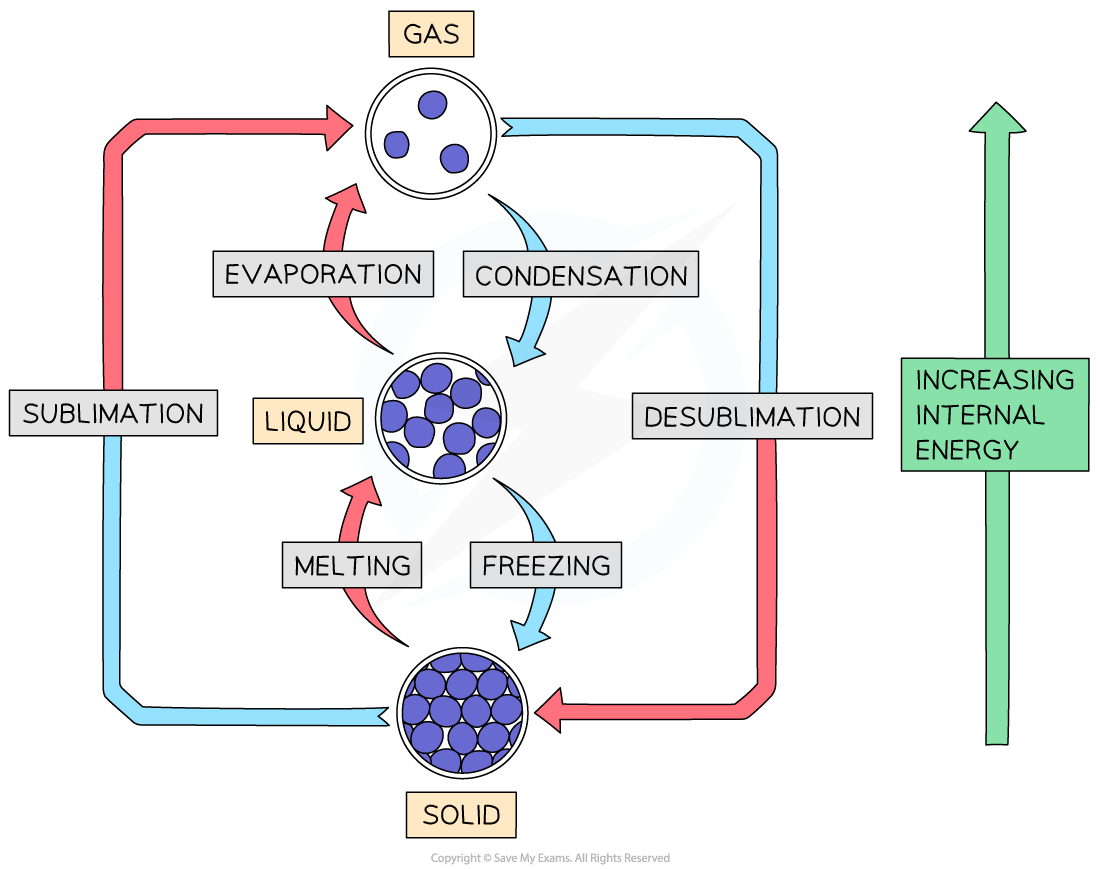
State changes require a change in the energy of the particles
Exam Hint Questions may show state changes with a reversible arrow: ⇌, which means that the process can go forwards and backwards.
Was this revision note helpful?
Build on this topic