Formation of Covalent Bonds (Edexcel IGCSE Chemistry)
Guided lessons are live for this note
Work through it step by step — key points, depth layers, a worked example and self-checks.
Spec point — know that a covalent bond is formed between atoms by the sharing of a pair of electrons
Formation of covalent bonds
-
Non-metal atoms can share electrons with other non-metal atoms to obtain a full outer shell of electrons
-
When atoms share pairs of electrons, they form covalent bonds
-
Covalent bonds between atoms are very strong
-
Covalently bonded substances may be simple molecular structures or giant covalent structures
- Simple molecular structures include oxygen and water
- Giant covalent structures include diamond and graphite
-
Shared electrons are called bonding electrons and occur in pairs
-
Electrons on the outer shell which are not involved in the covalent bond(s) are called non-bonding electrons
Covalent bonding
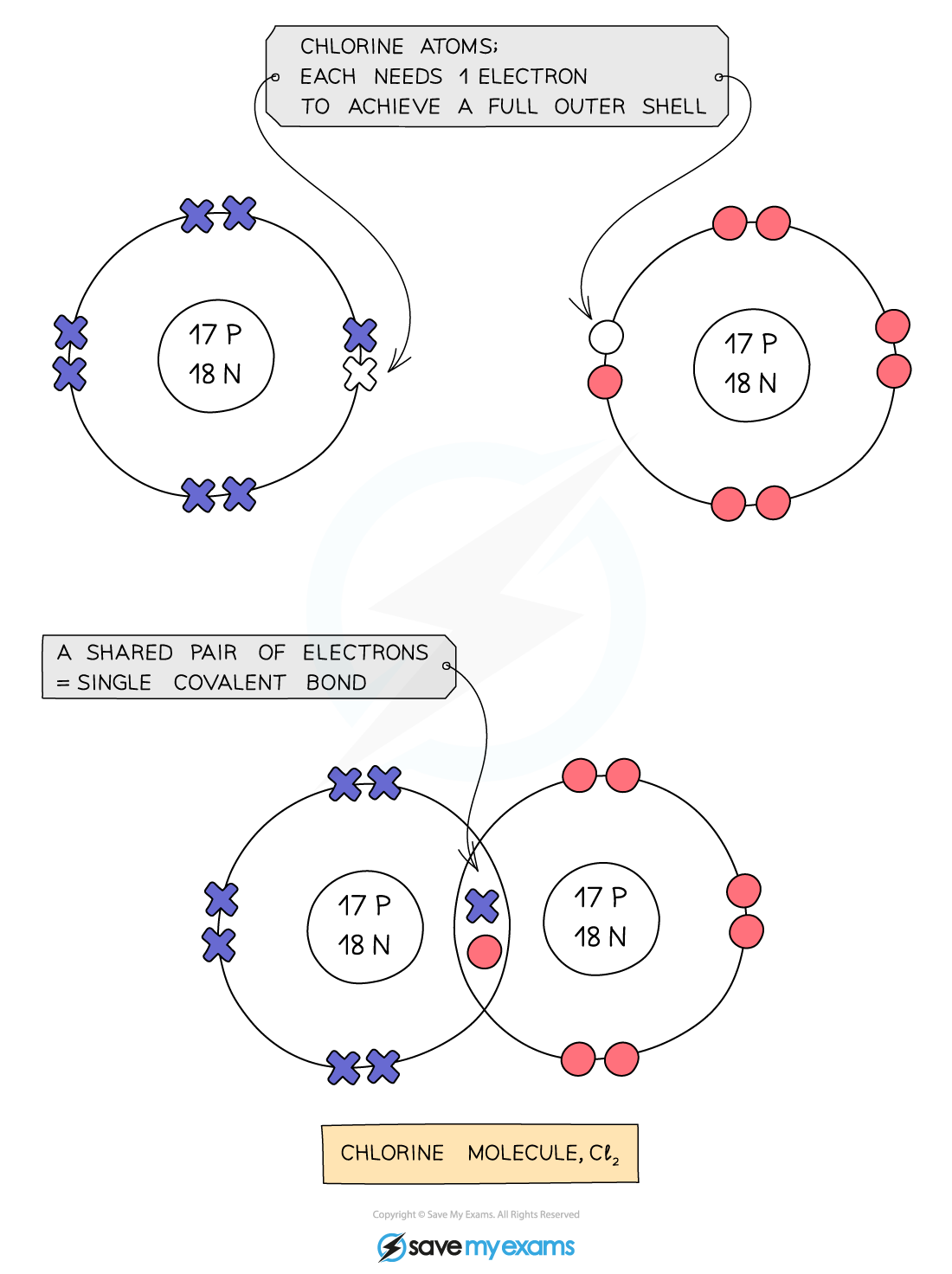
Two chlorine atoms share one electron each to form a covalent bond with a shared pair of electrons
Exam Hint A key difference between covalent bonds and ionic bonds is that in covalent bonds the electrons are shared between the atoms, they are not transferred (donated or gained) and no ions are formed.
Electrostatic Attractions
Spec point — understand covalent bonds in terms of electrostatic attractions
- There is a strong electrostatic attraction between the shared pair of electrons and the nuclei of the atoms involved, since the electrons are negatively charged and the nuclei are positively charged

The attraction between the shared pair of electrons and the nuclei of the atoms involved in a covalent bond
-
In a normal covalent bond, each atom provides one of the electrons in the bond
-
A covalent bond is represented by a short straight line between the two atoms, H-H
-
Covalent bonds should not be regarded as shared electron pairs in a fixed position; the electrons are in a state of constant motion and are best regarded as charge clouds
-
Sharing electrons in the covalent bond allows each of the 2 atoms to achieve an electron configuration similar to a noble gas
- This makes each atom more stable
Was this revision note helpful?
Build on this topic