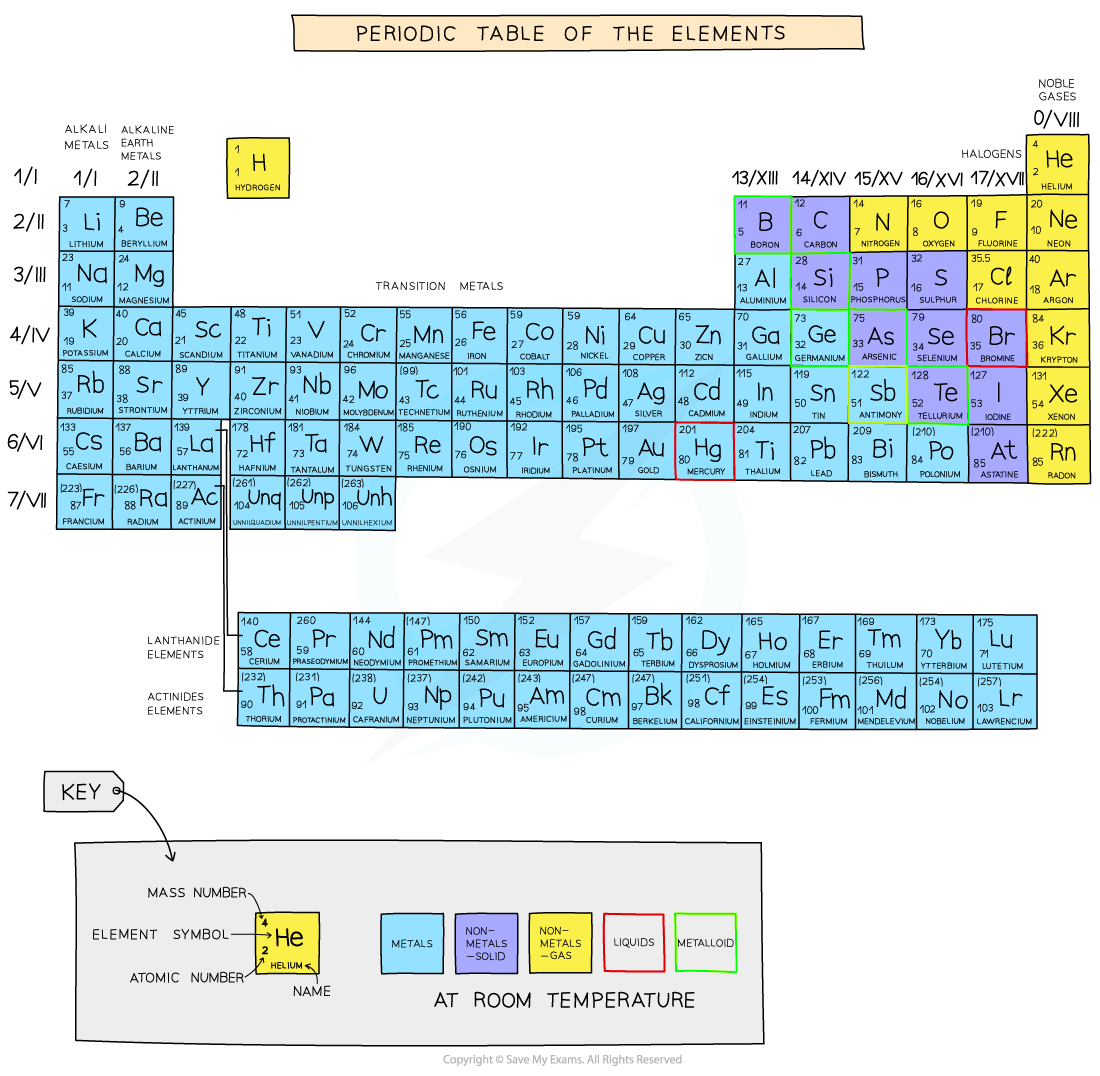
Classify Metals & Non-Metals
2 guided lessons · 18 checks · 1. Principles of Chemistry → The Periodic Table
Guided lessons for this note
Which concept don't you understand yet?
We'll explain it simply and check your understanding. Pick any lesson — any order works.
0 of 18 checks correct so far
Lesson 1 of 2
Properties of metals and non-metals
Sorting elements into metals and non-metals does not need a laboratory full of equipment: two quick tests settle most cases. Pass a current through the element and see whether it conducts, then check how its oxide treats acid and alkali. Good conductivity and a basic oxide point to a metal, while poor conductivity and an acidic oxide point to a non-metal.
What you know already
You already know from Atomic Structure how electrons fill the shells of an atom, and you can write arrangements such as 2,8,1. That picture is exactly what we need here, because the number of outer-shell electrons drives how an element conducts and how its oxide behaves. This note turns those two clues into a practical test for telling metals from non-metals.
Key points of understanding
- Electrical conductivity and the acid-base character of oxides are the working tests for this sorting.
- Metals hold one to three electrons in their outer shell, non-metals four to seven.
- Metallic bonding comes from metal atoms losing outer electrons; non-metals bond covalently by sharing them.
- Metals conduct well; non-metals are poor conductors, which makes the current test decisive.
- Metal oxides are basic; the oxides of non-metals are acidic, with a few neutral ones.
Choose a confidence level to continue.
Prefer to read it all at once? Show the full lesson as a page
1.Properties of metals and non-metals
Sorting elements into metals and non-metals does not need a laboratory full of equipment: two quick tests settle most cases. Pass a current through the element and see whether it conducts, then check how its oxide treats acid and alkali. Good conductivity and a basic oxide point to a metal, while poor conductivity and an acidic oxide point to a non-metal.
Key points
- Electrical conductivity and the acid-base character of oxides are the working tests for this sorting.
- Metals hold one to three electrons in their outer shell, non-metals four to seven.
- Metallic bonding comes from metal atoms losing outer electrons; non-metals bond covalently by sharing them.
- Metals conduct well; non-metals are poor conductors, which makes the current test decisive.
- Metal oxides are basic; the oxides of non-metals are acidic, with a few neutral ones.
Guided content from the SME authoring corpus — note rn_wTtM2fQVVjntRm64, pinned at 78ad6a2073c6 · promoted SyllabAI/syllabai-resources e967e75f1339