Formation of Covalent Bonds
2 guided lessons · 18 checks · 1. Principles of Chemistry → Covalent Bonding
Guided lessons for this note
Which concept don't you understand yet?
We'll explain it simply and check your understanding. Pick any lesson — any order works.
0 of 18 checks correct so far
Lesson 1 of 2
Formation of covalent bonds
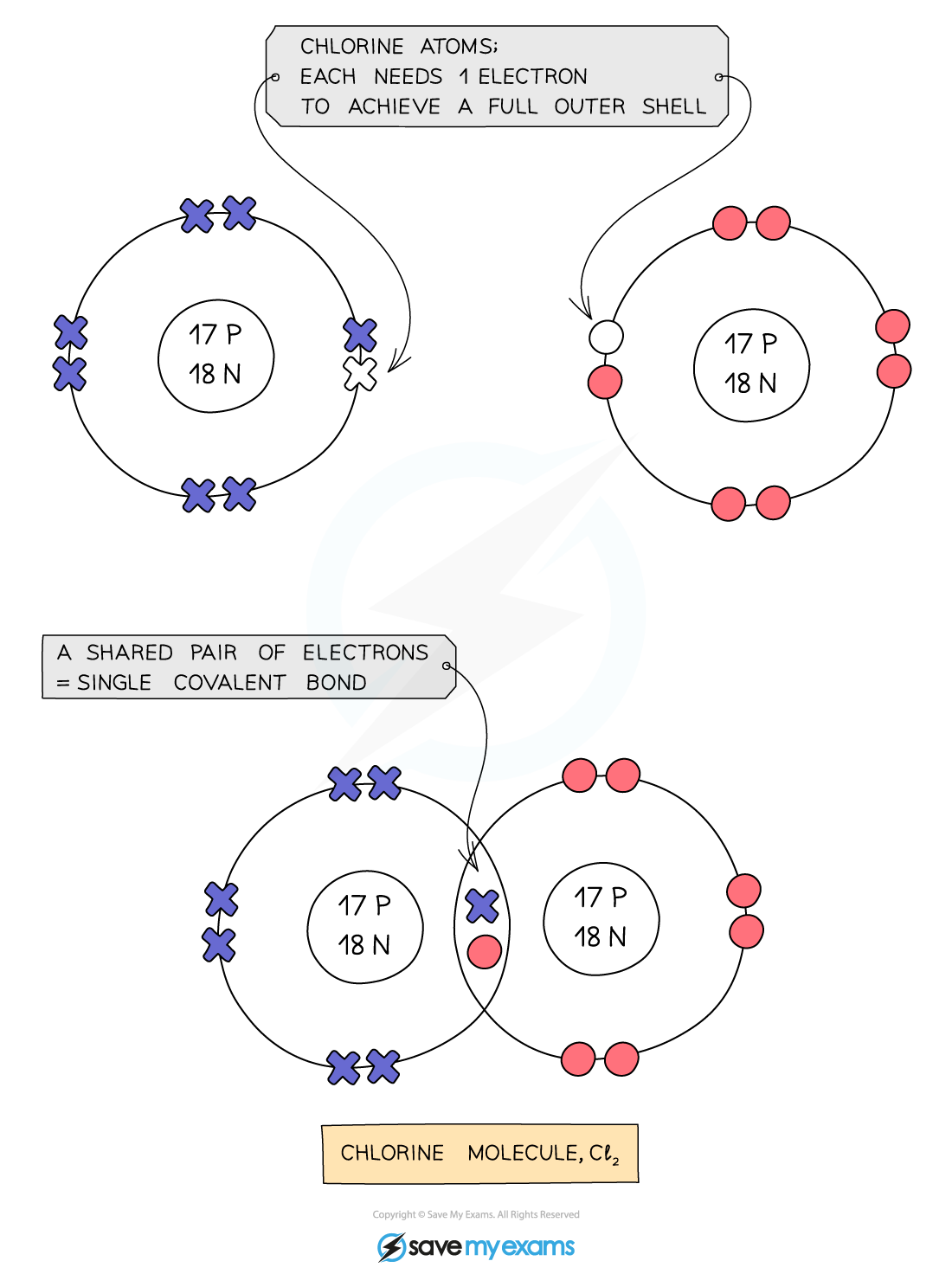
Non-metal atoms can reach a full outer shell without forming ions: they share pairs of electrons instead. Each shared pair is one covalent bond, and covalent bonds are very strong. Two chlorine atoms, for example, each supply one electron to a shared pair, and the shared electrons are then counted towards the outer shell of both atoms.
What you know already
From Ionic Bonding you already know that atoms can reach full outer shells by losing or gaining electrons. Non-metal atoms cannot hand electrons to one another, so this note shows the other route: sharing pairs of electrons, and the electrical attraction that makes each shared pair a strong bond.
Key points of understanding
- Covalent bonds form when non-metal atoms share pairs of electrons to gain full outer shells.
- Each shared pair of electrons is one covalent bond, and the bonds are very strong.
- Shared electrons are called bonding electrons and always occur in pairs.
- Outer electrons that take no part in the bond are called non-bonding electrons.
- Covalently bonded substances are either simple molecular structures, like water, or giant covalent structures, like diamond.
Choose a confidence level to continue.
Prefer to read it all at once? Show the full lesson as a page
1.Formation of covalent bonds
Non-metal atoms can reach a full outer shell without forming ions: they share pairs of electrons instead. Each shared pair is one covalent bond, and covalent bonds are very strong. Two chlorine atoms, for example, each supply one electron to a shared pair, and the shared electrons are then counted towards the outer shell of both atoms.
Key points
- Covalent bonds form when non-metal atoms share pairs of electrons to gain full outer shells.
- Each shared pair of electrons is one covalent bond, and the bonds are very strong.
- Shared electrons are called bonding electrons and always occur in pairs.
- Outer electrons that take no part in the bond are called non-bonding electrons.
- Covalently bonded substances are either simple molecular structures, like water, or giant covalent structures, like diamond.
Guided content from the SME authoring corpus — note rn_vfmJxw4VQgXKzXF3, pinned at fa1f302050ba · promoted SyllabAI/syllabai-resources e967e75f1339