Reversible Reactions (Edexcel IGCSE Chemistry)
Guided lessons are live for this note
Work through it step by step — key points, depth layers, a worked example and self-checks.
Spec point — know that some reactions are reversible and this is indicated by the symbol ⇌ in equations describe reversible reactions such as the dehydration of hydrated copper(II) sulfate and the effect of heat on ammonium chloride
Reversible reactions
-
Some reactions go to completion, where the reactants are used up to form the product molecules and the reaction stops when all of the reactants are used up
-
In reversible reactions, the product molecules can themselves react with each other or decompose and form the reactant molecules again
-
It is said that the reaction can occur in both directions:
- The forward reaction forming the products
- The reverse reaction forming the reactants
-
When writing chemical equations for reversible reactions, two opposing arrows are used to indicate the forward and reverse reactions occurring at the same time
⇌
- Each one is drawn with just half an arrowhead – the top one points to the right, and the bottom one points to the left
- The direction a reversible reaction takes can be changed by changing the reaction conditions
Thermal decomposition of ammonium chloride
- Heating ammonium chloride produces ammonia and hydrogen chloride gases:
NH4Cl (s) → NH3 (g) + HCl (g)
- As the hot gases cool down they recombine to form solid ammonium chloride
NH3 (g) + HCl (g) → NH4Cl (s)
- So, the reversible reaction is represented like this:
NH4Cl (s) ⇌ NH3 (g) + HCl (g)
Dehydration of hydrated copper(II) sulfate
-
Reversible reactions can be seen in some hydrated salts
-
These are salts that contain water of crystallisation which affects their shape and colour
- Water of crystallisation is the water that is included in the structure of some salts during the crystallisation process
-
One example is copper(II) sulfate:
hydrated copper(II) sulfate ⇌ anhydrous copper(II) sulfate + water
CuSO4•5H2O ⇌ CuSO4+ 5H2O
-
The hydrated salt is copper(II) sulfate pentahydrate, CuSO4•5H2O
- These are usually seen as blue crystals
- The hydrated salt can be heated / dehydrated to form anhydrous copper(II) sulfate, CuSO4
- This reaction is endothermic as energy is taken in to remove the water
-
The anhydrous salt is copper(II) sulfate
- This is usually seen as white crystals / powder
- Adding water to the anhydrous salt forms the hydrated copper(II) sulfate pentahydrate, CuSO4•5H2O
- This reaction is highly exothermic
The dehydration of hydrated copper(II) sulfate
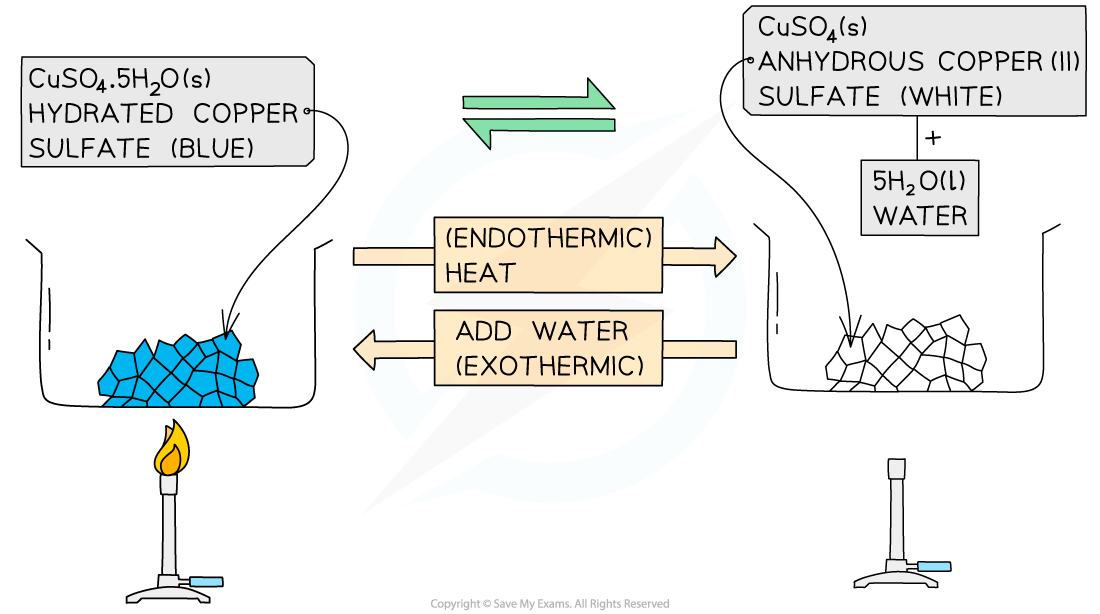
The dehydration of hydrated salts is often a reversible reaction
Exam Hint The reverse reaction may also be called the backwards reaction. A generic reversible reaction is shown as
A + B ⇌ C + D
Was this revision note helpful?