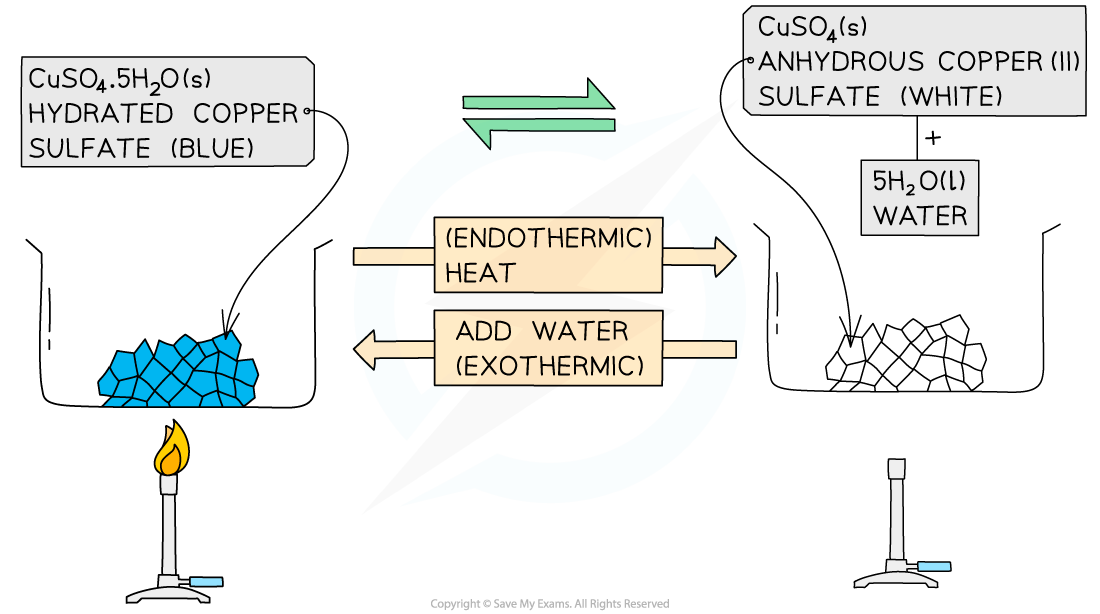
Reversible Reactions
2 guided lessons · 18 checks · 3. Physical Chemistry → Reversible Reactions & Equilibria
Guided lessons for this note
Which concept don't you understand yet?
We'll explain it simply and check your understanding. Pick any lesson — any order works.
0 of 18 checks correct so far
Lesson 1 of 2
Reactions that run both ways
Most equations you have met end when the reactants run out, but some reactions can be undone by their own products. This lesson introduces the double arrow that marks chemistry able to travel in both directions.
What you know already
From Rates of Reaction you already know that changing conditions changes how fast reactions run. This note shows that conditions can even change the direction a reaction takes, using the two-arrow symbol that marks a reversible change. Two classic examples, heated ammonium chloride and blue copper sulfate, carry the whole idea.
Key points of understanding
- In reversible reactions the product molecules can react again or decompose to reform the reactants.
- A reversible reaction can occur in both directions at the same time.
- The forward reaction forms the products while the reverse reaction forms the reactants.
- The symbol with two half arrowheads, one pointing each way, indicates a reversible reaction.
- Changing the reaction conditions can change the direction a reversible reaction takes.
Choose a confidence level to continue.
Prefer to read it all at once? Show the full lesson as a page
1.Reactions that run both ways
Most equations you have met end when the reactants run out, but some reactions can be undone by their own products. This lesson introduces the double arrow that marks chemistry able to travel in both directions.
Key points
- In reversible reactions the product molecules can react again or decompose to reform the reactants.
- A reversible reaction can occur in both directions at the same time.
- The forward reaction forms the products while the reverse reaction forms the reactants.
- The symbol with two half arrowheads, one pointing each way, indicates a reversible reaction.
- Changing the reaction conditions can change the direction a reversible reaction takes.
Guided content from the SME authoring corpus — note rn_t68QRDhwR6r5gxYX, pinned at 51a6ed34e715 · promoted SyllabAI/syllabai-resources e967e75f1339