Metallic Bonding
2 guided lessons · 18 checks · 1. Principles of Chemistry → Metallic Bonding
Guided lessons for this note
Which concept don't you understand yet?
We'll explain it simply and check your understanding. Pick any lesson — any order works.
0 of 18 checks correct so far
Lesson 1 of 2
Metallic bonding & the lattice diagram
A metal is a giant structure of atoms arranged in a regular pattern. Within the lattice the atoms release their outer electrons, turning into positive ions, while the released electrons become delocalised and move freely between the ions like a sea. The metallic bond is the strong attraction between those positive ions and the delocalised electrons, and a simple 2-D diagram shows ions in rows with the electrons scattered between them.
What you know already
From Ionic Bonding you already know that metal atoms lose their outer electrons to form positive ions. This note keeps those electrons instead: in a pure metal the outer electrons are released into a shared sea that flows around an array of positive ions, and that single picture explains conduction, malleability and the high melting points of metals.
Key points of understanding
- A metal is a giant structure whose atoms sit in a regular, repeating pattern.
- Within the lattice the atoms lose their outer electrons, becoming positive metal ions.
- The released outer electrons are delocalised and move freely between the positive ions.
- The metallic bond is the strong pull that the positive ions and the electron sea exert on each other.
- A 2-D diagram of the metallic lattice shows rows of ions with delocalised electrons between them.
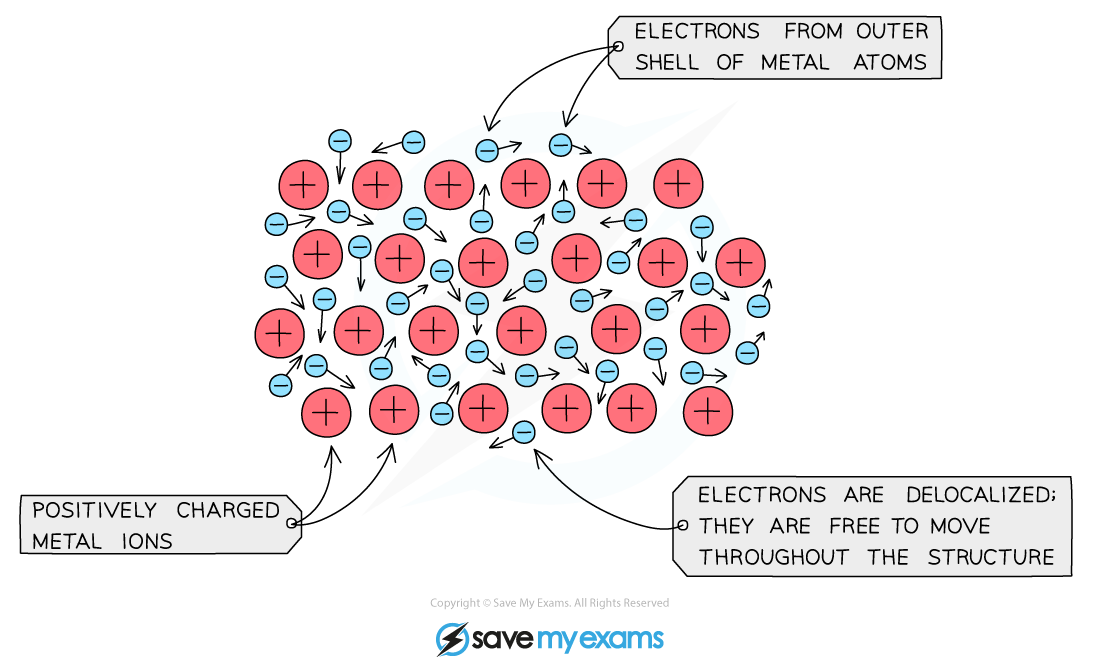
Metallic bonds exist between positive metal ions and delocalised electrons
Choose a confidence level to continue.
Prefer to read it all at once? Show the full lesson as a page
1.Metallic bonding & the lattice diagram
A metal is a giant structure of atoms arranged in a regular pattern. Within the lattice the atoms release their outer electrons, turning into positive ions, while the released electrons become delocalised and move freely between the ions like a sea. The metallic bond is the strong attraction between those positive ions and the delocalised electrons, and a simple 2-D diagram shows ions in rows with the electrons scattered between them.
Metallic bonds exist between positive metal ions and delocalised electrons
Key points
- A metal is a giant structure whose atoms sit in a regular, repeating pattern.
- Within the lattice the atoms lose their outer electrons, becoming positive metal ions.
- The released outer electrons are delocalised and move freely between the positive ions.
- The metallic bond is the strong pull that the positive ions and the electron sea exert on each other.
- A 2-D diagram of the metallic lattice shows rows of ions with delocalised electrons between them.
First pass
Picture rows of positive metal ions with small electrons scattered freely between them. Each ion pulls on the shared sea of electrons, and the sea pulls back on every ion at once, which is the metallic bond holding the whole structure together.
Analogy — Think of marbles set in a fixed grid, all sitting in one shared puddle of glue: every marble touches the same glue, and the glue is what grips the whole tray together.
Exam pointer — In the 2-D diagram, label the ions with their positive charges and show the electrons between the rows; both parts carry credit.
Going deeper
The lattice forms because metal atoms relinquish their outer-shell electrons, generating an array of positive ions bathed in delocalised electrons. Electrostatic attraction between the ions and the shared electron sea acts throughout the structure, and the same attraction is what the 2-D diagram of rows and free electrons is drawn to represent.
Analogy — Picture a tray of ball bearings resting in oil that flows freely between them: the oil reaches every ball at once, and any pull on the oil is felt by the whole tray.
Exam pointer — Use the full phrase attraction between the positive ions and the delocalised electrons; naming only one party leaves the bonding explanation incomplete.
Checks
0 of 9 attempted · 0 correct
2.Properties of metals
The same bonding picture explains the typical physical properties of metals. Most metals have high melting and boiling points, because a lot of energy is needed to overcome the strong attractions between the ions and the electron sea. Metals conduct electricity, because the delocalised electrons are free to move and carry charge. And most metals are malleable, because their layers of ions can slide over one another when a force is applied.
Key points
- Most metals have high melting and boiling points, because strong electrostatic forces need lots of energy to break.
- The forces grip between positively charged metal ions and the negatively charged electrons that surround them.
- Metals conduct electricity because their delocalised electrons are available to move and carry charge.
- Most metals are malleable, meaning they can be hammered into shape.
- Malleability works because the atoms or ions form layers, and a push makes one layer slide across its neighbour.
First pass
Three properties, one cause. The grip between ions and the electron sea is strong, so melting takes high temperatures. The sea can flow, so metals conduct. And because the ion rows are neat layers, a hammer makes one layer slide past the next without breaking the grip, so the metal reshapes instead of shattering.
Analogy — Think of a stack of identical trays in thick syrup: the syrup grips everything (high melting point), the syrup itself can flow (conduction), and one tray can slide sideways off its neighbour without tearing anything (malleability).
Exam pointer — The exam insists on correct terminology: for malleability, refer to atoms or ions in layers, never just particles, or the mark is lost.
Going deeper
Each property maps onto the bonding model: high melting points follow from the strong electrostatic attraction between ions and the electron sea; conductivity follows from mobile delocalised electrons carrying charge through the lattice; and malleability follows from the regular layering of ions, which lets planes slide under force while the collective bond persists.
Analogy — Picture a deck of cards gripped loosely by a rubber band: the band holds the whole deck together, individual cards can still slide, and a coin dropped through the deck can drift from one end to the other.
Exam pointer — Property questions are explanation questions: name the structural feature first, then attach the property, and keep the atoms-and-ions wording for malleability.
Checks
0 of 9 attempted · 0 correct
From the revision note
Diagrams on this note's page that are not tied to a specific lesson.
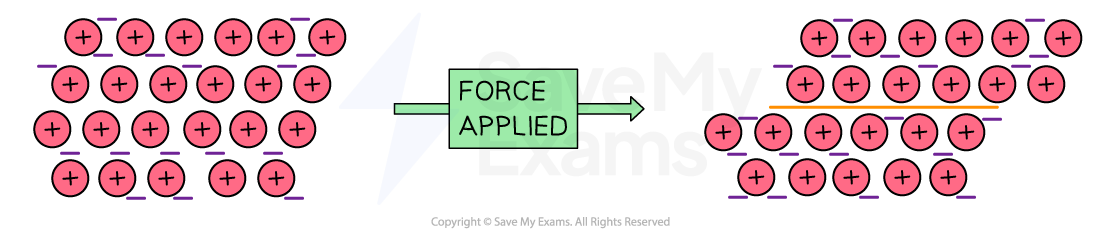
The atoms are able to slide over each other as they are arranged in layers
Guided content from the SME authoring corpus — note rn_Hp2nK8XpN2SmjdQc, pinned at fa1f302050ba · promoted SyllabAI/syllabai-resources e967e75f1339