Diffusion & Dilution (Edexcel IGCSE Chemistry)
Guided lessons are live for this note
Work through it step by step — key points, depth layers, a worked example and self-checks.
Spec point — understand how the results of experiments involving the dilution of coloured solutions and diffusion of gases can be explained
Diffusion and dilution
- Diffusion and dilution experiments support a theory that all matter (solids, liquids and gases) is made up of tiny, moving particles
Diffusion
-
Diffusion occurs in gases and liquids, due to the random motion of their particles
-
It is where particles move from an area of high concentration to an area of low concentration
-
Eventually the concentration of particles is even as the particles are evenly spread throughout the available space
-
Diffusion happens on its own and no energy input is required
- Although, it occurs faster at higher temperatures because the particles have more kinetic energy
Diffusion in gases
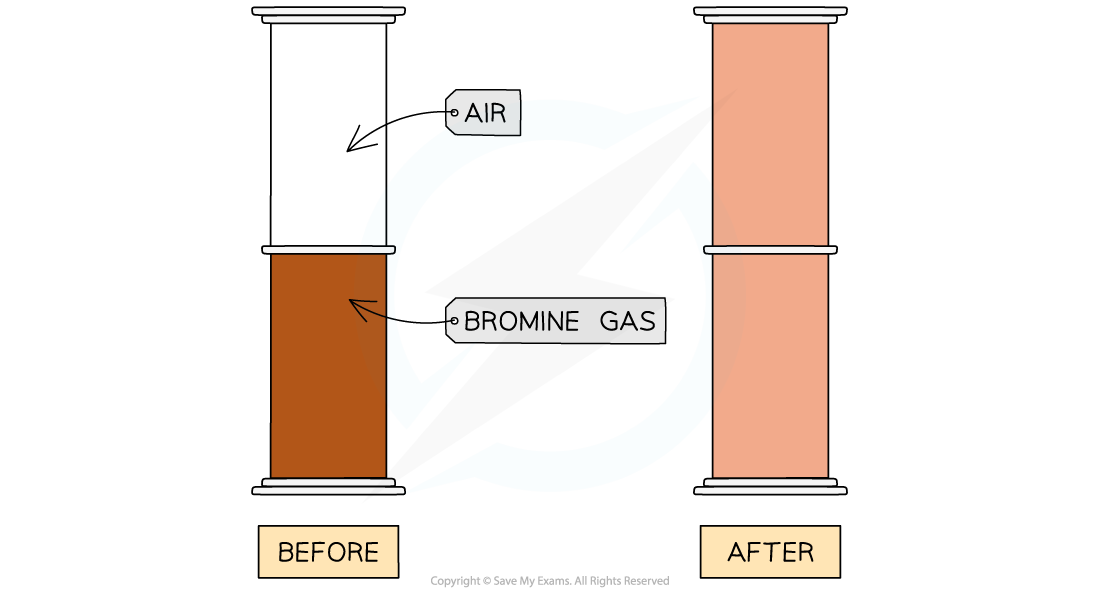
Diffusion of red-brown bromine gas
Description:
- Here, we see the diffusion of bromine gas from one gas jar to another
- After 5 minutes the bromine gas has diffused from the bottom jar to the top jar
Explanation:
- The air and bromine particles are moving randomly and there are large gaps between particles
- The particles can therefore easily mix together
Diffusion in liquids
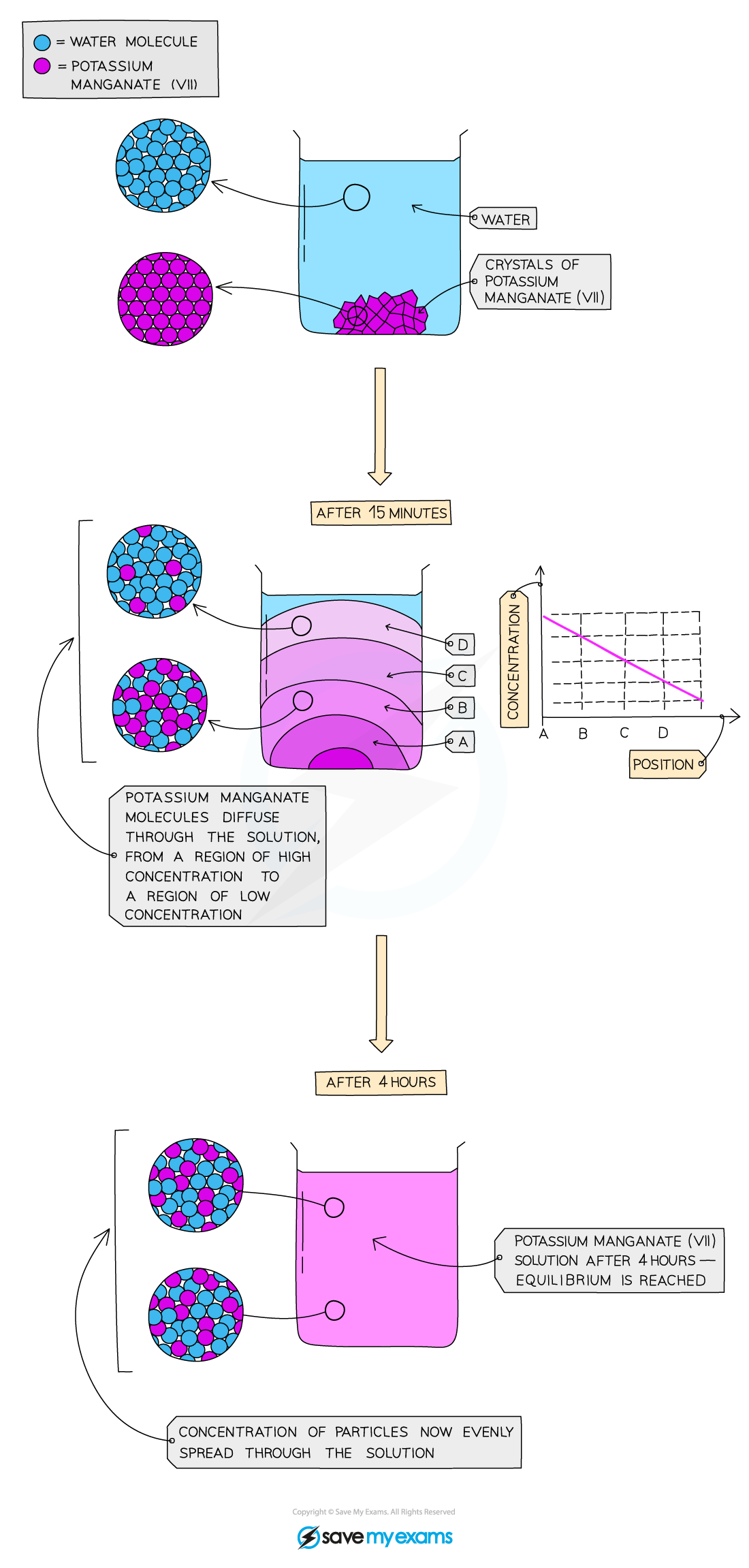
Diffusion of potassium manganate(VII) in water over time
Description:
- When potassium manganate (VII) crystals are dissolved in water, a purple solution is formed
- A small number of crystals produce a highly intense colour
Explanation:
- The water and potassium manganate (VII) particles are moving randomly and the particles can slide over each other
- The particles can therefore easily mix together
- Diffusion in liquids is slower than in gases because the particles in a liquid are closely packed together and move more slowly
Dilution
-
Dilution is the process of adding more solvent (usually water) to a solution
-
This decreases the concentration of solute particles
-
The solute particles become more spread out but are still present in the solution
-
The colour of the solution becomes fainter with each dilution, but it does not disappear immediately
-
Dilution does not remove particles
- It spreads them out more
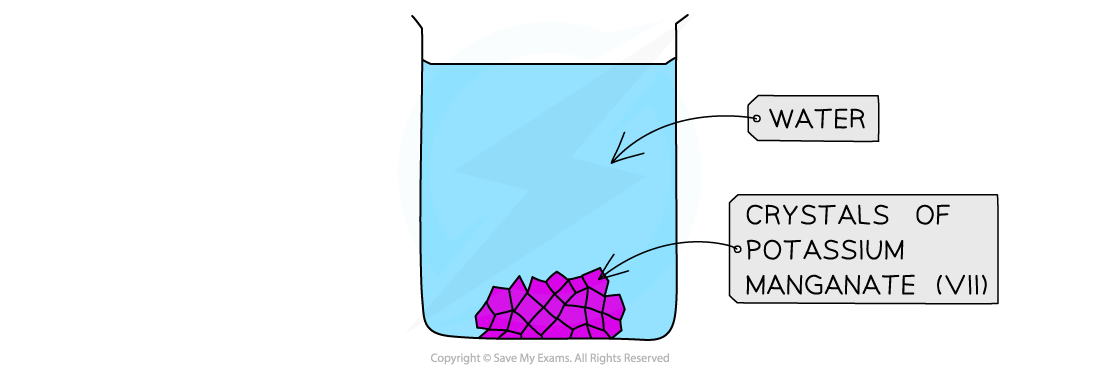
Dissolving potassium manganate (VII) in water
Description:
- When potassium magnate (VII) crystals are dissolved in water, the solution can be diluted several times
- The colour fades but does not disappear until a lot of dilutions have been done
Explanation:
- This indicates that there are a lot of particles in a small amount of potassium manganate (VII) and therefore the particles must be very small
Exam Hint Diffusion and dilution provide evidence for the kinetic theory of matter.
Was this revision note helpful?
Build on this topic