Food Shortages (Cambridge International IGCSE Geography)
Causes & Effects of Food Shortages
Spec point —
3.2.2· Recognise the causes & effects of food shortages
- In 2015, world leaders committed to ending world hunger by 2030
- The UN estimates that the number of people in 'hunger emergencies' has increased from 135 million in 2019 to 345 million in 2022
- Global food prices are rising—23% higher than in 2021
- World grain reserves are lower than they have been for 14 years
- Women and girls account for 70% of the people suffering from hunger
Causes of food shortages
-
The causes of food shortages can be divided into natural and human factors
-
It is important to remember that natural causes can often be made worse by human activity
-
An example would be floods, which result from heavy and prolonged rainfall but may be made worse by:
- urbanisation
- deforestation
- climate change leading to increased snow and ice melt, sea level rise and changing weather patterns
-
Natural causes of food shortages
-
Flooding
- Crops cannot cope with being waterlogged
- Causes the death of livestock
-
Drought and unreliable rainfall
- This can reduce crop yields significantly
- Causes the death of livestock
-
Disease
- Reduce yields
- Result in livestock deaths/culling, e.g. swine flu
-
Pests
- Locusts can wipe out entire fields of crops in a matter of hours
-
Tropical cyclones
- Heavy rainfall and strong winds, which can destroy large areas of crops
Human causes of food shortages
-
War and conflict
- People are unable to farm due to the conflict
- War also disrupts the supply and movement of food supplies
-
Rising food prices
- People cannot afford the food that they need
-
Human-induced global warming
- This leads to changing weather patterns, increased temperatures and rising sea levels
-
Lack of investment
- Many LEDCs have poor transport systems, which means that transporting food and livestock is difficult
- Lack of funds to invest in agriculture
-
Corruption
- Investment in rural areas and agriculture does not happen due to corrupt politicians taking the money
-
Rapid population increase
- The food available has to be shared between more people, decreasing the amount that people have
-
Soil erosion and desertification
- Overgrazing and over-cultivation lead to a loss of soil fertility so plants won't grow, or yields decrease
Effects of food shortages
-
The impact of food shortages ranges from undernutrition to wasting
- Undernutrition: People do not consume enough calories; this is linked to 45% of all child deaths
- Malnutrition: people's diet lacks the correct nutrients to keep them healthy
- Wasting, when people have low weight in relation to their height, affects 45 million children under the age of 5
-
Rising food prices
- When there is increased demand and reduced supply, the prices increase
-
Underdevelopment: loss of productivity
- If a country's workforce is suffering from food shortages, they will be less productive, and development will slow or even reverse
-
Soil erosion and desertification
- Farmers may over-cultivate and overgraze the land in an attempt to increase the amount of food available
-
Social unrest
- Food shortage may lead people to riot and loot
-
Migration
- People migrate to other countries or to urban areas where the food supply is better. This can impact those areas with the development of illegal settlements
Worked Example Describe the natural problems that cause food shortages.
[3 marks]
Answer:
- Drought causes crop failure [1]
- Floods destroy crops [1]
- Tropical storms destroy crops and cause flooding [1]
- Pests eat crops [1]
- Disease destroys the crop [1]
Possible Solutions to the Problem of Food Shortages
Spec point —
3.2.2· Describe the possible solutions to the problem of food shortages
- There are several solutions to food shortages these range from food aid to genetically modified crops
Food aid
- This can be short (after a disaster or in a crisis) or long-term (often given to the LEDC government to distribute)
- The aid is given by MEDCs often through organisations such as the World Food Programme (WFP) as well as by Non-Governmental Organisations (NGOs) such as Oxfam and Save The Children
| Advantages | Disadvantages |
|---|---|
| Saves lives during a crisis | - Can increase the dependence of LEDCs on food aid - Reduces the sales of crops grown by local farmers - Expensive to transport |
Irrigation
- The artificial watering of crops—the success of this is dependent on the type of irrigation
- Surface irrigation or drip irrigation are examples of irrigation types
| Advantages | Disadvantages |
|---|---|
| Increases crop production and yields in areas with low rainfall | - Loss of water through evaporation - Increased salinity of the soil affects crop growth - Increases pressure on water resources |
Genetically Modified (GM) crops
- When the genetic material of a crop is altered to make it disease/pest resistant, have higher yield or be drought resistant
Advantages
- Increases the yield of crops as they are not as susceptible to pests or diseases
Disadvantages
- Concerns about the impacts on the environment
Green Revolution and high-yield varieties
- Involved in the development of high-yield varieties of main food crops, including wheat, maize and rice
Advantages
- Increased yields
- Larger farm incomes increased
Disadvantages
- Needed high inputs of fertilisers/pesticides
- Increased mechanisation leads to fewer jobs
Education of farmers
- Education for farmers about sustainable farming methods
| Advantages | Disadvantages |
|---|---|
| - Low cost - Increases farming knowledge - Increases yields | - None |
Mechanisation
- Use of tractors and other machines to complete farming tasks
Advantages
- Increases yields as more land can be cultivated
- More time-efficient
- Less labour needed
Disadvantages
- Reduces jobs in agriculture
- Machines can be expensive to buy and maintain
Fertilisers/pesticides
- Fertilisers are added to increase yields by adding nitrogen
- Pesticides are used to kill or deter pests from eating crops
| Advantages | Disadvantages |
|---|---|
| - Increases the yield - Reduces losses from pests | - Damage to the environment, e.g. eutrophication - Concerns about the impact on human health |
Appropriate technology
- Includes methods such as Contour ploughing or intercropping
Advantages
- Increases yield as water infiltration improves and soil erosion decreases
Disadvantages
- None
Case Study: Yemen
Spec point —
3.2.2· A farm or agricultural system
- There are many examples of countries which suffer food shortages
- The example below of Yemen can be used as an example in the final exam
Case Study
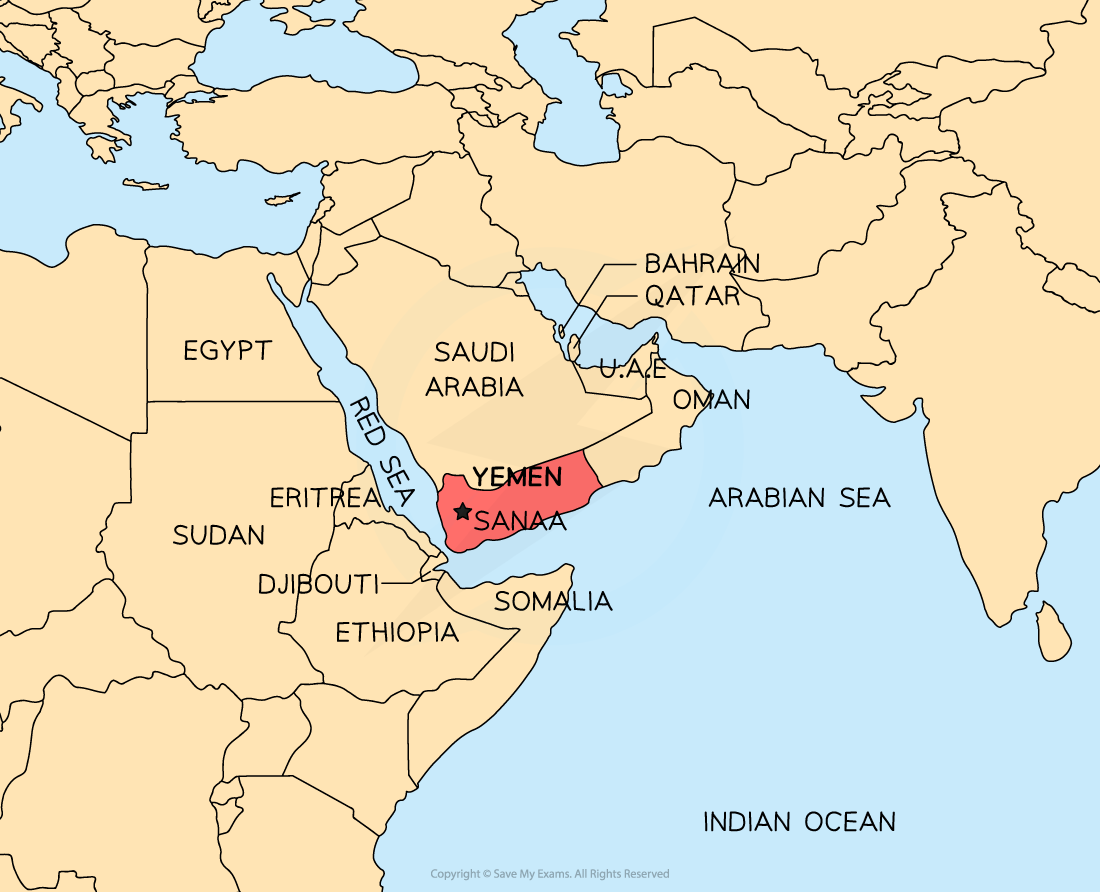
- Yemen is located in the south-east of the Arabian Peninsula
Location of Yemen
- Yemen has a mainly hot desert climate with a temperate climate in the western mountains
- In summer months, temperatures reach 40 ºC and there is little rainfall
- Winter months are cooler between 25 and 35 ºC, but with little rainfall
Agriculture
There is increasing agricultural activity in Yemen with crops including:
- millet
- corn
- wheat
- barley
- sorghum
Other crops include coffee, cotton and fruit which were grown for export
Over 73% of the population relies on agriculture as their main source of income
Causes of food shortages
Conflict
- In 2015, after years of internal conflict, a civil war broke out
- Continued conflicts have led over 4 million Yemenis to be displaced
- Food aid supplies have been affected by blockades at the ports intended to stop weapons from entering the country
- Internal infrastructure (roads, airports and communication) has also been affected by the conflict, which stops the movement of food around the country
Drought
- In recent years, drought has further affected supplies
- The main crop-growing areas have received only one-third to half of the usual precipitation
Pests
- In 2019, swarms of locusts hit Yemen, destroying many of the crops
- The conflict affected the control and monitoring program
- The lack of pesticides meant that the Yemenis struggled to control the insects
Corruption
- Food aid is taken by those involved in the fighting and those in power
- It often does not reach those who need it most
Population increase
- The population has increased to almost 30 million from 26.5 million in 2015
- This increases the demand for food
Effects of food shortages
The Yemeni economy has declined
These issues have mostly happened in the crop-growing areas in the south-west
In 2016, it is estimated that farm produce losses totalled $964.5 million
Yemen became dependent on imports for 90% of its grain supplies
- Much of this was from Ukraine, the supply of which has been affected by the Russian invasion
More than 80% of the population live below the poverty line
Over 50% of the population working in agriculture have lost their jobs
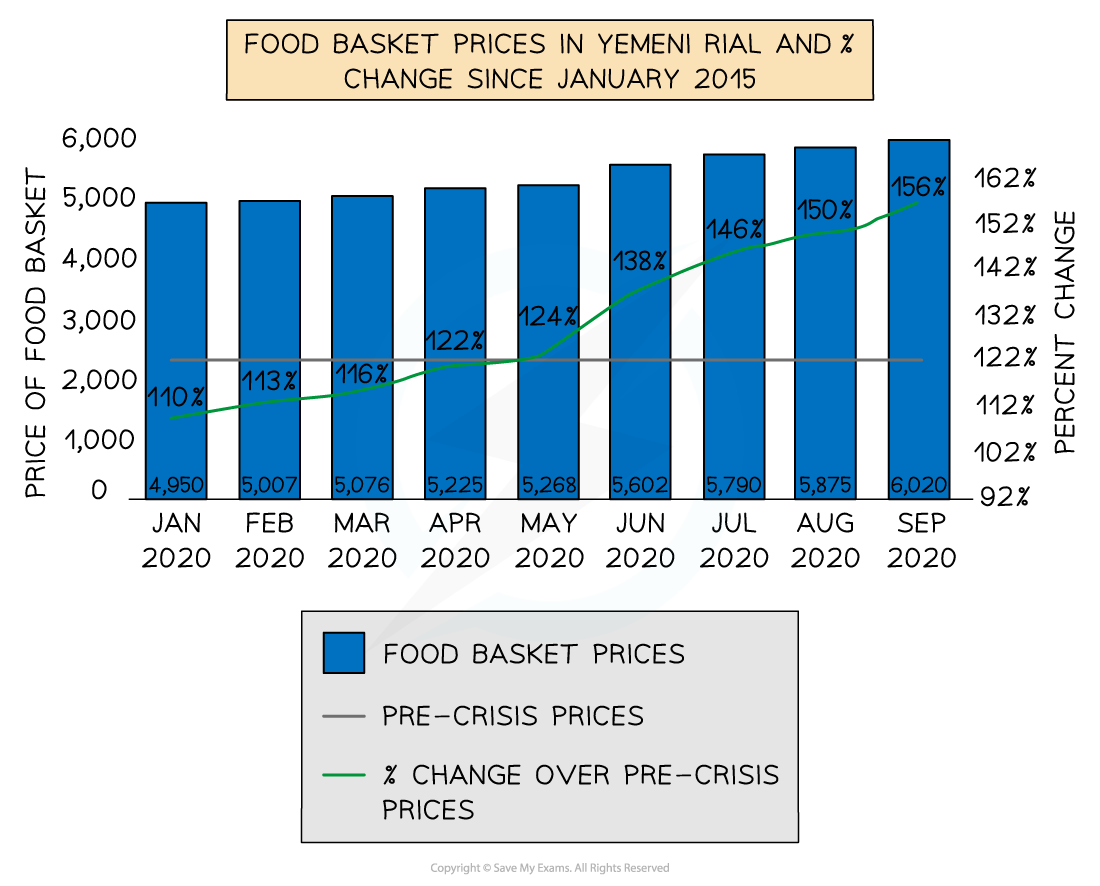
Food prices have increased between 30 and 70%, meaning people cannot afford a healthy diet
*Food basket price in Yemen *
- The UN estimates more than 226,000 Yemenis have died due to food shortages and lack of health services
- Acute malnutrition now threatens over 50% of children under 5
- The total number of food insecure population is expected to reach 19 million by the end of 2022
Solutions
Since the start of the conflict, billions in aid have been sent to Yemen through organisations such as:
- UNICEF
- Red Cross
- World Food Program
- Oxfam
Getting aid to the people who need it is challenging for the reasons outlined in 'causes' above
The World Food Program provides 13 million people with food assistance through:
- Rations
- Vouchers
- Cash transfers
Until the end of the conflict, the food shortages are likely to continue and may even get worse
Was this revision note helpful?
Build on this topic