Agricultural Systems (Cambridge International IGCSE Geography)
Spec point —
3.2.1· Describe & explain the main features of an agricultural system; inputs, processes & outputs
Agricultural Systems
-
To obtain food, humans use and modify the ecosystems through farming
-
There are four groupings commonly used to categorise farming:
- Arable and pastoral
- Commercial and subsistence
- Extensive and intensive
- Nomadic and sedentary
-
A farm that has both livestock and crops is a mixed farm
Factors influencing the type of agriculture
Physical factors
-
Temperature
- All crops have a minimum temperature below which they will not grow or will not produce a good yield; wheat grows best between 21 and 24 ºC
-
Growing season
- The length of the growing season affects the type of crop grown—barley needs about 90 days from sowing to harvest, whereas rice takes about 120 days
-
Precipitation
- Both the average annual rainfall and the distribution of rain over the year affect the types of crops grown
-
Relief and slope aspect
- The altitude of the land affects temperature and the steepness affects the suitability for crops
- In local areas, different crops may be grown on south-facing slopes, which get more sunshine and are warmer
-
Soil type and fertility
- In areas with thin, infertile soils, grazing is likely to dominate as crops need deeper, more fertile soil
-
Drainage
- For most crops to grow, the land needs to be well drained so that roots do not get waterlogged
Human factors
-
Tradition
- Many farms simply grow the crops or raise the livestock that have been on the farm for generations
-
Subsidies
- Farmers may change crops or livestock depending on the money available from the government
-
Transport
- The cost of transporting the product may affect what is produced
- Livestock transport is more expensive than grain transport
-
Farm size
- Due to economies of scale, larger farms can afford more in terms of feed, fertiliser and machinery; this may affect what is produced
-
Market demand
- The changing demand for produce
- There has been an increase in demand for meat such as buffalo and ostrich, which may affect the choice of what is produced
-
Capital
- The amount of money a farmer has to invest will affect the machines and artificial inputs (irrigation, pesticides, fertilisers) they can afford
Farming systems
- All farms are systems; they have inputs, processes and outputs
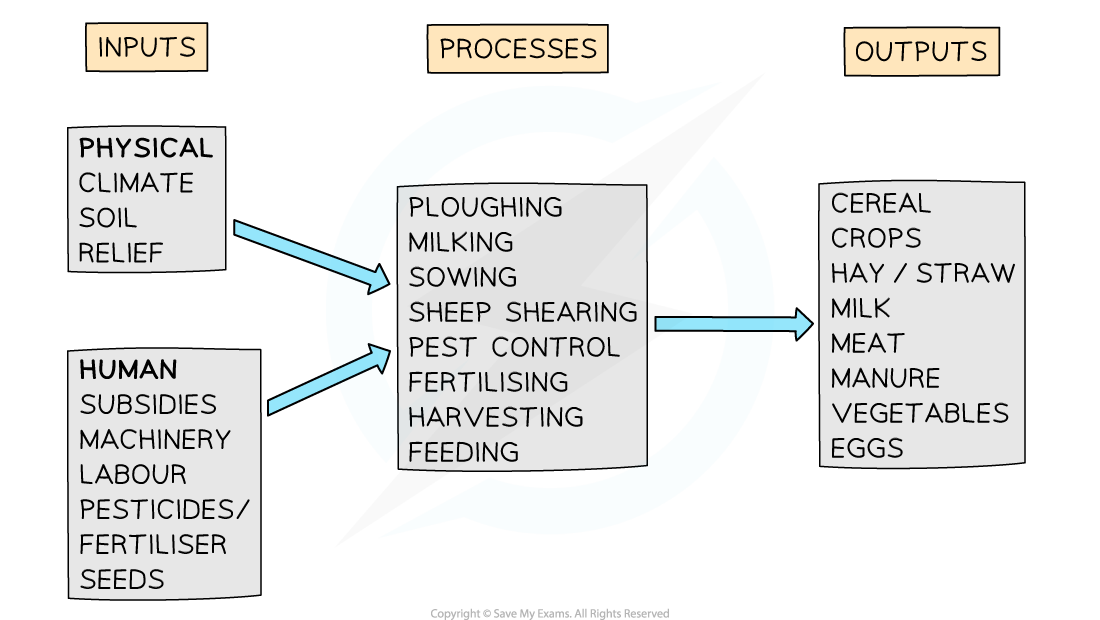
A farming system
Impacts of farming systems
-
All farming systems impact the ecosystem in which they are located
-
Some have more impact than others:
- Monocultures reduce diversity by limiting animals' food access
- Nutrient cycling often depends on natural (manure) or artificial fertilisers
- Ecosystems are modified with inputs of seed, fertiliser, pesticides, herbicides and the use of machines
- Where food webs are reduced, so too is the amount of biomass
Exam Hint Remember, farms do fit into more than one category. For example, a sheep farm in Cumbria. The UK would be categorised as arable, commercial, extensive and sedentary.
Worked Example Insert the following words into the table below to show examples of inputs, processes and outputs of a mixed farm.
[3 marks]
Choose from the words below
milk wheat harvesting ploughing water pesticides
Inputs Processes Outputs Final answer: Answer
Inputs Processes Outputs water harvesting wheat pesticides ploughing milk
Case Study: Sheep Farming
Spec point —
3.2.1· A farm or agricultural system
- There are many examples of farming that can be used in the final exam
- The example below is of sheep farming in Cumbria
Case Study
- The relief of the land in Cumbria limits the type of farming
- Lowland areas are used for cattle grazing and limited amounts of crops
- Sheep farming dominates, with approximately 3 million sheep farmed in the area
- An example of extensive, commercial, pastoral and sedentary farming
Characteristics
Sheep farms usually have three land use zones:
- The fell: these are the hills over 300 m and is used for grazing
- The intake: the lower slopes, which are divided into fields
- The inbye: land close to the farm buildings used to bring the sheep in for lambing and shearing. Some crops may also be grown here for animal feed (turnips/hay)
Inputs
- Inputs can be divided into physical and human
Physical inputs
Climate
- A short growing season means the area is unsuitable for most crops, as well as high rainfall. In many areas over 1500mm
Soils
- In the upland areas' soils are thin and acidic
Relief
- Many steep slopes with large areas of upland
Human inputs
Machinery, fuel and buildings
- Quad bikes and sheds for lambing
Labour
- Low labour requirements. Farms are often worked by one person with additional help when needed
Subsidies
- Without subsidies, many sheep farmers would make a loss
Feed
- Needed for winter months when uplands are snow-covered and grass doesn't provide the nutrients needed
Processes
There are not large numbers of processes on a hill sheep farm, but they do include:
- monitoring the sheep
- lambing
- dipping—to reduce parasites and maggots
- shearing
Outputs
- Lambs are bred for meat and sent for slaughter before they are 1 year old (usually 6-8 months)
- Wool from shearing (this often costs more than the farmer gets for the fleece)
- Mutton—this is meat from sheep over 1 year old
Challenges
- Hill sheep farming is often not profitable, and farmers rely upon subsidies or diversification
- Disease: foot and mouth outbreak. In 2001, nearly 500,000 sheep had to be killed to prevent the further spread of the disease
- Fuel, machinery and feed costs have all increased
- Lamb prices fluctuate depending on the market and this affects income
- Wool prices average about 32p for a kilo; this is less than the cost of shearing the sheep so shearing costs the farmer money
- Fewer people want to become sheep farmers
- Since leaving the EU, the UK is intending to phase out subsidies and replace them with payments for environmental work
Impacts
- Many sheep farmers are diversifying into areas such as campsites and holiday cottages
- Conversion to organic, such as Low Sizergh Farm in South Cumbria, can increase profits as people pay more for organic meat and wool
- Farmers taking on additional jobs and farming part-time
- Changing of breeds to those that shed their fleece and don't require shearing, though this may not be suitable for the upland areas
Was this revision note helpful?
Build on this topic