Tetramethylsilane (TMS) & Deuterated Solvents (Cambridge International A-Level Chemistry)
Use of Tetramethylsilane (TMS)
Spec point —
37.4.3
-
In NMR spectroscopy, tetramethylsilane (TMS) is used as a reference compound
-
The organic compound is dissolved in TMS before being introduced to the magnetic field of the spectrometer
-
It is an ideal chemical to use as a reference
- TMS is inert and volatile
- This reduces undesirable chemical reactions with the compound to be analysed
- It also mixes well with most organic compounds
-
TMS gives a single sharp peak on the NMR spectrum and is given a value of zero
-
The molecular formula of TMS is Si(CH3)4
- There are 12 hydrogens in this molecule
- All of the protons are in the same molecular environment. Therefore gives rise to just one peak
- This peak has a very high intensity as it accounts for the absorption of energy from 12 1H nuclei
The structure of tetramethylsilane

Tetramethylsilane (TMS) – Si(CH3)4
- When peaks are recorded from the sample compound, they are measured and recorded by their shift away from the sharp TMS peak
- This gives rise to the chemical shift values for different 1H environments in a molecule
The 1H NMR spectrum for tetramethylsilane
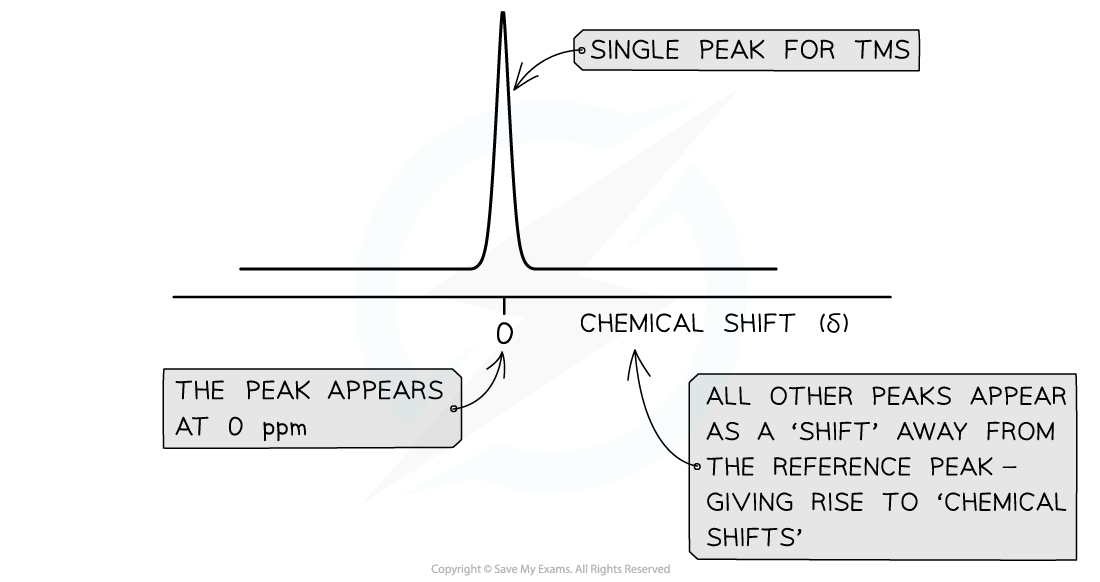
1H NMR spectrum for TMS showing its signal at 0 ppm
Deuterated Solvents in Proton NMR
Spec point —
37.4.4
-
When samples are analysed through NMR spectroscopy, they must be dissolved in a solvent
-
Tetramethylsilane (TMS) is a commonly used solvent in NMR as it gives one sharp reference peak on NMR spectra
-
However, the proton atoms can still interfere with peaks of a sample compound
-
To avoid this interference, solvents containing deuterium can be used instead, e.g. CDCl3
- Deuterium (2H) is an isotope of hydrogen (1H)
-
Deuterium nuclei absorb radio waves in a different region to the protons analysed in organic compounds
-
Therefore, the reference solvent peak will not interfere with those of the sample
Identifying the -OH or -NH signal in an NMR spectrum
-
In ¹H NMR, samples are dissolved in a solvent to help separate molecules and prevent them from interacting
-
The solvent must:
- Be a good solvent for organic molecules
- Not contain any hydrogen (¹H) atoms, so it does not interfere with the NMR signals
Deuterated and non-deuterated solvents
-
Carbon tetrachloride, CCl4:
- This solvent does not contain hydrogen, so it does not produce 1H NMR signals.
- It is suitable for 1H NMR but does not dissolve all molecules well.
-
Deuterated solvents are often used in 1H NMR spectroscopy because deuterium (²H) is an isotope of hydrogen with no nuclear spin, which does not affect NMR results
-
Deuterochloroform / Chloroform-d, CDCl3:
- This is often preferred because it contains deuterium (2H) instead of hydrogen, so it does not interfere with the proton NMR spectrum
-
Deuterium oxide / Heavy water, D2O:
- The deuterium atoms exchange reversibly with the protons in the -OH and -NH groups, allowing these signals to be identified in the NMR spectrum
Identifying -OH and -NH signals
-
Protons in -OH (hydroxyl) and -NH (amine) groups give singlet peaks in ¹H NMR, but these signals can be tricky:
- They are broad or sometimes fall outside normal chemical shift ranges
- The proton in these groups exchanges quickly with protons from water or acids, so only one peak appears
- Their chemical shift ranges may overlap with other types of protons, making them difficult to interpret
-
To identify these groups more clearly, proton exchange with deuterium oxide (D2O) is used:
- The deuterium atoms in D2O exchange reversibly with the protons in the -OH or -NH groups
-OH + D2O ⇌ -OD + HOD
-NH-CO- + D2O ⇌ -ND-CO- + HOD
-
Since deuterium does not absorb in the same region as protons in the NMR spectrum, the signal for -OH or -NH disappears after D2O is added
-
This confirms the presence of -OH or -NH groups in the molecule
- If a peak disappears after adding D2O, it must have been due to the exchange of a proton from an -OH or -NH group
-
This technique is particularly useful because -OH and -NH peaks can be broad and difficult to assign confidently without D2O exchange
Was this revision note helpful?