Hybridisation (Cambridge International A-Level Chemistry)
Orbitals & Hybridisation in Covalent Bonding
Bond overlap in covalent bonds
-
A single covalent bond is formed when two nonmetals combine
-
Each atom that combines has an atomic orbital containing a single unpaired electron
-
When a covalent bond is formed, the atomic orbitals overlap to form a combined orbital containing two electrons
- This new orbital is called the molecular orbital
-
The greater the atomic orbital overlap, the stronger the bond
-
Sigma (σ) bonds are formed by direct overlap of orbitals between the bonding atoms
-
Pi (π) bonds are formed by the sideways overlap of adjacent above and below the σ bond
σ bonds
- Sigma (σ) bonds are formed from the end-on overlap of atomic orbitals
- S orbitals overlap this way as well as p orbitals
Forming sigma bonds
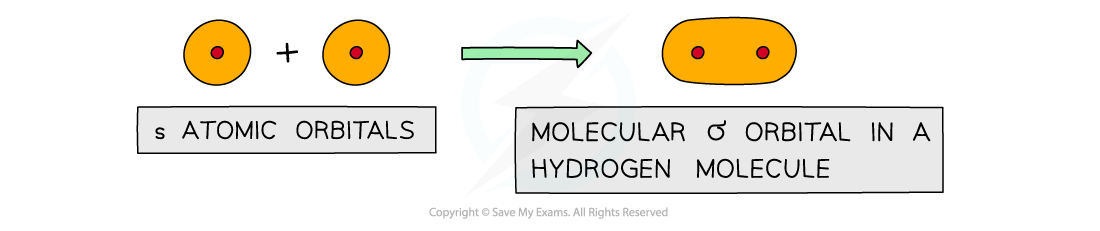
Sigma orbitals can be formed from the end-on overlap of s orbitals
- The electron density in a σ bond is symmetrical about a line joining the nuclei of the atoms forming the bond
- The pair of electrons is found between the nuclei of the two atoms
- There is an electrostatic force of attraction between the electrons and nuclei which bonds the atoms to each other
π bonds
- Pi (π) bonds are formed from the sideways overlap of adjacent p orbitals
- The two lobes that make up the π bond lie above and below the plane of the σ bond
- This maximises the overlap of the p orbitals
- A single π bond is drawn as two electron clouds one arising from each lobe of the p orbitals
- The two clouds of electrons in a π bond represent one bond containing two electrons
Forming pi bonds
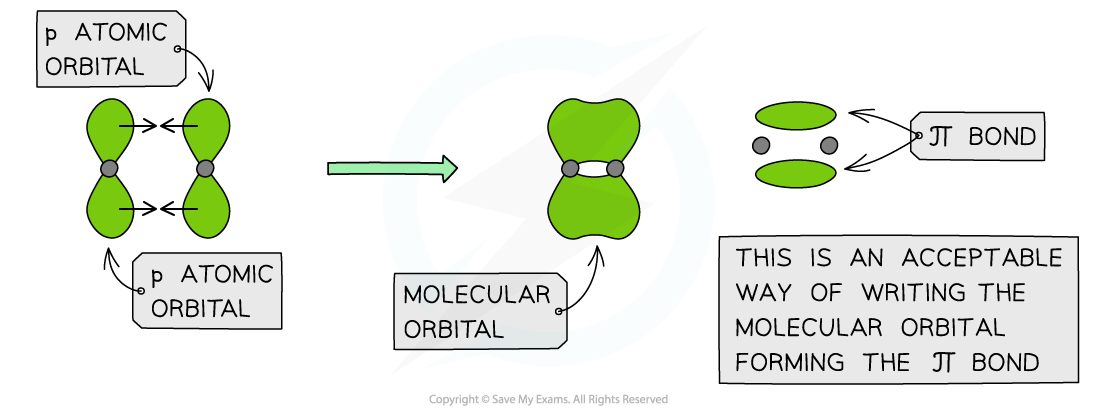
π orbitals can be formed from the end-on overlap of p orbitals
Examples of sigma & pi bonds
-
Hydrogen
- The hydrogen atom has only one s orbital
- The s orbitals of the two hydrogen atoms will overlap to form a σ bond
Sigma bonding in hydrogen
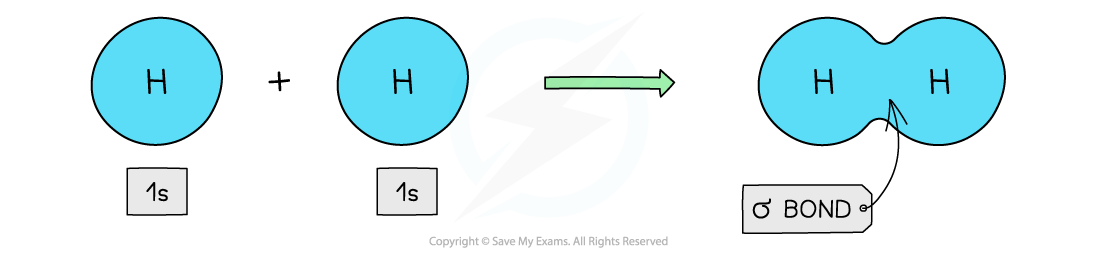
Direct overlap of the 1s orbitals of the hydrogen atoms results in the formation of a σ bond
-
Ethene
- Each carbon atom uses three of its four electrons to form σ bonds
- Two σ bonds are formed with the hydrogen atoms
- One σ bond is formed with the other carbon atom
- The fourth electron from each carbon atom occupies a p orbital which overlaps sideways with another p orbital on the other carbon atom to form a π bond
- This means that the C-C is a double bond: one σ and one π bond
Pi bonding in ethene
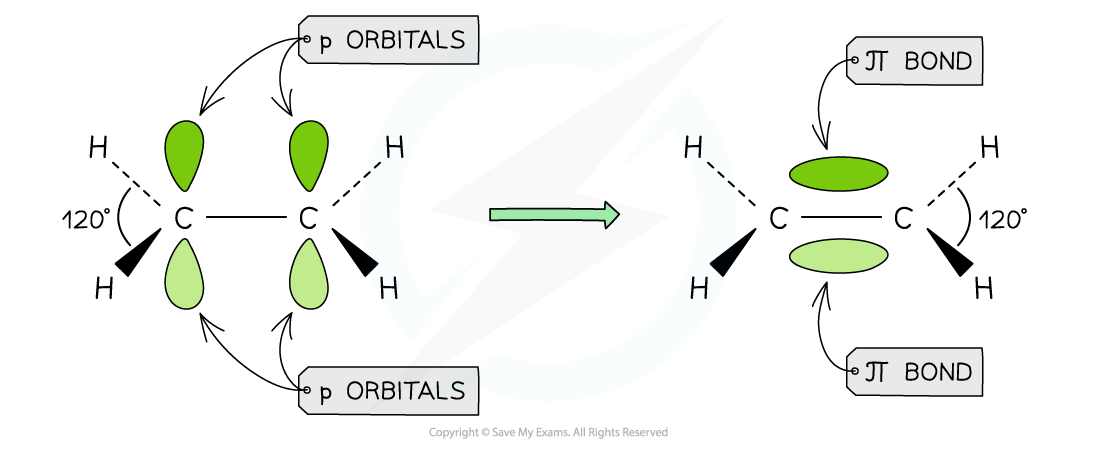
Overlap of the p orbitals results in the forming of a π bond in ethene
Sigma and pi bonding in ethene
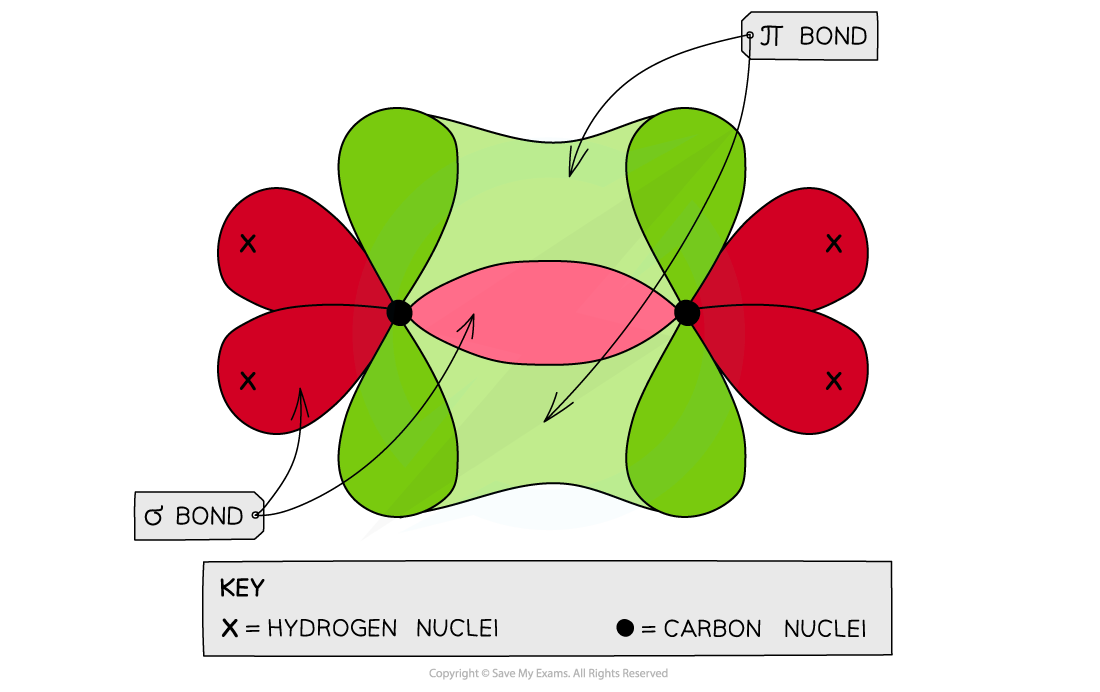
Each carbon atom in ethene forms two sigma bonds with hydrogen atoms and one σ bond with another carbon atom. The fourth electron is used to form a π bond between the two carbon atoms
-
Ethyne
- This molecule contains a triple bond formed from two π bonds(at right angles to each other) and one σ bond
- Each carbon atom uses two of its four electrons to form σ bonds
- One σ bond is formed with the hydrogen atom
- One σ bond is formed with the other carbon atom
- Two electrons are used to form two π bonds with the other carbon atom
Sigma and pi bonding in ethyne
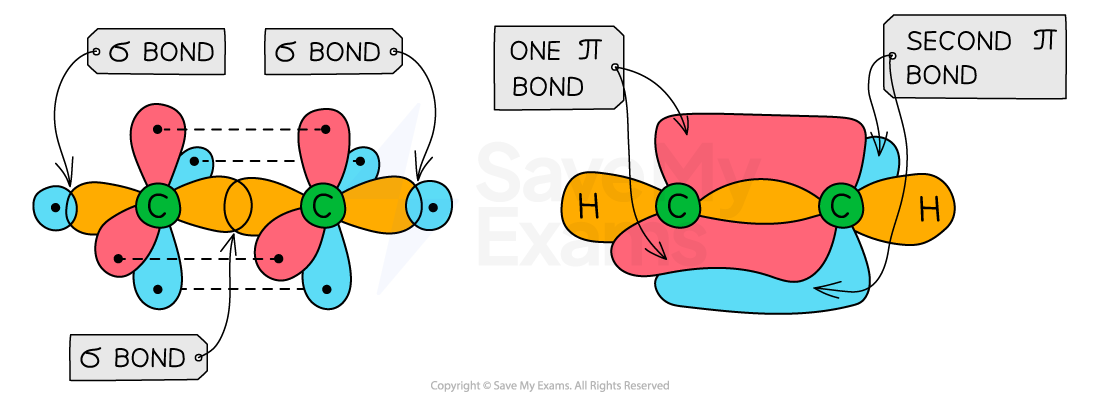
Ethyne has a triple bond formed from two π bonds and one σ bond between the two carbon atoms
-
Hydrogen cyanide
- Hydrogen cyanide contains a triple bond
- One σ bond is formed between the H and C atom (overlap of an sp C hybridised orbital with the 1s H orbital)
- A second σ bond is formed between the C and N atom (overlap of an sp C hybridised orbital with an sp orbital of N)
- The remaining two sets of p orbitals of nitrogen and carbon will overlap to form two π bonds at right angles to each other
Sigma and pi bonding in hydrogen cyanide
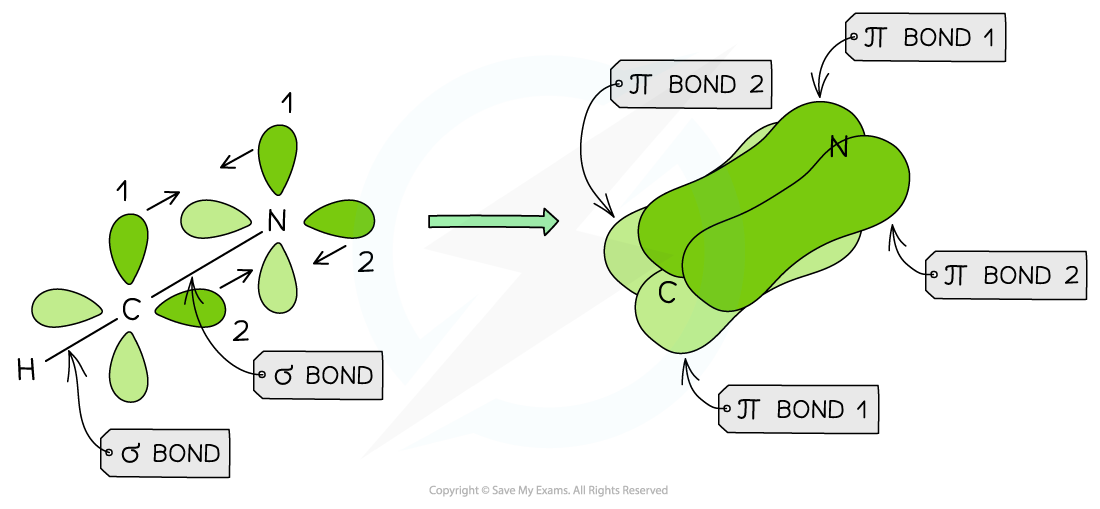
Hydrogen cyanide has a triple bond formed from the overlap of two sets of p orbitals of nitrogen and carbon and the overlap of an sp hybridised carbon orbital and a p orbital on the nitrogen
-
Nitrogen
- Nitrogen too contains a triple bond
- The triple bond is formed from the overlap of the sp orbitals on each N to form a σ bond and the overlap of two sets of p orbitals on the nitrogen atoms to form two π bonds
- These π bonds are at right angles to each other
Sigma and pi bonding in nitrogen molecules
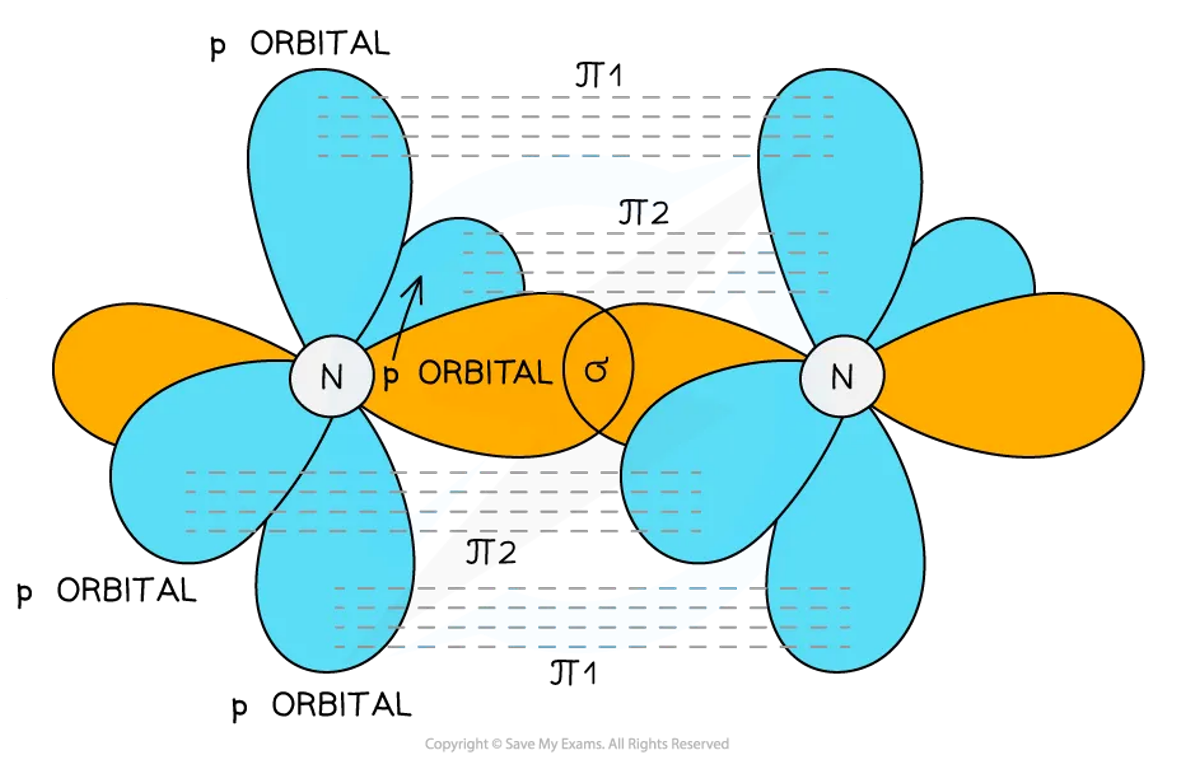
The triple bond is formed from two π bonds and one σ bond
Hybridisation
- The p atomic orbitals can also overlap end-on to form σ bonds
- In order for them to do this, they first need to become modified in order to gain s orbital character
- The orbitals are therefore slightly changed in shape to make one of the p orbital lobes bigger
- This mixing of atomic orbitals to form covalent bonds is called hybridisation
What is sp3 hybridisation?
-
One s orbital and three p orbitals from the same shell mix to form four sp3hybrid orbitals
-
These hybrid orbitals have ¼ s character and ¾ p character
- These orbitals are asymmetric, with a larger lobe similar in shape to a p orbital
-
The four sp3 orbitals arrange themselves with tetrahedral geometry
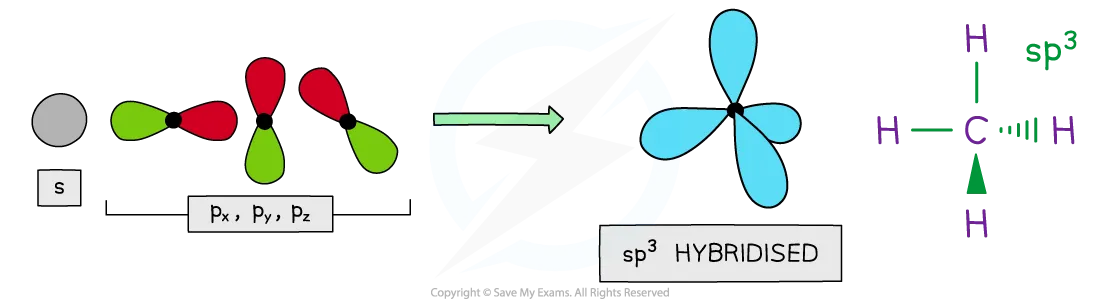
4 x sp³ hybrid orbitals are formed from one s orbital and three p orbitals
-
This hybridisation explains the bonding and shape in molecules like methane and ammonia
-
Methane, CH4:
-
The carbon atom forms four single covalent bonds
-
Each carbon sp3 hybrid orbital overlaps head-on with a hydrogen 1s orbital
-
This results in:
- Four identical sigma bonds
- Tetrahedral electron domain geometry
- Tetrahedral molecular geometry
- A 109.5° bond angle
-
-
Hybrid orbitals can accommodate both bonding pairs and lone pairs of electrons
-
Ammonia, NH3:
-
The nitrogen atom forms three single covalent bonds
-
Each nitrogen has three bonding pairs and one lone pair in sp3 hybrid orbitals
-
This results in:
- Three identical sigma bonds and one lone pair
- Tetrahedral electron domain geometry
- Trigonal pyramidal molecular geometry
- A 107° bond angle
-
What is sp2 hybridisation?
-
One s orbital and two p orbitals from the same shell mix to form three sp2hybrid orbitals
-
These hybrid orbitals have ⅓ s character and ⅔ p character
- These orbitals are asymmetric, with a larger lobe similar in shape to a p orbital
-
The three sp2 orbitals arrange themselves with trigonal planar geometry
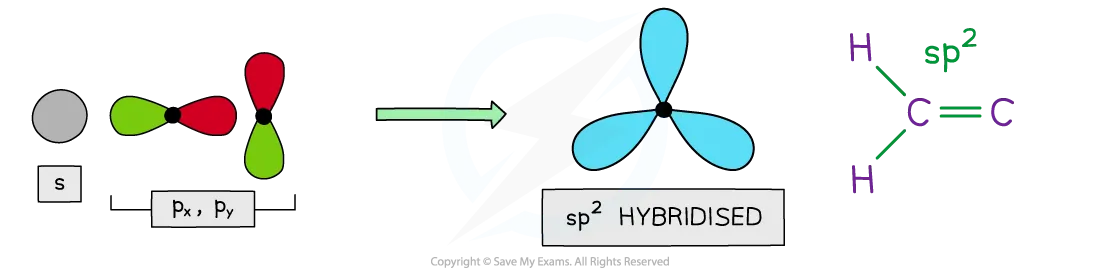
3 x sp2 hybrid orbitals are formed from one s orbital and two p orbitals
-
This explains the bonding and geometry seen when carbon forms a double bond, such as in alkenes
-
Ethene:
-
Each carbon atom forms three sigma bonds and one pi bond
-
The carbon atoms are sp² hybridised
-
Each carbon uses three sp² orbitals to form σ bonds:
- Two with hydrogen atoms
- One with the other carbon
-
One unhybridised p orbital to form a π bond with the other carbon
-
This results in:
- One C=C double bond containing 1 σ and 1 π bond
- Trigonal planar electron domain geometry
- Trigonal planar molecular geometry
- A 120° bond angle around each carbon
-
-
This bonding arrangement also occurs in carbonyl groups, where both carbon and oxygen use sp2 hybrid orbitals to form the double bond
What is sp hybridisation?
-
One s orbital and one p orbital from the same shell mix to form two sp hybrid orbitals
-
These hybrid orbitals have ½ s character and ½ p character
- These orbitals are asymmetric, with a larger lobe similar in shape to a p orbital
-
The two sp orbitals arrange themselves with linear geometry

2 sp hybrid orbitals are formed from one s orbital and one p orbital
-
This explains the bonding and geometry seen when carbon forms a triple bond, such as in alkynes
-
Ethyne:
-
Each carbon atom forms two sigma bonds and two pi bonds
-
The carbon atoms are sp hybridised
-
Each carbon uses two sp orbitals to form σ bonds:
- One with hydrogen
- One with the other carbon
-
Two unhybridised p orbitals form two π bonds with the other carbon
-
This results in:
- One CC triple bond containing 1 σ and 2 perpendicular π bonds
- Linear electron domain geometry
- Linear molecular geometry
- A 180° bond angle around each carbon
-
Exam Hint Carbon forms four bonds. The type of bond depends on how many p orbitals are used in hybridisation:
sp3
- 4 - 3 = 1
- So, the carbon atom forms single bonds
sp2
- 4 - 2 = 2
- So, the carbon atom forms a double bond
sp
- 4 - 1 = 3
- So, the carbon atom forms a triple bond
This page focuses on carbon (a second-period element), but hybridisation also occurs in third-period elements like phosphorus and sulfur.
- These atoms use 3s and 3p orbitals
- They may also use 3d orbitals when forming expanded octets
Was this revision note helpful?
Build on this topic