Price Elasticity of Demand (PED) (Edexcel IGCSE Economics)
The Definition & Calculation of PED
Spec point —
1.1.4a
-
The law of demand states that when there is an increase in price, there will be a fall in the quantity demanded
- Economists are interested by how much the quantity demanded will fall
-
Price elasticity of demand reveals how responsive the change in quantity demanded is to a change in price
- The responsiveness is different for different types of products
Calculation of PED
- PED can be calculated using the following formula
- To calculate a % change, use the following formula
Worked Example A firm raises the price of its products from $10 to $15. Its sales fall from 100 to 40 units per day. Calculate the PED of its products
Step 1: Calculate the % change in QD
****$% \Delta \text{QD} = \frac{40 - 100}{100} \times 100
% \Delta \text{QD} = - 60 %$****
Step 2: Calculate the % change in P
$% \Delta \mathrm{P} = \frac{15 - 10}{10} \mathrm{x} 100
% \Delta \mathrm{P} = 50 %$
Step 3: Insert the above values in the PED formula
$\text{PED} = \frac{% \Delta \text{in} QD}{% \Delta \text{in} \mathrm{P} }
\text{PED} = \frac{- 60}{ 50}
\text{PED} = - 1.2 $
Step 4: Final answer = 1.2
The PED value will always be negative so economists ignore the sign and present the answer as 1.2
Exam Hint When doing elasticity calculations, make sure that your final answer is not expressed as a percentage.
You may be asked to state the formula for PED
Interpreting PED Values
Spec point —
1.1.4e
The Classification of PED Values
| Value and Name | Explanation | Diagram |
|---|---|---|
| 0 Perfectly inelastic | - The QD is completely unresponsive to a change in P (very theoretical value e.g. heart transplant is extremely inelastic but possibly not perfectly) | |
| 0 →1 Relatively Inelastic | - The %∆ in QD is less than proportional to the %∆ in P (e.g. addictive products) | 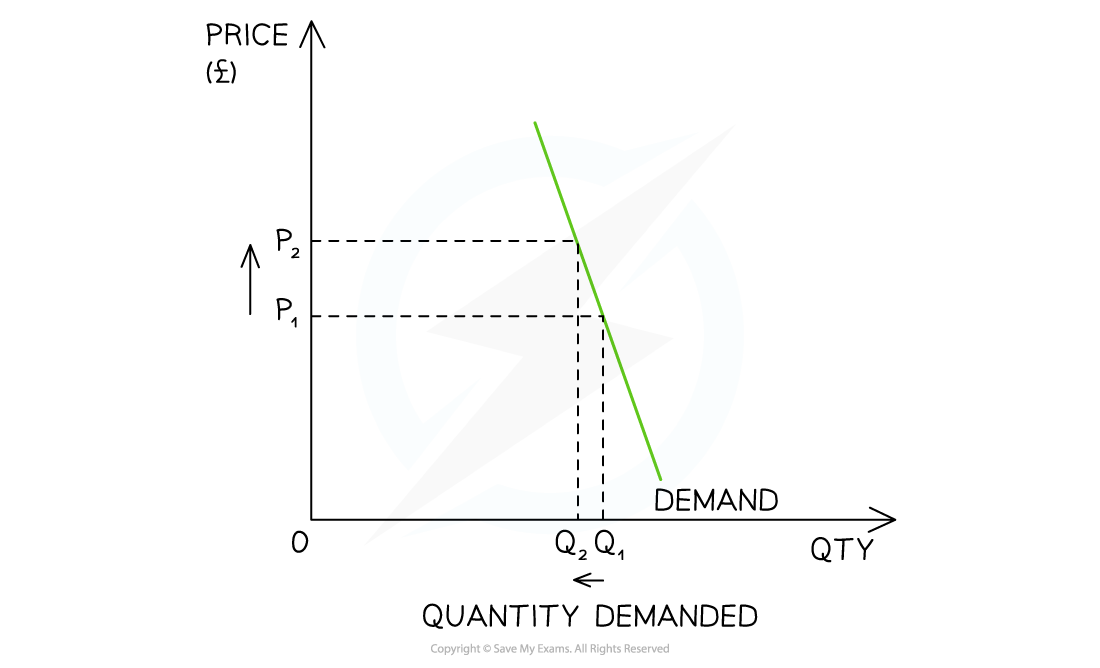 |
| 1 Unitary Elasticity | - The % ∆ in QD is exactly equal to the %∆ in P | 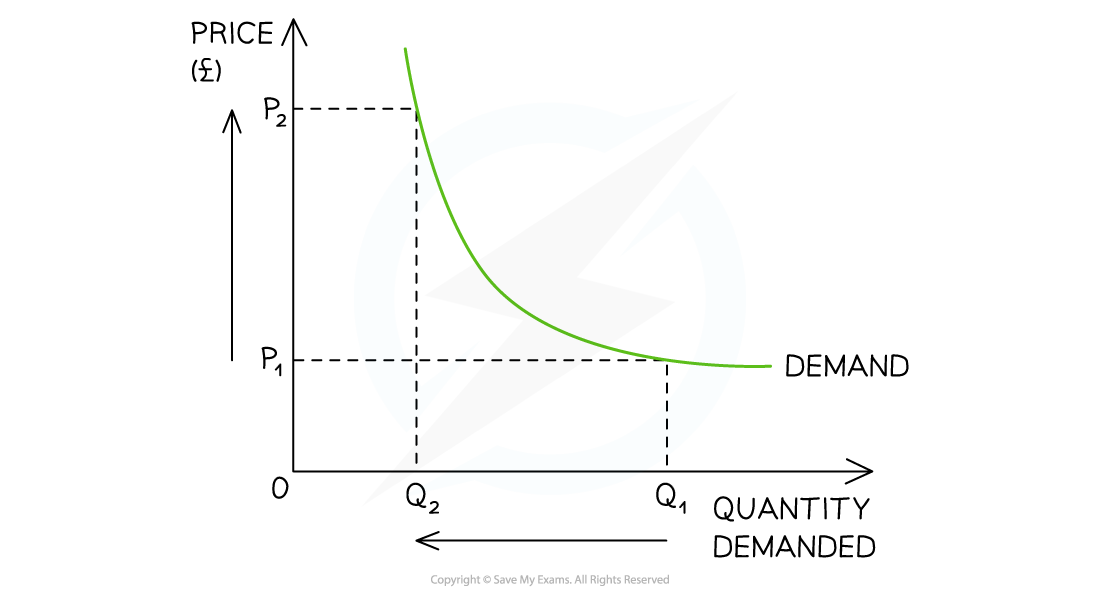 |
| 1 → ∞ Relatively Elastic | - The %∆ in QD is more than proportional to the %∆ in P (e.g. luxury products) | 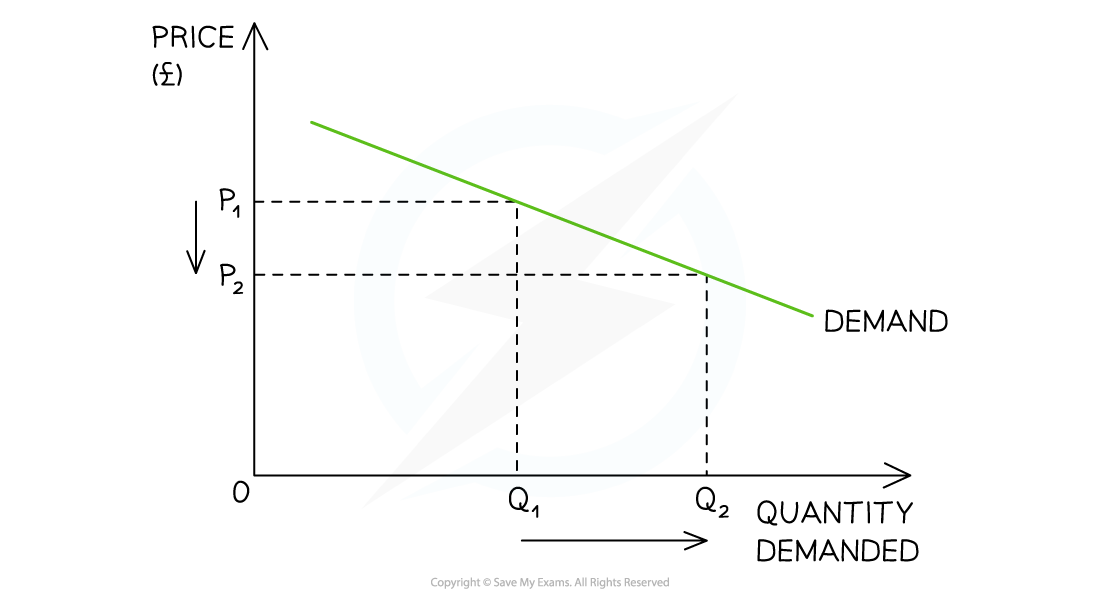 |
| ∞ Perfectly Elastic | - The %∆ in QD will fall to zero with any %∆ in P (highly theoretical elasticity) | 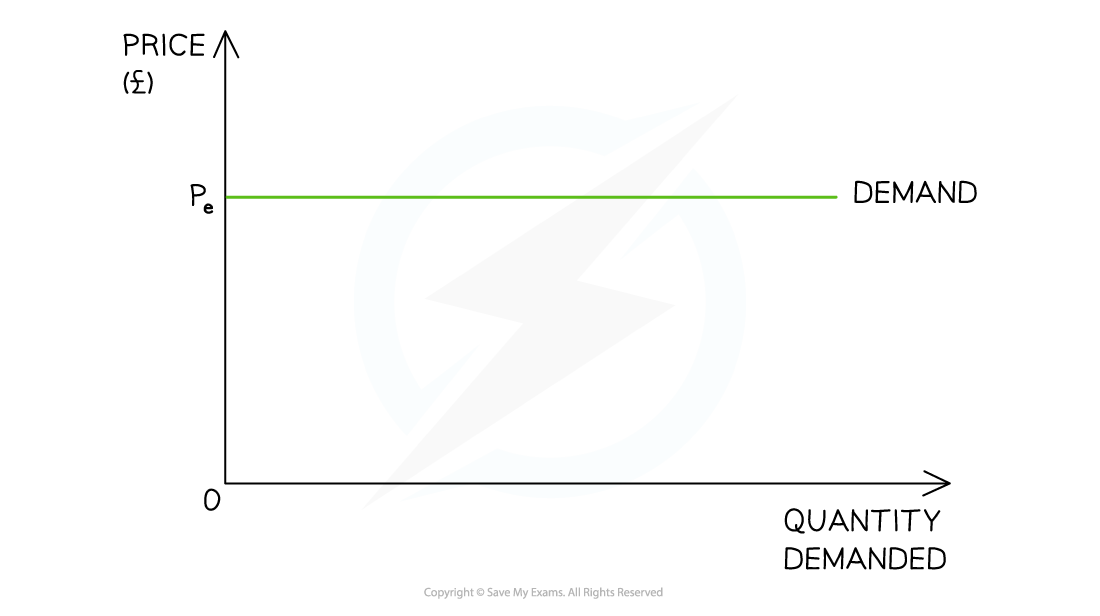 |
Was this revision note helpful?
Build on this topic