Government Intervention: Labour Market (Edexcel IGCSE Economics)
Reasons for a National Minimum Wage
Spec point —
1.2.6d
-
Government's often intervene in the labour market by setting a minimum wage
-
A minimum wage is a legally imposed wage level that employers must pay their workers
- It is set above the market rate
- The minimum wage/hour often varies based on age
-
The aim is to improve equity and avoid the exploitation of workers
-
It protects low income earners as it ensures workers receive a fair wage, supporting their basic needs
-
This protection is likely to impact workers in lower-paid sectors
- These sectors include retail, hospitality and agriculture industries
-
-
A higher minimum wage can act as an incentive for workers to supply labour
- More workers are prepared to supply themselves to the market for work
- Workers may have improved productivity as they feel more motivated to work with higher wages
National Minimum Wage Diagram
Spec point —
1.2.6d
-
Australia set the national minimum wage at $23.23 per hour in 2024
- This is above the market wage rate
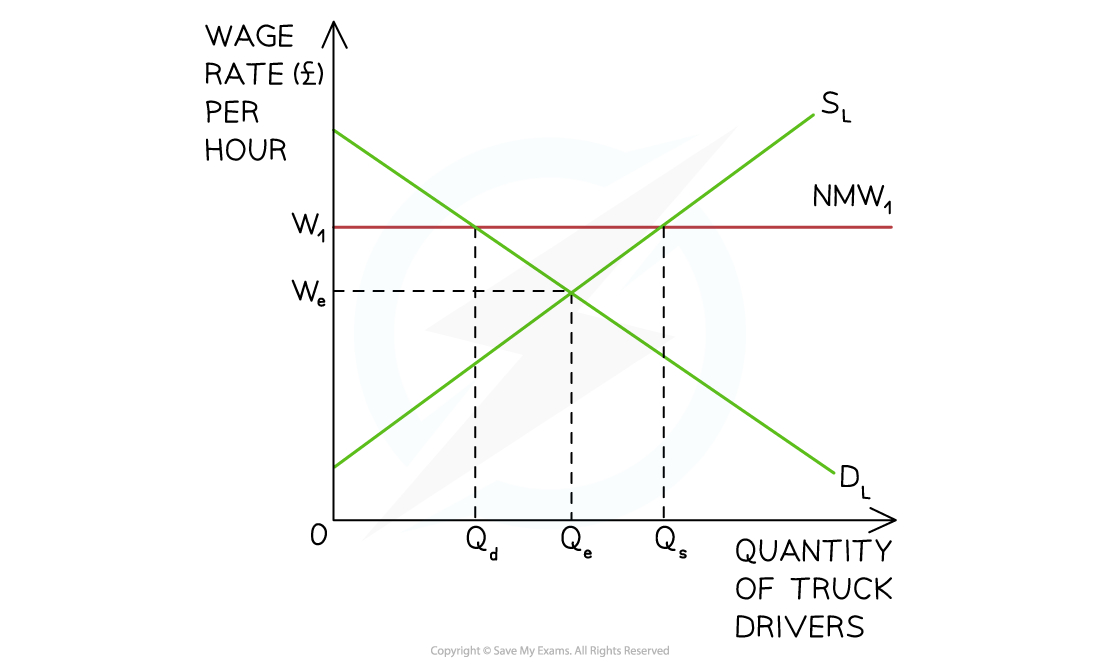
A national minimum wage (NMW1) is imposed above the market wage rate (We) at W1
Diagram analysis
- The market equilibrium wage and quantity for truck drivers in Australia is at WeQe
- The government imposes a national minimum wage (NMW) at W1
- Incentivised by higher wages, the supply of labour increases from Qe to Qs
- Facing higher production costs, the demand for labour by firms **decreases **from Qe to Qd
- This means that at a wage rate of W1 there is** excess supply of labour** and the potential for unemployment is equal to QdQs
Increasing the minimum wage level
- Should a country decide to increase the minimum wage, it will further distort the market, resulting in an increase in the excess supply of labour
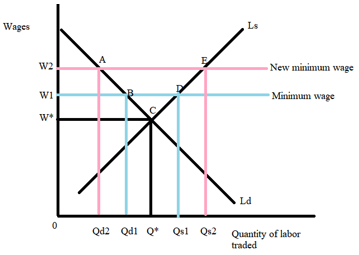
The initial excess supply was equal to BD. The new minimum wage is higher and increases the excess supply to AE
Diagram analysis
-
With the original minimum wage set at W1, the excess supply of labour in the market is equal to Qs1-Qd1
-
An increase in the minimum wage to W2 has the following effects:
- The quantity of labour demanded by firms contracts from Qd1to Qd2
- The quantity of labour supplied by workers extends from Qs1to Qs2
- There is an even greater excess supply of labour (unemployment) equal to Qs2-Qd2
Evaluation of a National Minimum Wage
Spec point —
1.2.6d
- A minimum wage can be controversial, as it has different impacts on stakeholders
Evaluating the use of minimum wages
| Advantages | Disadvantages |
|---|---|
| - Guarantees a minimum income for the lowest paid workers - Higher income levels help to increase consumption in the economy - May incentivise workers to be more productive - The increase in productivity may allow the firms to offset the increase in wages - The overall standard of living in the economy may improve | - Raises the costs of production for firms that may respond by raising the price of goods and services - If firms are unable to raise their prices, the introduction of a minimum wage may force them to lay off some workers, increasing unemployment - If unemployment increases, then government tax revenues will fall(and benefit payments will increase) |
Exam Hint When evaluating the use of minimum wages, do not assume that they will automatically increase unemployment. Question that assumption.
Many studies have shown that unemployment does not increase, and in some instances, employment increases. This is because some workers are receiving higher wages and choosing to consume more. This increases total demand in the economy, which in turn increases the demand for labour by firms, thus reducing/eliminating any potential unemployment.
Was this revision note helpful?
Build on this topic