Monetary Policy (Edexcel IGCSE Economics)
An Overview of Monetary Policy
Spec point —
2.1.2b
-
Monetary policy involves adjusting the the central bank's interest rate and the money supply in order to influence the total demand in an economy
- If businesses and households borrow money, they must pay it back plus interest, so in effect the price of borrowing money is the interest paid
- The money supply is the amount of money in circulation in an economy at any given moment in time
- It consists of coins, banknotes, bank deposits and central bank reserves
-
Central Banks are usually responsible for setting monetary policy
- Central Bank committees usually meet 4-8 times a year to set policy
- In an economic crisis, the committee may sit more frequently
The Role of the Central Bank
Spec point —
2.1.2b
- Central Banks play a vital role in maintaining stability in the financial system. Additionally, the policy tools at their disposal help to meet Government economic objectives and create economic growth
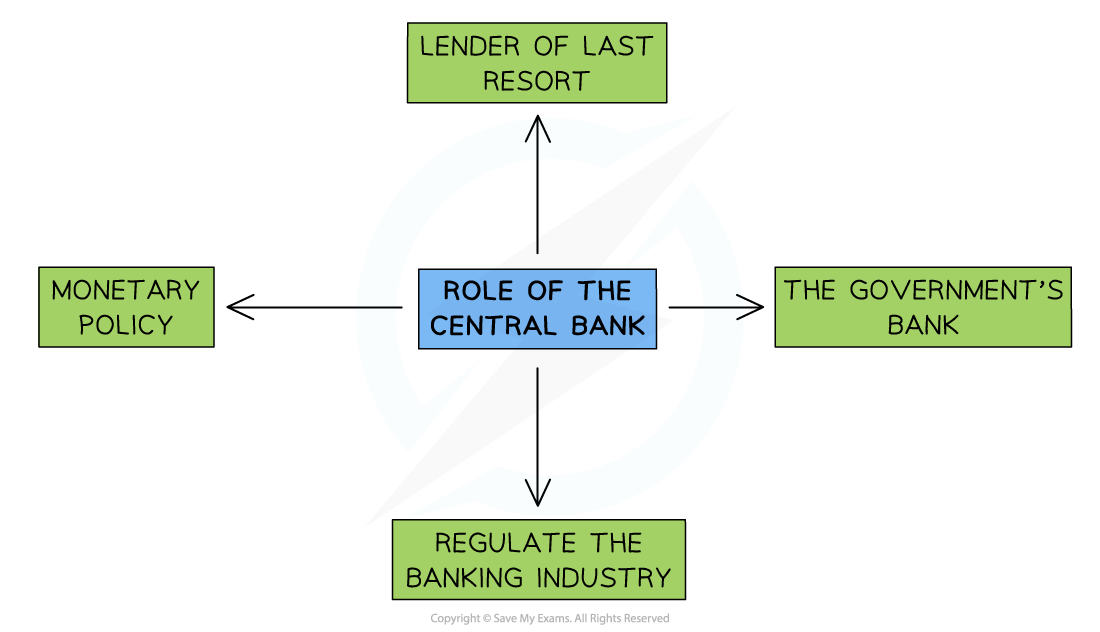
Central Banks play four important roles in the economy
- Implementation of monetary policy This is more fully explained in Sub-topic 4.4.1
- Banker to the government The Government sets the annual budget but it is the Central Bank that manages the tax receipts and payments. In 2022 there were 5.7 million public sector workers in the UK who had to be paid by the Central Bank each month
- Banker to the banks—lender of last resort Commercial banks are able to borrow from the Central Bank when they run into short-term liquidity issues. Without this help, they might go bankrupt leading to instability in the financial system and a potential loss of savings for many households
- Regulation of the banking industry The high level of asymmetric information in financial markets requires that commercial banks be regulated in order to protect consumers
Interest & the Base Rate
Spec point —
2.1.2b
Interest and the Base Rate
-
Interest is the cost of borrowing money or the reward received for saving money
-
The interest rate is the percentage charged for borrowing money or the percentage offered for saving money
- E.g. DBS bank in Singapore offers an interest rate of 3% on savings
-
The base rate(also know as the bank rate) is the interest rate at which the Central Bank lends money to commercial banks such as HSBC or Lloyds Bank
-
Commercial Banks use the base rate as the baseline for interest rates offered to their customers
-
E.g. If the base rate set by the Central Bank is 2%, then DBS will borrow money from the Central Bank at 2% and lend it to customers at 3%
- This allows DBS to make a profit of 1% on the transaction
-
-
Central Banks usually have a special committee that meets regularly to decide if the base rate should be modified
-
The Monetary Policy Committee (MPC) under the Bank of England (UK Central Bank) is responsible for setting monetary policy
-
It meets roughly eight times a year to set policy and consists of nine members
-
The single most important consideration in their deliberations is the inflation target rate of 2% CPI
-
At this meeting, they each vote to set the central base rate
- A majority vote decides the policy
- Some effects of the decision are immediate, for example, some mortgage rates are usually adjusted in line with changes of the base rate on the same day
- It can take up to two years for the full effects of interest rate changes to be seen throughout in the economy
-
Was this revision note helpful?
Build on this topic