Catalysts (Edexcel IGCSE Chemistry)
Guided lessons are live for this note
Work through it step by step — key points, depth layers, a worked example and self-checks.
Catalysts & Rates
Spec point — know that a catalyst is a substance that increases the rate of a reaction, but is chemically unchanged at the end of the reaction know that a catalyst works by providing an alternative pathway with lower activation energy
The effect of a catalyst on rate of reaction
-
Catalysts are substances which speed up the rate of a reaction without themselves being altered or consumed in the reaction
- Normally only small amounts of catalysts are needed to have an effect on a reaction
- The mass of a catalyst at the beginning and end of a reaction is the same
-
Catalysts do not form part of the chemical equation but they are sometimes seen above or below the reaction arrow:
N2 (g) + 3H2 (g) rightwards harpoon over leftwards harpoon from 450 space degree straight C comma space 200 space atm to iron space catalyst of 2NH3 (g)
SO2 (g) + O2 (g) → from straight V_ 2 straight O_ 5 catalyst to 450 degree straight C of SO3 (g)
-
Different processes require different types of catalysts but they all work on the same principle:
- They provide an alternative pathway for the reaction to occur
- The alternative pathway has a lower activation energy
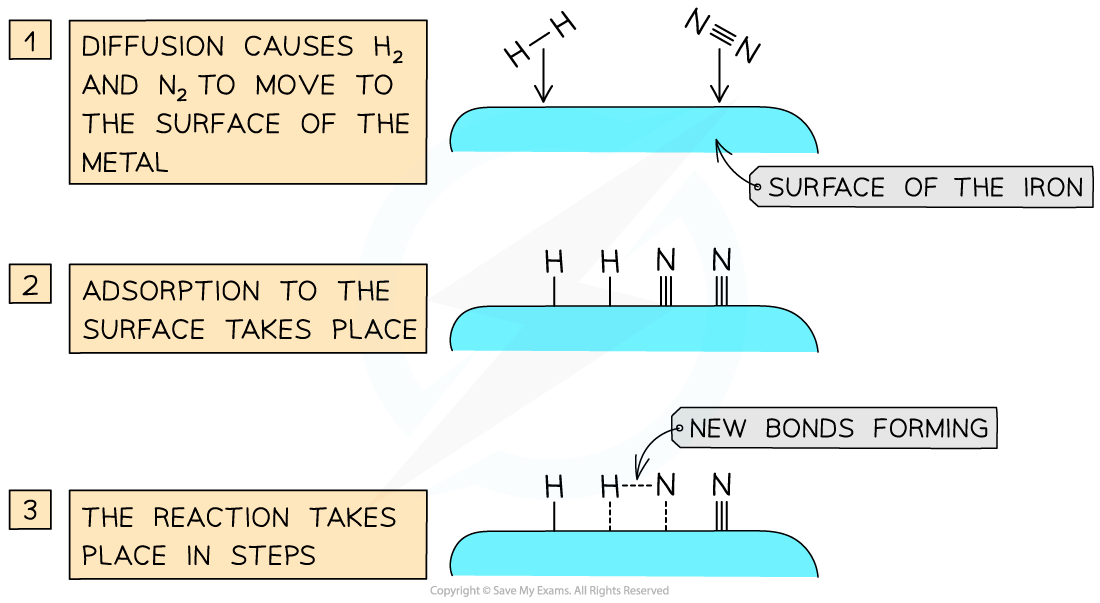
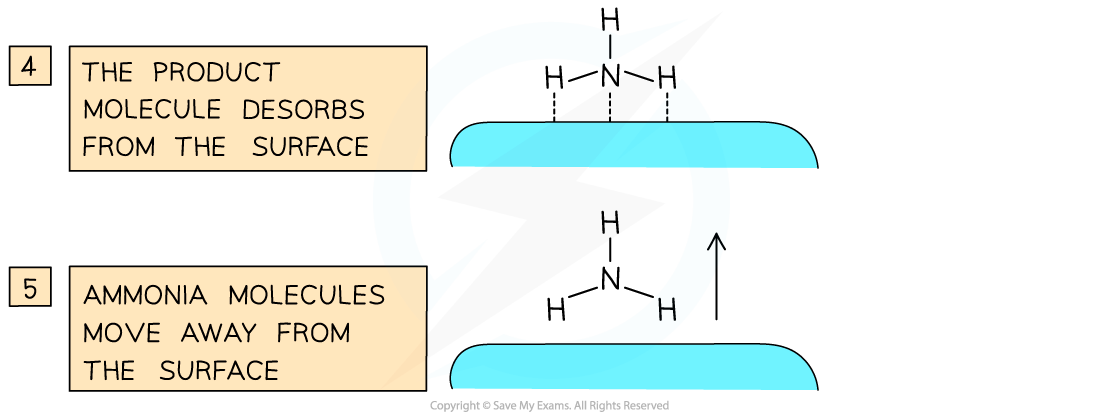
Catalysts work by attracting reactant molecules on to the surface and so providing an alternate reaction pathway of lower energy
-
Catalysis is a very important branch of chemistry in commercial terms as catalysts increase the rate of reaction (hence the production rate) and they reduce energy costs
-
The transition metals are used widely as catalysts as they have variable oxidation states allowing them to readily donate and accept different numbers of electrons
- This is key to their catalytic activity
-
Enzymes act as catalysts in biological systems
Exam Hint The effect of a catalyst on activation energy can be shown on a reaction profile.
Was this revision note helpful?
Build on this topic