Solubility (Edexcel IGCSE Chemistry)
Guided lessons are live for this note
Work through it step by step — key points, depth layers, a worked example and self-checks.
Spec point — know what is meant by the term solubility in the units g per 100 g of solvent
Solubility
-
Solubility is a measurement of how much of a substance will dissolve in a given volume of a liquid
- The liquid is called the solvent
- The solubility of a gas depends on pressure and temperature
-
Different substances have different solubilities
-
Solubility can be expressed in g per 100 g of solvent
-
Solubility of solids is affected by temperature
- As temperature increases, solids usually become more soluble
-
Solubility of gases is affected by temperature and pressure; in general:
- As pressure increases, gases become more soluble
- As temperature increases, gases become less soluble
Solubility Curves
Spec point — understand how to plot and interpret solubility curves
- Solubility graphs or curves represent solubility in g per 100 g of water plotted against temperature
- To plot a solubility curve, the maximum mass of solute that can be dissolved in 100 g of water before a saturated solution is formed, is determined at a series of different temperatures
Solubility curve for three salts
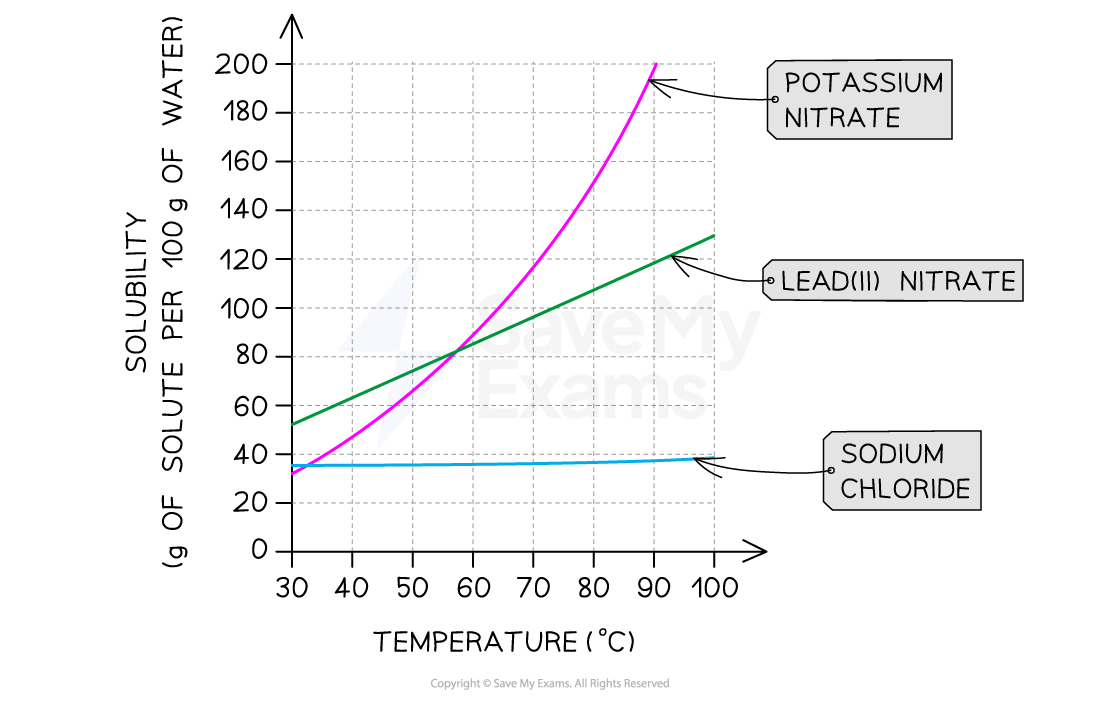
While most salts become more soluble as temperature increases, sodium chloride (common salt) shows very little change.
Worked Example Use the solubility curve to answer these questions:
- Determine how much potassium nitrate will dissolve in 20 g of water at 50 °C?
- 200 cm3 of saturated lead(II) nitrate solution was prepared at a temperature of 90 °C. What mass of lead(II) nitrate crystals form if the solution was cooled to 40 °C?
Answers:
- At 50 °C, the solubility of potassium nitrate is 68 g per 100 g of water So scaling, 68 x (20 / 100) = 13.6 g of potassium nitrate will dissolve in 20 g of water
- Solubility of lead(II) nitrate at 90 oC is 118 g / 100 g water, and 64 g / 100 g water at 40 °C. Therefore for mass of crystals formed = 118 – 64 = 54 g (for 100 cm3 of solution). However, 200 cm3 of solution was prepared, So total mass of lead(II) nitrate crystallised = 2 x 54 = 108 g
Exam Hint As temperature increases, solids usually become more soluble and gases become less soluble.
Was this revision note helpful?
Build on this topic