Acids, Alkalis & Neutralisation (Edexcel IGCSE Chemistry)
Guided lessons are live for this note
Work through it step by step — key points, depth layers, a worked example and self-checks.
Acids & Alkalis
Spec point — know that acids in aqueous solution are a source of hydrogen ions and alkalis in a aqueous solution are a source of hydroxide ions
-
When acids are added to water, they form positively charged hydrogen ions (H+)
- The presence of H+ ions is what makes a solution acidic
-
When alkalis are added to water, they form negative hydroxide ions (OH–)
- The presence of the OH– ions is what makes the aqueous solution an alkali
-
The pH scale is a numerical scale which is used to show how acidic or alkaline a solution is
- It is a measure of the amount of the hydrogen ions present in solution
Neutralisation
Spec point — know that alkalis can neutralise acids
-
A neutralisation reaction occurs when an acid reacts with an alkali
-
When these substances react together in a neutralisation reaction, the H+ ions react with the OH– ions to produce water
-
Not all reactions of acids are neutralisations
- For example when a metal reacts with an acid, although a salt is produced there is no water formed so it does not fit the definition of neutralisation
-
For example, when hydrochloric acid is neutralised a sodium chloride and water are produced:
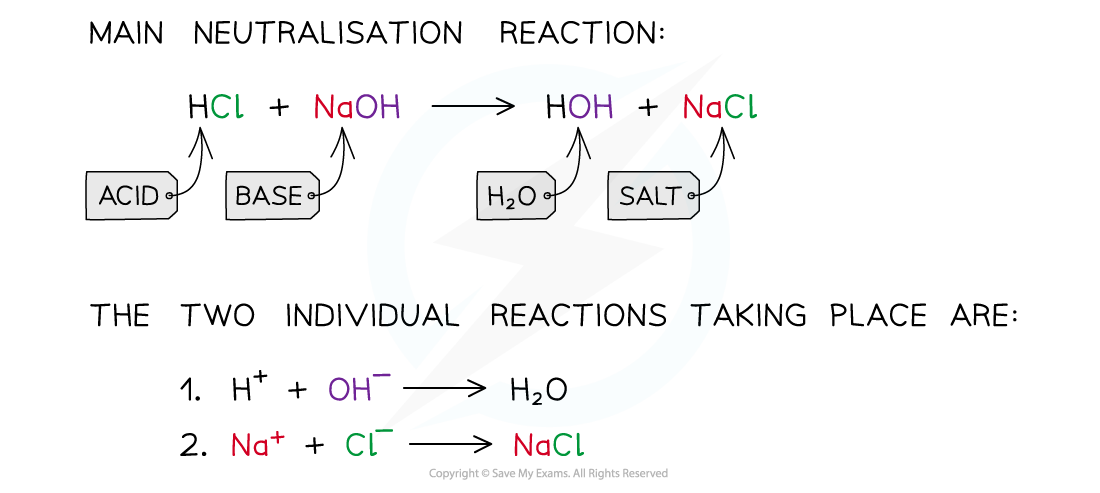
- The net ionic equation of all acid-base neutralisations and is what leads to a neutral solution, since water has a pH of 7:
H+ (aq)****+ OH– (aq)⟶ H2O (l)
-
Neutralisation is very important in the treatment of soils to raise the pH as some crops cannot tolerate pH levels below 7
- This is achieved by adding bases to the soil such as limestone and quicklime
Exam Hint Not all reactions of acids are neutralisations. For example, when a metal reacts with an acid, although a salt is produced there is no water formed so it does not fit the definition of neutralization.
Was this revision note helpful?