Group 1: Reactivity & Electronic Configurations (Edexcel IGCSE Chemistry)
Guided lessons are live for this note
Work through it step by step — key points, depth layers, a worked example and self-checks.
Spec point — explain the trend in reactivity in Group 1 in terms of electronic configurations
Electronic configuration of Group 1 elements
-
The reactivity of the Group 1 metals increases as you go down the group
-
When a Group 1 element reacts its atoms only need to lose electron, as there is only 1 electron in the outer shell
- When this happens, 1+ ions are formed
-
The next shell down automatically becomes the outermost shell and since it is already full, a Group 1 ion obtains noble gas configuration
-
As you go down Group 1, the number of shells of electrons increases by 1
- This means that the outermost electron gets further away from the nucleus, so there are weaker forces of attraction between the outermost electron and the nucleus
- Less energy is required to overcome the force of attraction as it gets weaker, so the outer electron is lost more easily
- So, the alkali metals get more reactive as you descend the group
Electronic configuration of Group 1 elements
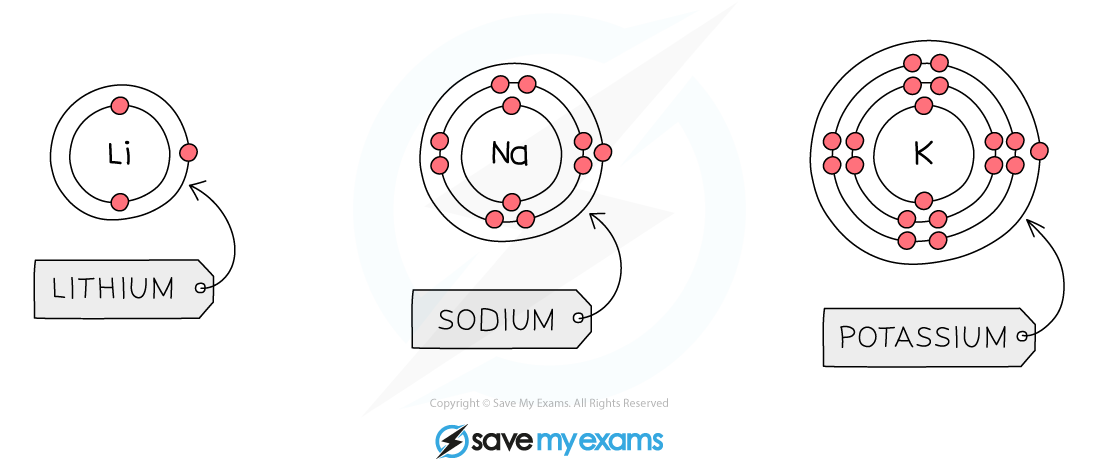
These electron shell diagrams of the first 3 alkali metals show that the Group 1 metals have 1 electron in their outer shell
Exam Hint In your exams, you could be asked to explain the trend in reactivity of the alkali metals - make sure you answer this question using their electronic configuration to support your answer.
Was this revision note helpful?