Moles, Mass & RFM
2 guided lessons · 18 checks · 1. Principles of Chemistry → Chemical Formulae, Equations, Calculations
Guided lessons for this note
Which concept don't you understand yet?
We'll explain it simply and check your understanding. Pick any lesson — any order works.
0 of 18 checks correct so far
Lesson 1 of 2
The Mole
Bundles make counting practical. Paper is sold in reams and eggs in dozens, and chemists bundle particles in the same spirit: one mole is a fixed count of particles, 6.02 × 10^23 of them. Because every mole holds the same count, one mole of different substances generally has a different mass — a value called the molar mass.
What you know already
You already met relative atomic mass (Ar) in Atomic Structure, where it compares the mass of an atom with the carbon-12 scale. You can also write formulae such as H2O and NaCl and add atomic masses to find a compound's relative formula mass. This note adds the mole, the bridge between the masses you can weigh and the numbers of particles that react.
Key points of understanding
- Chemical amounts are counted in moles, and the mole (mol) is the accepted unit of amount of substance.
- Equal amounts in moles contain equal numbers of particles, whatever the substance.
- The number of particles in one mole is the Avogadro constant, 6.02 × 10^23 per mole.
- The mass of one mole is the molar mass: for an element it matches the relative atomic mass in grams.
- For a compound, the molar mass matches the relative formula mass in grams, found by adding the atomic masses together.
Choose a confidence level to continue.
Prefer to read it all at once? Show the full lesson as a page
1.The Mole
Bundles make counting practical. Paper is sold in reams and eggs in dozens, and chemists bundle particles in the same spirit: one mole is a fixed count of particles, 6.02 × 10^23 of them. Because every mole holds the same count, one mole of different substances generally has a different mass — a value called the molar mass.
Key points
- Chemical amounts are counted in moles, and the mole (mol) is the accepted unit of amount of substance.
- Equal amounts in moles contain equal numbers of particles, whatever the substance.
- The number of particles in one mole is the Avogadro constant, 6.02 × 10^23 per mole.
- The mass of one mole is the molar mass: for an element it matches the relative atomic mass in grams.
- For a compound, the molar mass matches the relative formula mass in grams, found by adding the atomic masses together.
First pass
A mole is simply a fixed number of particles: 6.02 × 10^23 of them, the same count for every substance. The mass of that count is the molar mass, and for an element it equals the relative atomic mass written in grams.
Analogy — Think of a dozen. A dozen eggs and a dozen oranges hold the same count but weigh differently; a mole of carbon and a mole of helium also hold the same count but weigh 12 g and 4 g.
Exam pointer — Questions may ask how many particles sit in a mole of atoms, molecules, ions or electrons — the count is identical, so always name the particle type in the answer.
Going deeper
The mole (mol) is the unit of amount of substance: one mole of any species contains 6.02 × 10^23 of the particles stated, whether atoms, molecules, ions or formula units. Molar mass links that count to grams, matching Ar for elements and Mr for compounds.
Analogy — A bank counting notes in bundles still cares which currency it holds; a chemist counting particles in moles still cares whether the bundle contains sodium atoms or hydrogen molecules.
Exam pointer — Expect a comparison item such as: one mole of carbon holds as many atoms as there are molecules in one mole of carbon dioxide — state the particle type, then apply the Avogadro constant.
Checks
0 of 9 attempted · 0 correct
2.Moles-Mass Calculations
Balances cannot weigh out one mole directly, yet reactions happen particle by particle in fixed molar ratios. The way through is arithmetic: one relationship links moles, mass in grams and molar mass, and it works in both directions. Master the rearrangement once and every moles-mass question becomes two lines of working.
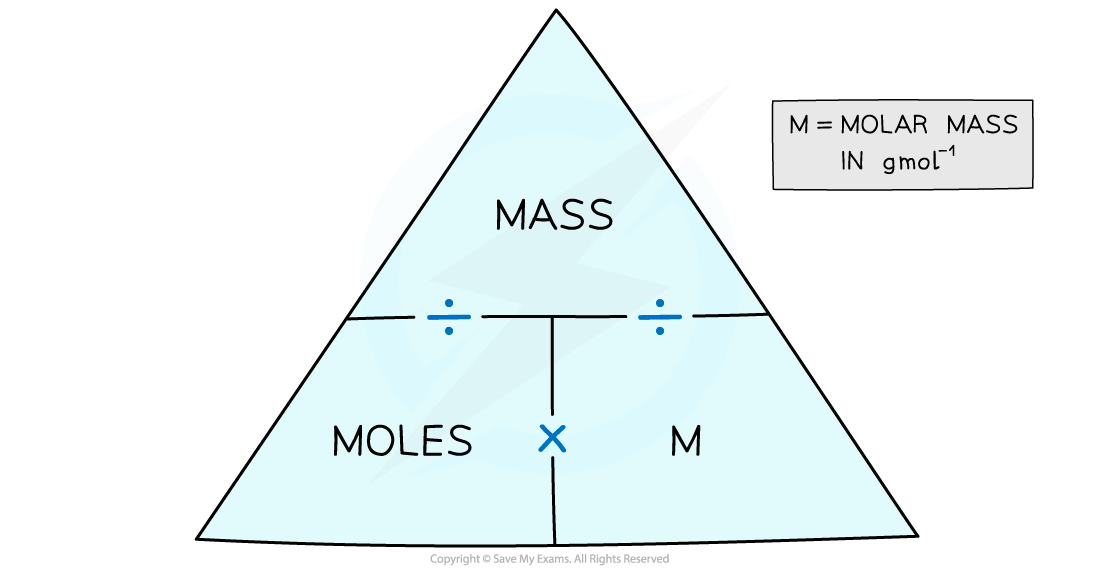
Formula triangle for moles, mass and molar mass
Key points
- Reactions happen in molar ratios, but laboratory balances read grams, so converting between the two units is unavoidable.
- One relationship links the quantities: moles = mass ÷ molar mass.
- Rearranged the same way, mass = moles × molar mass.
- Molar mass carries the unit g mol^-1 and is numerically equal to Ar for an element or Mr for a compound.
- Standard form keeps very small or large answers readable, such as 7.71 × 10^-3 mol for 2.64 g of sucrose.
First pass
To find moles, divide the mass by the molar mass; to find mass, multiply the moles by the molar mass. Watch the units as a direction check: g mol^-1 cancels grams to leave moles.
Analogy — Coins come in rolls of a fixed mass. Weighing a bag of rolls and dividing by the mass of one roll tells you how many rolls you have — the same move as grams divided by g mol^-1.
Exam pointer — Write the relationship before substituting numbers and show every step; method marks survive an arithmetic slip, while a bare answer does not.
Going deeper
Amount in moles = mass in grams ÷ molar mass in g mol^-1, where molar mass equals Ar for an element and Mr for a compound; rearranging gives mass = moles × molar mass. Quote very small or very large answers in standard form to three significant figures.
Analogy — A currency converter uses one exchange rate in two directions, pounds to euros or the reverse; the moles-mass relationship is that single rate, and molar mass is the published figure on the board.
Exam pointer — Stems often supply Mr directly, as with 2.64 g of sucrose at Mr 342.3; divide, then present the answer in standard form with the unit mol still visible.
Checks
0 of 9 attempted · 0 correct
Guided content from the SME authoring corpus — note rn_xT8XsdJtDX5gNFXj, pinned at 78ad6a2073c6 · promoted SyllabAI/syllabai-resources e967e75f1339