Calorimetry
2 guided lessons · 18 checks · 3. Physical Chemistry → Energetics
Guided lessons for this note
Which concept don't you understand yet?
We'll explain it simply and check your understanding. Pick any lesson — any order works.
0 of 18 checks correct so far
Lesson 1 of 2
Calorimetry for reactions in solution
Mixing two solutions and watching the thermometer is the simplest energy measurement in chemistry. This lesson shows the insulated set-up that keeps the heat in and the working assumptions that let the numbers be trusted.
What you know already
From Exothermic & Endothermic you already know that reactions hand heat to their surroundings or take it from them. This note shows how simple calorimetry turns that heat into numbers you can compare, first for reactions mixed in solution and then for burning fuels. It ends with the errors that spoil the measurement and how to shut them down.
Key points of understanding
- The energy produced by a reaction in solution is found by measuring the temperature change when the solutions are mixed.
- The solutions are mixed in an insulated container to prevent heat loss to the surroundings.
- Solution calorimetry suits neutralisation reactions, dissolving solids in water and displacement reactions.
- A simple calorimeter can be a polystyrene cup, a vacuum flask or a metal can.
- Assumptions include a specific heat capacity of 4.18 J/g/°C, a density of 1 g/cm3 and negligible heat losses.
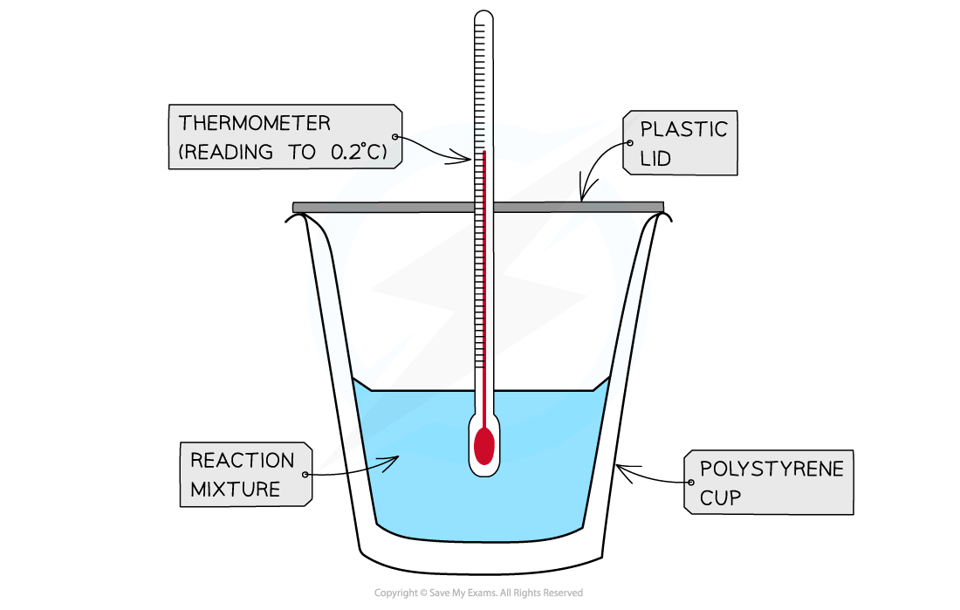
A polystyrene cup can act as a calorimeter to find enthalpy changes in a chemical reaction
Choose a confidence level to continue.
Prefer to read it all at once? Show the full lesson as a page
1.Calorimetry for reactions in solution
Mixing two solutions and watching the thermometer is the simplest energy measurement in chemistry. This lesson shows the insulated set-up that keeps the heat in and the working assumptions that let the numbers be trusted.
A polystyrene cup can act as a calorimeter to find enthalpy changes in a chemical reaction
Key points
- The energy produced by a reaction in solution is found by measuring the temperature change when the solutions are mixed.
- The solutions are mixed in an insulated container to prevent heat loss to the surroundings.
- Solution calorimetry suits neutralisation reactions, dissolving solids in water and displacement reactions.
- A simple calorimeter can be a polystyrene cup, a vacuum flask or a metal can.
- Assumptions include a specific heat capacity of 4.18 J/g/°C, a density of 1 g/cm3 and negligible heat losses.
First pass
To compare energies from solutions, mix them in a cup that keeps heat in and record how much the temperature climbs. The cup, flask or can that holds the mixture is the calorimeter.
Analogy — It is like weighing soup in a vacuum flask so none of the heat leaks out before you measure how warm it got.
Exam pointer — Name the insulated container, the thermometer and the stirred mixture when describing this experiment.
Going deeper
The temperature change of a mixed solution measures the energy produced, provided the vessel is insulated so heat stays inside. The working assumes the solution behaves like pure water, with a specific heat capacity of 4.18 J/g/°C and a density of 1 g/cm3.
Analogy — A polystyrene cup is the budget version of a laboratory flask: cheap, light and surprisingly good at trapping heat where you want it.
Exam pointer — List the assumptions when asked: water-like specific heat capacity and density, container ignored, complete reaction, negligible losses.
Checks
0 of 9 attempted · 0 correct
2.Burning fuels and the errors that follow
Burning a fuel under a known mass of water turns the flame into a heater you can score. This lesson walks the copper-can experiment step by step, then faces the two errors that always lurk in it.
Key points
- Combustion calorimetry uses the heat released by a burning fuel to raise the heat content of water.
- A fixed volume of water is heated in a copper can while a spirit burner with the fuel is weighed before and after.
- The flame is extinguished once the water has risen by about 20 °C and the final temperature is recorded.
- The main sources of error are heat losses and incomplete combustion of the fuel.
- A lid over the calorimeter and shielding from draughts reduce the heat lost to the surroundings.
First pass
Burn a weighed burner under a can of water, then weigh it again; the mass lost is the fuel burned and the thermometer shows the warmth gained. Heat escapes and fuel burns poorly, and both spoil the answer.
Analogy — It is like boiling a kettle in a draughty doorway: some heat never reaches the water, exactly as some flame heat never reaches the can.
Exam pointer — Name heat losses and incomplete combustion as the errors, with a lid and shielding as the fixes.
Going deeper
The burning fuel transfers heat to water in a copper can, and weighing the spirit burner before and after shows how much fuel was consumed. Heat lost to the surroundings and heat absorbed by the calorimeter are the main errors, reduced by a lid and by shielding the flame from draughts.
Analogy — A windbreak behind a camp stove keeps the flame working on the pan instead of the breeze, just as shielding keeps the flame heating the can.
Exam pointer — Describe the full sequence, including the 20 °C target rise and the re-weighing, and finish with the two named errors.
Checks
0 of 9 attempted · 0 correct
From the revision note
Diagrams on this note's page that are not tied to a specific lesson.
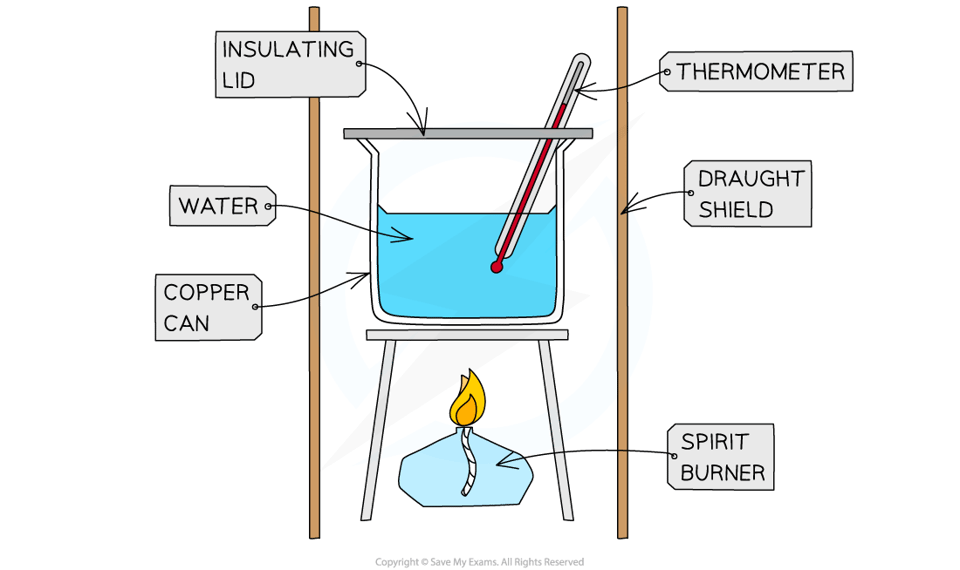
A lid is used to prevent heat loss
Guided content from the SME authoring corpus — note rn_w25KHshCMNQWwftj, pinned at 51a6ed34e715 · promoted SyllabAI/syllabai-resources e967e75f1339