Flame Tests
2 guided lessons · 18 checks · 2. Inorganic Chemistry → Chemical Tests
Guided lessons for this note
Which concept don't you understand yet?
We'll explain it simply and check your understanding. Pick any lesson — any order works.
0 of 18 checks correct so far
Lesson 1 of 2
How to carry out a flame test
A flame test identifies which metal cation is present by the colour the sample paints onto a Bunsen flame. The wire loop is cleaned in dilute acid and burned clean in the blue flame first, because any leftover ions would add their own colours and mask the one you need to see. Only then is the loop dipped into the sample and held at the flame's edge.
What you know already
From Tests for Gases you already know that gases betray themselves with splints and litmus paper. This note moves from gases to solids, where the metal ion paints the Bunsen flame itself in a colour that names it.
Key points of understanding
- The flame test identifies positive metal ions by flame colour.
- The loop is made of unreactive wire, commonly nichrome or platinum.
- The wire is dipped in dilute acid and held in the blue flame until no colour shows.
- The sample is picked up on the loop and placed at the edge of the blue flame.
- Cleaning in acid first prevents contamination from ions already on the wire.
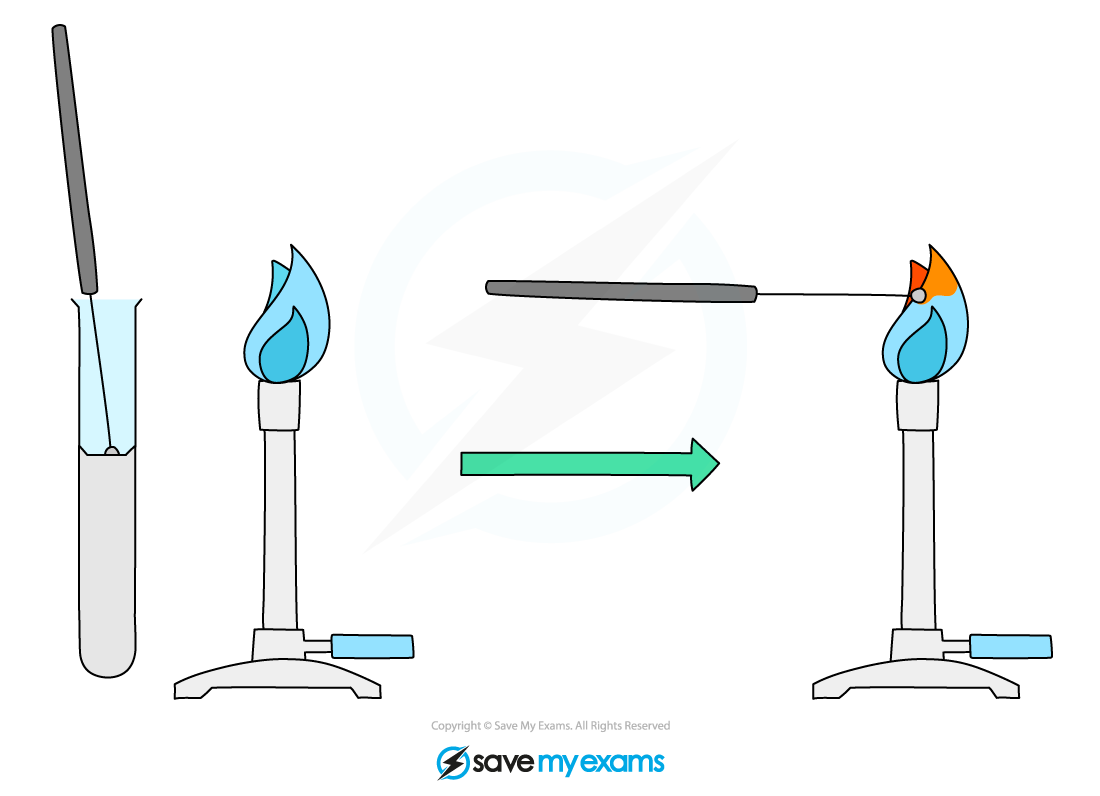
Diagram showing the technique for carrying out a flame test
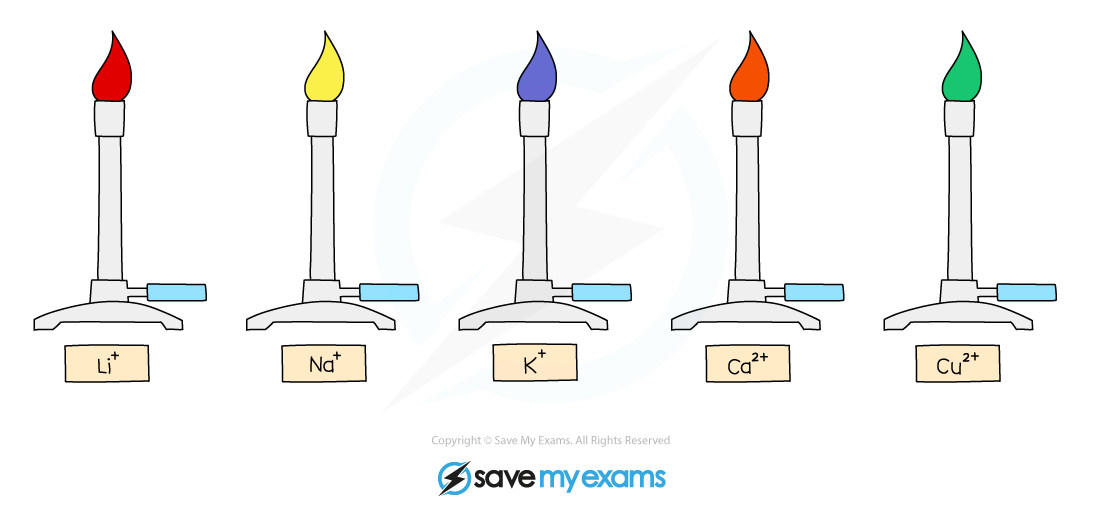
Diagram showing the colours formed in the flame test for metal ions
Choose a confidence level to continue.
Prefer to read it all at once? Show the full lesson as a page
1.How to carry out a flame test
A flame test identifies which metal cation is present by the colour the sample paints onto a Bunsen flame. The wire loop is cleaned in dilute acid and burned clean in the blue flame first, because any leftover ions would add their own colours and mask the one you need to see. Only then is the loop dipped into the sample and held at the flame's edge.
Diagram showing the technique for carrying out a flame test
Diagram showing the colours formed in the flame test for metal ions
Key points
- The flame test identifies positive metal ions by flame colour.
- The loop is made of unreactive wire, commonly nichrome or platinum.
- The wire is dipped in dilute acid and held in the blue flame until no colour shows.
- The sample is picked up on the loop and placed at the edge of the blue flame.
- Cleaning in acid first prevents contamination from ions already on the wire.
First pass
Clean a wire loop in dilute acid, heat it in the blue flame until it glows with no colour, dip it in the sample, then hold it at the edge of the blue flame and read the colour.
Analogy — Cleaning the loop first is like wiping a paintbrush clean before dipping it: any old colour left on the bristles would muddy the new one.
Exam pointer — Method marks sit in the order clean, heat clean, dip, test, so write the sequence as separate steps.
Going deeper
The acid wash dissolves ionic leftovers off the wire, and the flame check proves the loop is clean before anything is sampled. Two or more ions on the wire together would each add their colour, and one colour could mask another, so the test would fail at the very step it is meant to succeed.
Analogy — It is the same reason a chef tastes from a clean spoon every time: a spoon that has met one dish already carries its flavour into the next judgement.
Exam pointer — If asked why the acid cleaning matters, answer in terms of mixed or masked colours, not in terms of hygiene or safety.
Checks
0 of 9 attempted · 0 correct
2.The five cation colours
Five cations and their flame colours make up the table to learn: lithium burns red, sodium yellow, potassium lilac, calcium orange-red and copper(II) blue-green. The colours only show properly on a hot blue flame, so the Bunsen air hole is opened before testing. Mixing up yellow and orange-red, or lilac and blue-green, costs the mark.
Key points
- Lithium ions colour the flame red.
- Sodium ions colour the flame yellow.
- Potassium ions colour the flame lilac.
- Calcium ions colour the flame orange-red.
- Copper(II) ions colour the flame blue-green.
First pass
The colour table is short and fixed: Li+ red, Na+ yellow, K+ lilac, Ca2+ orange-red, Cu2+ blue-green. Heat the sample strongly on a blue flame, then match the colour you see to the table without second-guessing.
Analogy — The five colours are like five uniforms on a sports field: once the shirts are learned, a single glance tells you which team, which ion, is playing.
Exam pointer — Spell lilac correctly and write orange-red and blue-green as the two-word colours, because vague answers such as reddish lose marks.
Going deeper
Each cation has a fixed colour because its electrons release a characteristic set of wavelengths when the flame heats them. The pairs most often confused are the two reds, lithium versus calcium's orange-red, and the two cools, potassium's lilac versus copper(II)'s blue-green, so anchoring one member of each pair first makes the table stick.
Analogy — Think of the colours as signatures on cheques: lithium signs in plain red while calcium adds orange to its red, and potassium signs in soft lilac while copper(II) adds green to its blue.
Exam pointer — If a description says brick-red or orange, decide between Li+ and Ca2+ by the orange component; blue-green always points to Cu2+.
Checks
0 of 9 attempted · 0 correct
Guided content from the SME authoring corpus — note rn_vVdP57QhDYSVfZgy, pinned at a8889009338b · promoted SyllabAI/syllabai-resources e967e75f1339