Experiment: Finding Formulae of Compounds
2 guided lessons · 18 checks · 1. Principles of Chemistry → Chemical Formulae, Equations, Calculations
Guided lessons for this note
Which concept don't you understand yet?
We'll explain it simply and check your understanding. Pick any lesson — any order works.
0 of 18 checks correct so far
Lesson 1 of 2
Formulae of Simple Compounds by Experiment
A chemical formula can be dug out of the laboratory itself: weigh the substances before and after a reaction, convert both masses into moles, and compare the two. Experiments where a gas escapes or is taken up suit this treatment best, because the mass change is easy to see. The ratio of moles then hands you the empirical formula.
What you know already
The last few notes turned masses into moles and moles back into masses using relative formula masses. This note points that arithmetic at the laboratory bench: measure masses before and after a reaction, convert both into moles, and the ratio that falls out is the formula itself. The worked case is a salt that carries water inside its crystals.
Key points of understanding
- Mass measurements taken before and after a reaction are the raw material for a formula.
- Converting the masses into moles lets molar ratios be deduced, and the ratios give the empirical formula.
- Experiments with gases being lost or gained are the easiest to handle this way.
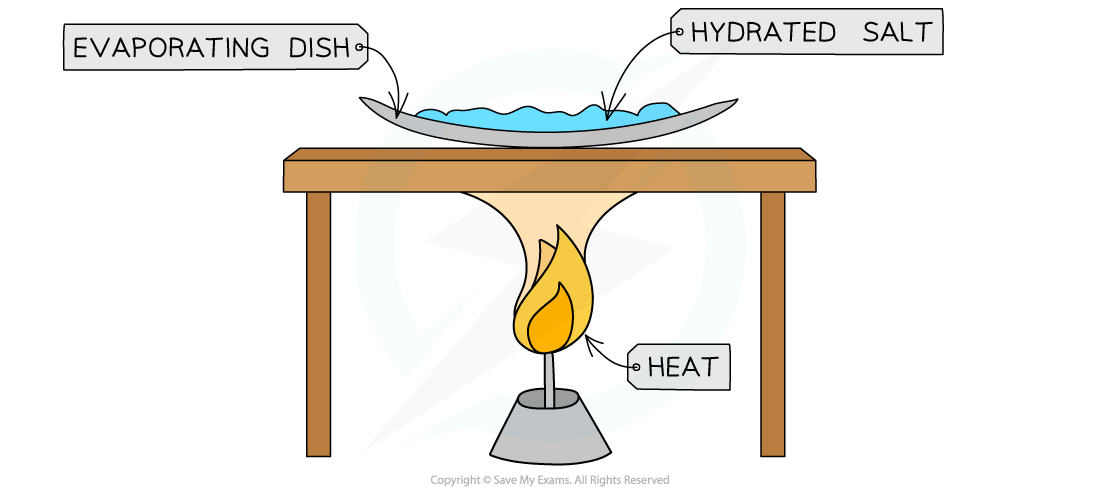
- Heating a hydrated salt drives its water off as vapour, shrinking the mass by exactly the water's contribution.
- The formulae of metal oxides, water and salts holding water of crystallisation can all be found experimentally.
Choose a confidence level to continue.
Prefer to read it all at once? Show the full lesson as a page
1.Formulae of Simple Compounds by Experiment
A chemical formula can be dug out of the laboratory itself: weigh the substances before and after a reaction, convert both masses into moles, and compare the two. Experiments where a gas escapes or is taken up suit this treatment best, because the mass change is easy to see. The ratio of moles then hands you the empirical formula.
Key points
- Mass measurements taken before and after a reaction are the raw material for a formula.
- Converting the masses into moles lets molar ratios be deduced, and the ratios give the empirical formula.
- Experiments with gases being lost or gained are the easiest to handle this way.
- Heating a hydrated salt drives its water off as vapour, shrinking the mass by exactly the water's contribution.
- The formulae of metal oxides, water and salts holding water of crystallisation can all be found experimentally.
Guided content from the SME authoring corpus — note rn_pWzTTBv3B4yGFfj3, pinned at da18433ed9e8 · promoted SyllabAI/syllabai-resources e967e75f1339