Practical: Prepare Lead(II)Sulfate
2 guided lessons · 18 checks · 2. Inorganic Chemistry → Acids, Bases & Salt Preparations
Guided lessons for this note
Which concept don't you understand yet?
We'll explain it simply and check your understanding. Pick any lesson — any order works.
0 of 18 checks correct so far
Lesson 1 of 2
Aim
This practical prepares a dry sample of lead(II) sulfate, an insoluble salt, from two solutions that are both soluble. Lead(II) nitrate provides the lead ions and potassium sulfate provides the sulfate ions, and when the two solutions meet, white lead(II) sulfate falls out of the mixture while potassium nitrate stays behind in the liquid.
What you know already
From Prepare an Insoluble Salt you already know the precipitation pattern of two soluble salts swapping partners. This note runs that pattern as a named practical, with measured volumes, filtration, washing and drying, ending with a dry sample of lead(II) sulfate.
Key points of understanding
- The aim is a pure, dry sample of lead(II) sulfate.
- The reactants are lead(II) nitrate solution and potassium sulfate solution.
- Both reactants must be soluble while the product must be insoluble.
- Lead(II) sulfate forms as the precipitate.
- Potassium nitrate remains dissolved in the liquid above the solid.
Choose a confidence level to continue.
Prefer to read it all at once? Show the full lesson as a page
1.Aim
This practical prepares a dry sample of lead(II) sulfate, an insoluble salt, from two solutions that are both soluble. Lead(II) nitrate provides the lead ions and potassium sulfate provides the sulfate ions, and when the two solutions meet, white lead(II) sulfate falls out of the mixture while potassium nitrate stays behind in the liquid.
Key points
- The aim is a pure, dry sample of lead(II) sulfate.
- The reactants are lead(II) nitrate solution and potassium sulfate solution.
- Both reactants must be soluble while the product must be insoluble.
- Lead(II) sulfate forms as the precipitate.
- Potassium nitrate remains dissolved in the liquid above the solid.
First pass
Two clear solutions, lead(II) nitrate and potassium sulfate, are mixed, and white lead(II) sulfate drops out as a solid. The potassium nitrate made alongside it stays dissolved, so the solid can be filtered off as the product.
Analogy — It is like two crowds meeting in a doorway where only one pairing is incompatible: the incompatible pair, lead and sulfate, clumps together and steps aside as a solid.
Exam pointer — State both reactant solutions by name and the white precipitate by name, because the practical mark scheme expects the full cast, not just the product.
Going deeper
The ionic story is that Pb2+ meets SO42- and their insoluble compound leaves the solution, while the spectator ions K+ and NO3- never leave it. The design constraint is the same as any precipitation: both chosen reactants must dissolve so they can meet, and the chosen product must not dissolve so it can be collected.
Analogy — The spectator ions are like the audience at a match: they are present for every moment of it but never step onto the pitch, which belongs only to the lead and sulfate players.
Exam pointer — Ionic-equation questions want Pb2+ plus SO42- giving PbSO4, with the spectator ions left out entirely.
Checks
0 of 9 attempted · 0 correct
2.Method
Equal volumes of the two solutions are measured, mixed and stirred, and the white solid is then collected by filtration. Washing with distilled water strips away traces of the leftover solutions, and a spell in a warm oven dries the product. Lead salts are toxic, so care is needed at every stage of the handling.
Key points
- 25 cm3 of 0.5 mol dm-3 lead(II) nitrate solution is measured into a small beaker.
- An equal volume of potassium sulfate solution is added and the mixture is stirred.
- Filtration separates the precipitate from the mixture.
- Distilled water washes away traces of the other solutions.
- The sample is left in an oven to dry.
First pass
Measure 25 cm3 of each 0.5 mol dm-3 solution into a beaker and stir them together. Filter off the white solid, rinse it with distilled water, then dry it in an oven to finish the sample.
Analogy — The method is a production line with four stations, mix, filter, wash, dry, and each station hands a cleaner product to the next.
Exam pointer — Quote the measured quantities if the question gives them, 25 cm3 of each solution, because practical write-ups expect the actual numbers.
Going deeper
Equal volumes of equal concentrations give the ions in matching amounts, so neither reactant is left wanting when the solid forms. The wash then removes the potassium nitrate solution soaking the residue, and oven drying removes the rinse water, delivering the product dry without heating it anywhere near decomposition.
Analogy — Rinsing the residue before drying is like towelling off before putting on clean clothes: skip the rinse and the drying stage simply bakes the old solution onto the solid.
Exam pointer — Safety questions expect the lead-salt toxicity named explicitly, with careful handling stated as the response.
Checks
0 of 9 attempted · 0 correct
From the revision note
Diagrams on this note's page that are not tied to a specific lesson.
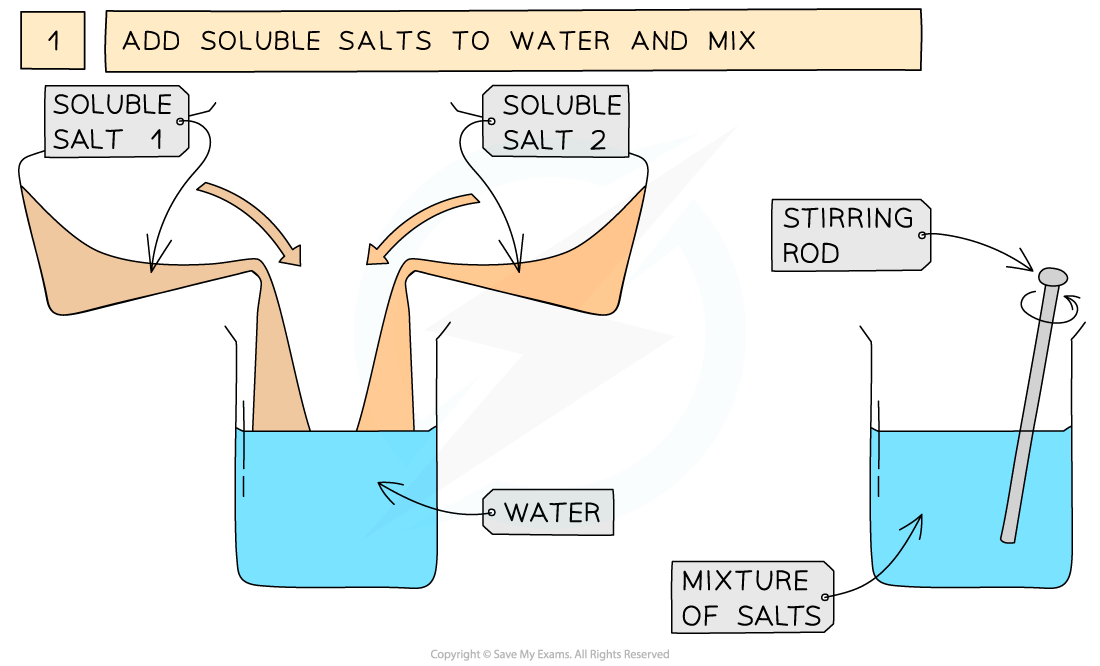
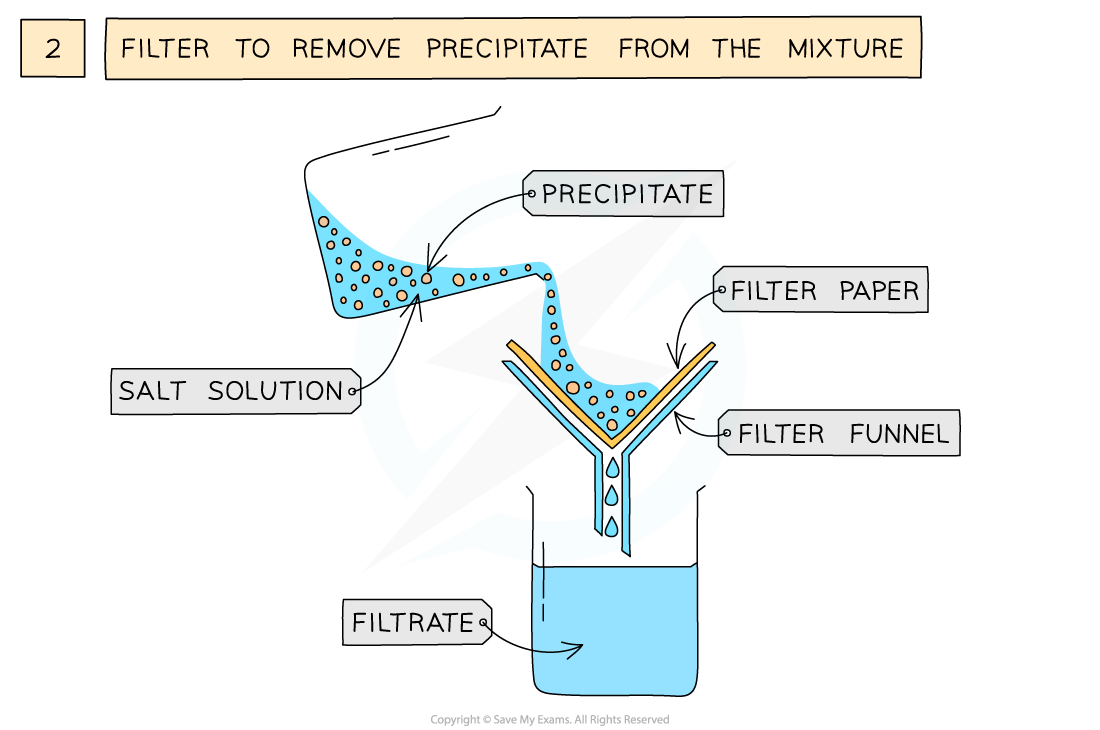
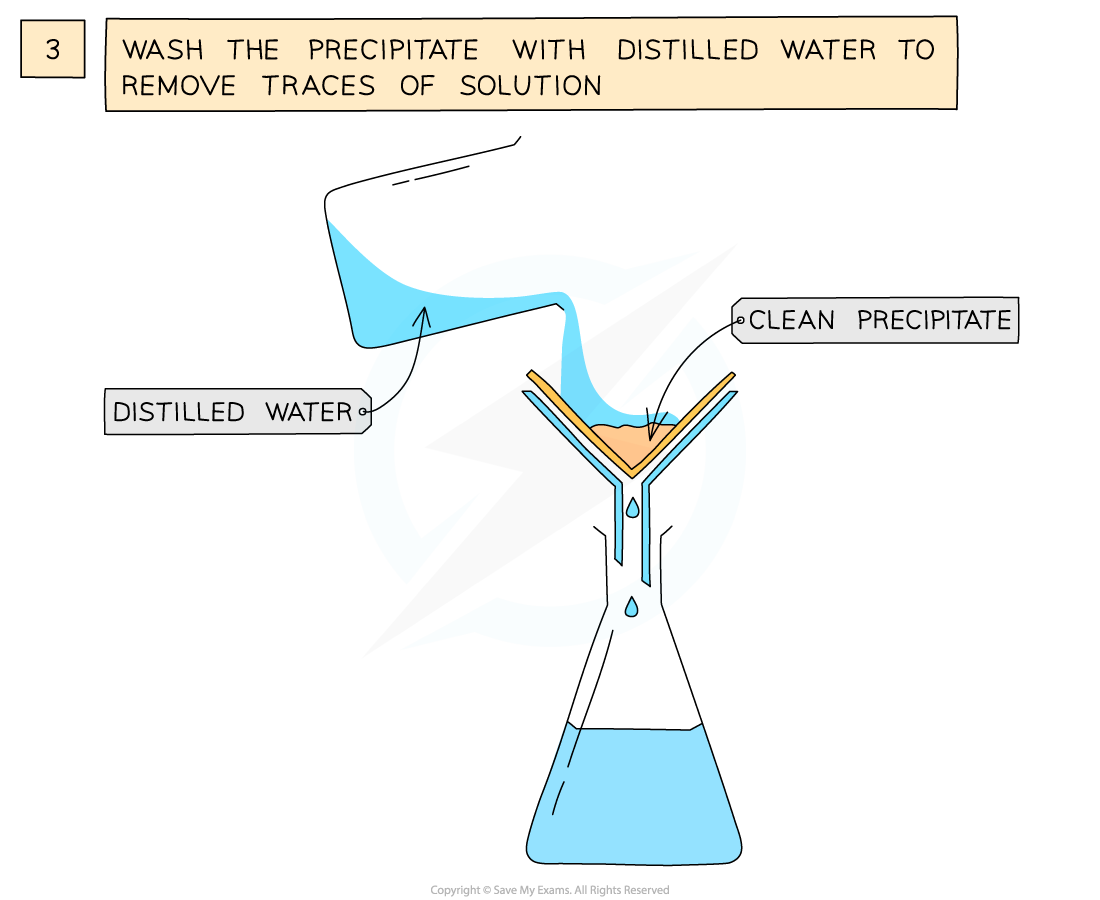
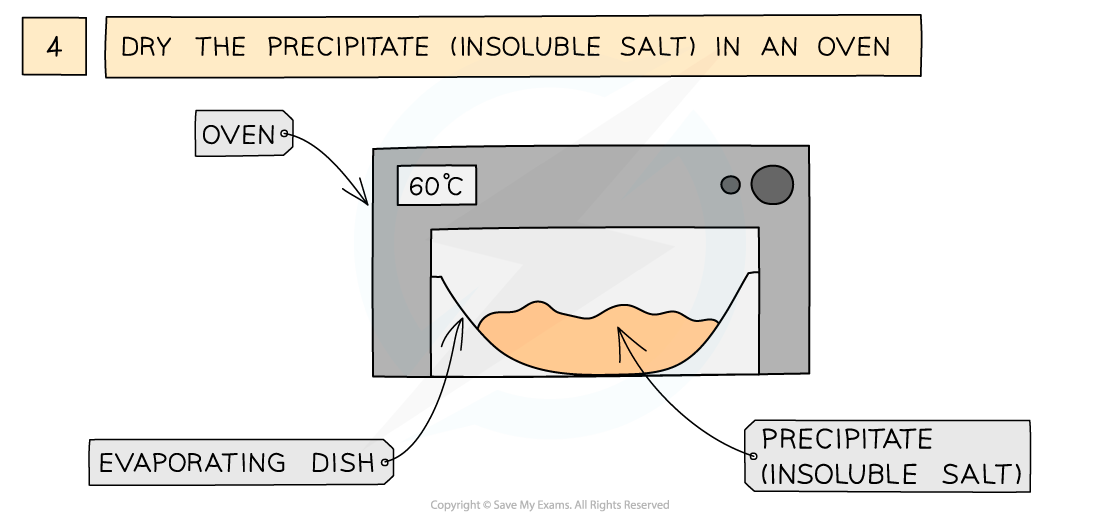
The preparation of lead(II)sulfate by precipitation from two soluble salts
Guided content from the SME authoring corpus — note rn_pBp5Z5C2RHTKk7Wn, pinned at a8889009338b · promoted SyllabAI/syllabai-resources e967e75f1339