Manufacture of Ethanol
2 guided lessons · 18 checks · 4. Organic Chemistry → Alcohols
Guided lessons for this note
Which concept don't you understand yet?
We'll explain it simply and check your understanding. Pick any lesson — any order works.
0 of 18 checks correct so far
Lesson 1 of 2
Hydration of ethene
Industry builds ethanol from ethene, the short alkene that cracking hands over in bulk. This lesson states the three conditions that switch the reaction on and follows the exit mixture through the condenser, where everything is sorted by boiling point.
What you know already
From the previous note you already know the two-carbon alcohol and its eagerness to meet oxygen. This note steps back to ask where industrial ethanol comes from: an oil-derived alkene joined with steam in one route, and living yeast digesting sugar in the other.
Key points of understanding
- The ethene feedstock comes from the cracking of hydrocarbons.
- Steam adds across the ethene double bond using a concentrated phosphoric acid catalyst.
- The conditions are a temperature of about 300 degrees Celsius and a pressure of 60 to 70 atmospheres.
- Unreacted ethene leaves first because it boils at minus 103 degrees, far below the liquids.
- The ethanol and water are then separated by fractional distillation.
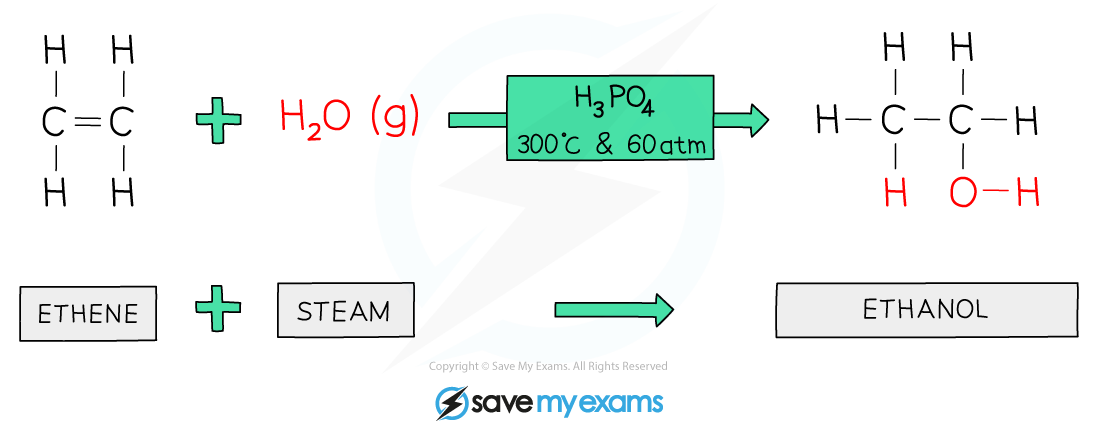
A water molecule adds across the C=C in the hydration of ethene to produce ethanol
Choose a confidence level to continue.
Prefer to read it all at once? Show the full lesson as a page
1.Hydration of ethene
Industry builds ethanol from ethene, the short alkene that cracking hands over in bulk. This lesson states the three conditions that switch the reaction on and follows the exit mixture through the condenser, where everything is sorted by boiling point.
A water molecule adds across the C=C in the hydration of ethene to produce ethanol
Key points
- The ethene feedstock comes from the cracking of hydrocarbons.
- Steam adds across the ethene double bond using a concentrated phosphoric acid catalyst.
- The conditions are a temperature of about 300 degrees Celsius and a pressure of 60 to 70 atmospheres.
- Unreacted ethene leaves first because it boils at minus 103 degrees, far below the liquids.
- The ethanol and water are then separated by fractional distillation.
First pass
Ethene from cracking reacts with steam to make ethanol. Concentrated phosphoric acid catalyses the change at about 300 degrees and 60 to 70 atmospheres, and the leaving mixture is sorted by boiling point.
Analogy — The carbon double bond is like an open zip; a water molecule zips straight into the gap, with the acid catalyst acting as the fingers that start the pull.
Exam pointer — Learn the three conditions as a set; examiners ask for the catalyst, the temperature and the pressure together.
Going deeper
Hydration adds steam across the ethene double bond using a concentrated phosphoric acid catalyst, a temperature near 300 degrees Celsius and a pressure of 60 to 70 atmospheres. Unreacted ethene, ethanol and water leave the chamber and are separated first by boiling point, then by fractional distillation.
Analogy — Picture a sorting office: parcels arrive mixed, the gas exits through the top vent first because it boils coldest, and the two liquids travel on to a second, slower line.
Exam pointer — Quote the boiling points if asked why ethene separates first: minus 103 against 78 and 100 degrees.
Checks
0 of 9 attempted · 0 correct
2.Fermentation
The second route lets yeast do the work: enzymes inside the cells split glucose into ethanol and carbon dioxide. The recipe is strict about air and gentle with warmth, and this lesson explains exactly why both conditions matter.
Key points
- Yeast enzymes break dissolved sugar or starch down into ethanol and carbon dioxide.
- The equation is written C6H12O6 giving 2CO2 plus 2C2H5OH.
- The mixture is kept between 25 and 35 degrees, with 30 degrees as the optimum.
- Air is excluded because the yeast must respire without oxygen to make ethanol.
- Yeast dies once the alcohol reaches about 15 percent, so the route runs in batches.
First pass
Yeast turns glucose into ethanol and carbon dioxide with no air present, at about 30 degrees. Colder runs too slowly, hotter harms the enzymes, and strong alcohol kills the yeast so the vessel restarts in batches.
Analogy — Yeast is a tiny workforce with a strict climate: too cold and they labour slowly, too hot and they quit, and at 15 percent alcohol they drown in their own product.
Exam pointer — Give the two reasons separately: no air because the process is anaerobic, and about 30 degrees to keep the enzymes working.
Going deeper
Enzymes in yeast split glucose without oxygen into ethanol and carbon dioxide, written as C6H12O6 giving two carbon dioxides plus two ethanols. Air is shut out so the yeast respires anaerobically, about 30 degrees keeps the enzymes active without harming them, and alcohol near 15 percent kills the yeast to end the batch.
Analogy — A brewery vat is a sealed greenhouse for workers who cannot stand a draught: keep the windows shut, hold a mild warmth, and harvest before their own product poisons them.
Exam pointer — State the optimum as about 30 degrees and explain both tails: too slow below, enzymes damaged above.
Checks
0 of 9 attempted · 0 correct
Guided content from the SME authoring corpus — note rn_ncFJkGhXFsKrkNkH, pinned at 45d591243cae · promoted SyllabAI/syllabai-resources e967e75f1339