Formation of Ions
2 guided lessons · 18 checks · 1. Principles of Chemistry → Ionic Bonding
Guided lessons for this note
Which concept don't you understand yet?
We'll explain it simply and check your understanding. Pick any lesson — any order works.
0 of 18 checks correct so far
Lesson 1 of 2
Formation of Ions
When an atom loses or gains electrons it stops being neutral and becomes an ion - a charged particle. Atoms make this trade to reach a full outer shell, the stable arrangement the noble gases already hold. Lose electrons and the charge is positive; gain them and it is negative.
What you know already
Atomic structure is old ground: protons and electrons counted, shells filled two-eight-eight. This note puts that picture to work - when atoms give up or take in electrons to reach a full outer shell, the balance between protons and electrons tips and charged particles called ions appear.
Key points of understanding
- An ion is an atom or group of atoms that carries an electric charge after losing or gaining electrons.
- The loss or gain of electrons happens so the atom can reach a full outer shell.
- Ions of group 1, 2, 3, 5, 6 and 7 elements end with a noble gas electronic structure.
- The noble gases named in the note are helium, neon and argon.
- Every metal atom loses electrons and becomes a positive ion; every non-metal gains electrons and becomes a negative ion.
Choose a confidence level to continue.
Prefer to read it all at once? Show the full lesson as a page
1.Formation of Ions
When an atom loses or gains electrons it stops being neutral and becomes an ion - a charged particle. Atoms make this trade to reach a full outer shell, the stable arrangement the noble gases already hold. Lose electrons and the charge is positive; gain them and it is negative.
Key points
- An ion is an atom or group of atoms that carries an electric charge after losing or gaining electrons.
- The loss or gain of electrons happens so the atom can reach a full outer shell.
- Ions of group 1, 2, 3, 5, 6 and 7 elements end with a noble gas electronic structure.
- The noble gases named in the note are helium, neon and argon.
- Every metal atom loses electrons and becomes a positive ion; every non-metal gains electrons and becomes a negative ion.
First pass
Ions form when atoms give up or take in electrons, and the charge tells which way it went: positive for lost, negative for gained. Groups 1, 2, 3, 5, 6 and 7 all land on a noble gas arrangement.
Analogy — Think of a supermarket loyalty card: a shopper one sticker short of a free item grabs one more, while a shopper holding one too many hands it back. Atoms gain or shed electrons the same way to reach a full card - a full outer shell.
Exam pointer — Exam questions ask why ions carry their charges: the answer is electron loss or gain, never proton changes - the nucleus never moves.
Going deeper
The definition has two halves: the particle, one atom or a group of atoms, and the charge, set by electrons lost or gained. Reaching a full outer shell is the driver, which is why group membership predicts the charge before any formula work starts.
Analogy — A full bus already moving is like a noble gas atom - complete, so it does not bother changing. Atoms short of a full bus squeeze on, atoms with spare passengers step off; either way the journey ends with a complete shell.
Exam pointer — The note's exam hint is worth memorising: electrons gained or lost equal the charge, so 2 electrons lost means 2+, and 1 electron gained means 1-.
Checks
0 of 9 attempted · 0 correct
2.Formation of Cations and Anions
Two names sort the charged particles: cations are positive ions born from lost electrons, anions are negative ions built from gained ones. Metals always lose, non-metals always gain. The diagrams trace sodium dropping one electron to become Na+, and chlorine picking one up to become Cl-.
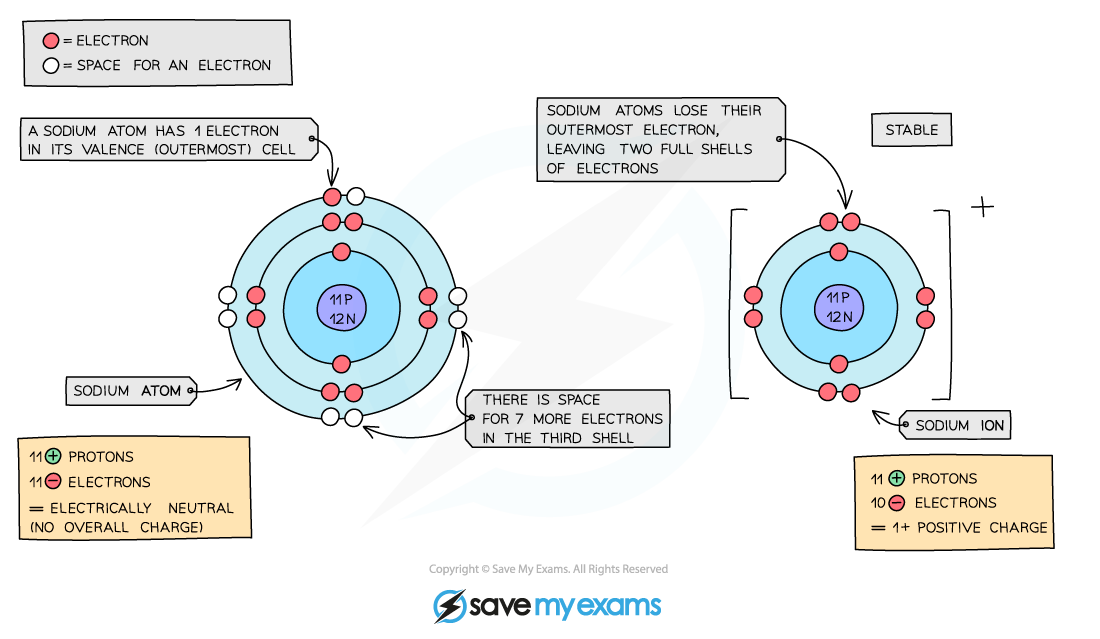
Diagram showing the formation of the sodium ion
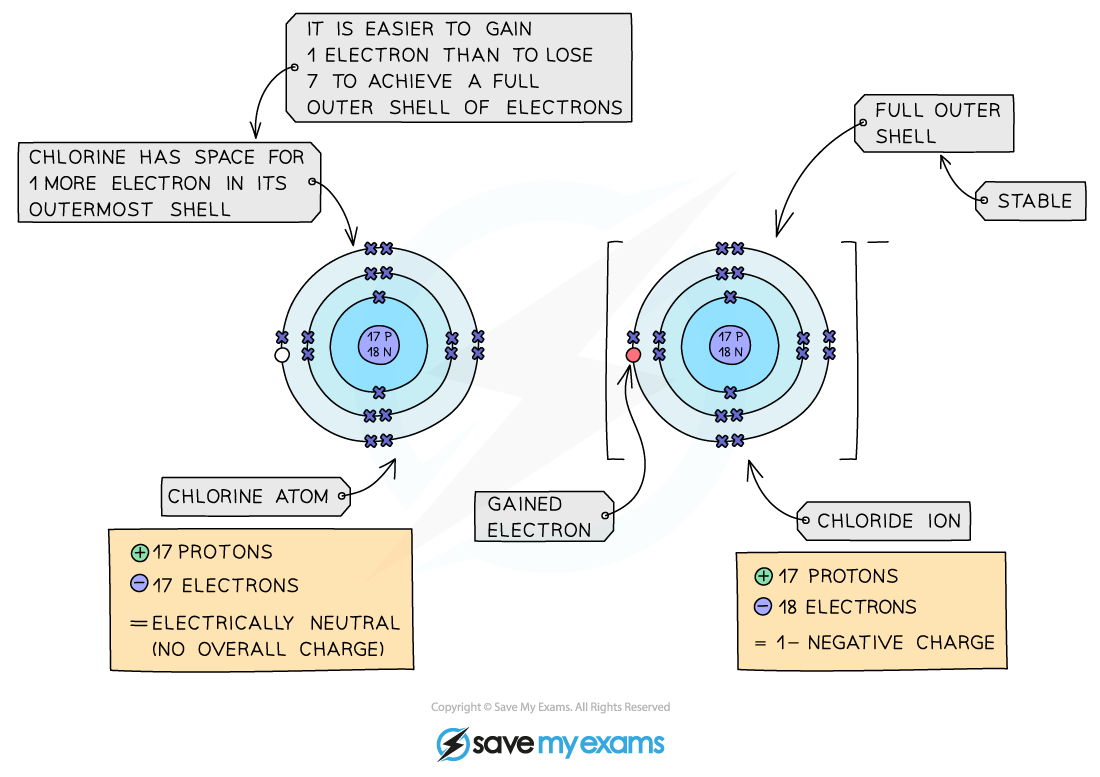
Diagram showing the formation of the chloride ion
Key points
- Cations are positive ions that form when atoms lose electrons, leaving more protons than electrons.
- Anions are negative ions that form when atoms gain electrons, ending with more electrons than protons.
- Every metal sheds electrons to other atoms and turns into a positive ion.
- Every non-metal takes electrons from other atoms and turns into a negative ion.
- A magnesium atom that loses 2 electrons carries a 2+ charge; a bromine atom that gains 1 electron carries a 1- charge.
First pass
Cations and anions are the two names to keep straight: cations lost electrons and read positive, anions gained electrons and read negative. Metals feed one side, non-metals the other, and the note's diagrams show sodium and chlorine each taking their route.
Analogy — Paying for a bus fare works both ways: hand over coins and you are short, take coins in and you are carrying extra. Electrons are the currency - paying them out charges the ion positive, collecting them charges it negative.
Exam pointer — Charge questions answer themselves once the count is known: magnesium losing 2 electrons reads 2+, bromine gaining 1 electron reads 1-.
Going deeper
The pairing is symmetrical: a cation has more protons than electrons because electrons left, and an anion has more electrons than protons because electrons arrived. The sodium and chloride diagrams mirror each other - one electron out for the metal, one electron in for the non-metal.
Analogy — Two shop tills face each other at closing: one till pays out and its balance runs positive on the ledger of lost coins, the other takes in and runs negative. Metals pay electrons out, non-metals take them in, and the charge records the direction.
Exam pointer — Diagram questions expect the charge arrow as well as the movement: Na+ and Cl- must carry their signs, and the exam hint's count rule justifies each one.
Checks
0 of 9 attempted · 0 correct
Guided content from the SME authoring corpus — note rn_mbcBZkygY4YpG2bf, pinned at da18433ed9e8 · promoted SyllabAI/syllabai-resources e967e75f1339