Group 7: Reactivity & Electronic Configurations
2 guided lessons · 18 checks · 2. Inorganic Chemistry → Group 7 (Halogens)
Guided lessons for this note
Which concept don't you understand yet?
We'll explain it simply and check your understanding. Pick any lesson — any order works.
0 of 18 checks correct so far
Lesson 1 of 2
Group 7: Reactivity & Electronic Configurations
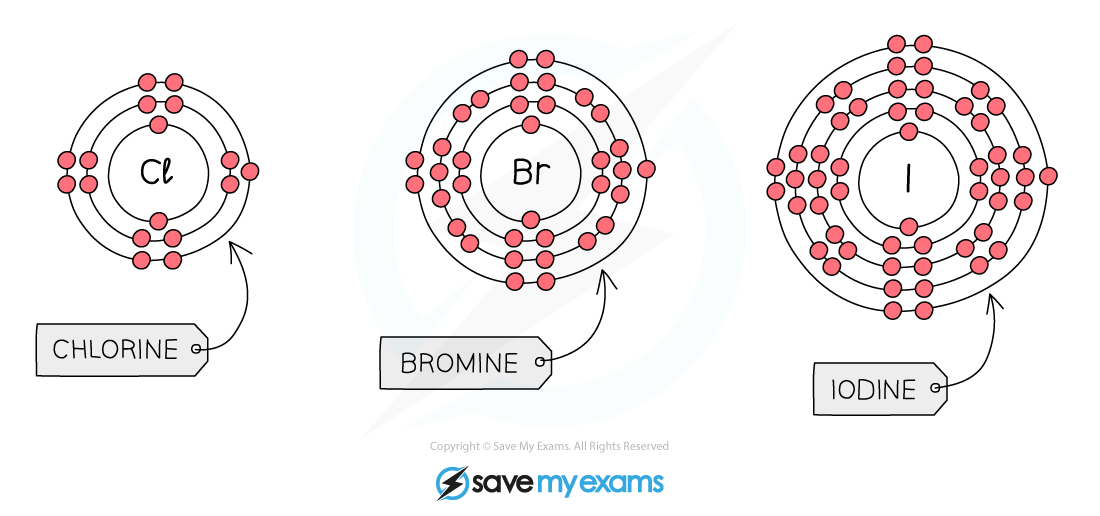
When halogen atoms react they gain one electron to complete their outer shell, forming negative ions called halide ions. This gain is what makes them reactive, and how easily it happens decides the reactivity order. Down the group the growing number of shells pushes the outer shell further from the nucleus, so the reactivity of the halogens decreases.
What you know already
From Group 7 (Halogens) you already know that each halogen carries seven electrons in its outer shell and commonly forms a 1- ion. This note explains why reactivity falls down the group: gaining that extra electron becomes harder the further the outer shell sits from the nucleus, which is the exact opposite of the Group 1 pattern.
Key points of understanding
- Halogen atoms gain one electron during reactions to form -1 ions called halide ions.
- Reactivity of the Group 7 non-metals decreases as you go down the group.
- The number of electron shells increases by one with each element down the group.
- The growing distance from the outer shell to the nucleus makes the halogens less reactive.
- Fluorine, with the smallest atom, is the most reactive halogen in the group.
Choose a confidence level to continue.
Prefer to read it all at once? Show the full lesson as a page
1.Group 7: Reactivity & Electronic Configurations
When halogen atoms react they gain one electron to complete their outer shell, forming negative ions called halide ions. This gain is what makes them reactive, and how easily it happens decides the reactivity order. Down the group the growing number of shells pushes the outer shell further from the nucleus, so the reactivity of the halogens decreases.
Key points
- Halogen atoms gain one electron during reactions to form -1 ions called halide ions.
- Reactivity of the Group 7 non-metals decreases as you go down the group.
- The number of electron shells increases by one with each element down the group.
- The growing distance from the outer shell to the nucleus makes the halogens less reactive.
- Fluorine, with the smallest atom, is the most reactive halogen in the group.
Guided content from the SME authoring corpus — note rn_jXXsc4wt2344BjxX, pinned at 6fb25fc02d1a · promoted SyllabAI/syllabai-resources e967e75f1339