Practical: Prepare Copper(II)Sulfate
2 guided lessons · 18 checks · 2. Inorganic Chemistry → Acids, Bases & Salt Preparations
Guided lessons for this note
Which concept don't you understand yet?
We'll explain it simply and check your understanding. Pick any lesson — any order works.
0 of 18 checks correct so far
Lesson 1 of 2
Method
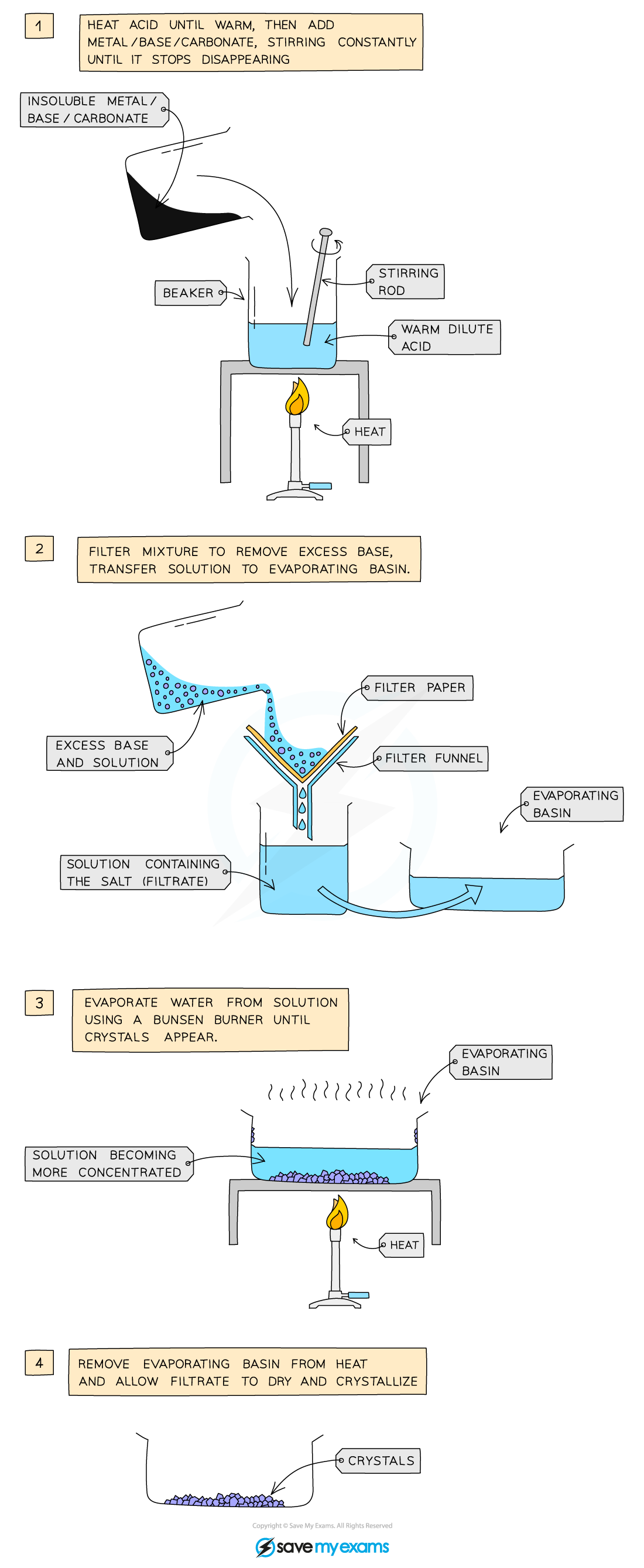
This practical makes a familiar blue salt from two simple starting materials: an acid and an insoluble black base. The first stage covers the reaction itself, from warming the acid to adding copper(II) oxide until it is in excess. Filtering then removes the leftover solid, leaving a clean blue solution behind.
What you know already
You already know from Acids, Alkalis & Titrations that acids react with bases to form salts and water. This practical puts that reaction to work in the laboratory: an insoluble base, copper(II) oxide, is stirred into warm acid until the acid is used up, and the salt it forms is recovered as blue crystals. Every step you will follow exists to keep that product pure and dry.
Key points of understanding
- The aim is a pure, dry batch of hydrated copper(II) sulfate crystals, made from copper(II) oxide.
- Warming the dilute sulfuric acid gently speeds up the reaction with the base.
- Copper(II) oxide is added slowly to the hot acid and stirred until it is in excess.
- Being in excess means the base stops dissolving and a suspension forms in the acid.
- Filtering removes the excess solid base, leaving the salt solution in the evaporating basin.
Choose a confidence level to continue.
Prefer to read it all at once? Show the full lesson as a page
1.Method
This practical makes a familiar blue salt from two simple starting materials: an acid and an insoluble black base. The first stage covers the reaction itself, from warming the acid to adding copper(II) oxide until it is in excess. Filtering then removes the leftover solid, leaving a clean blue solution behind.
Key points
- The aim is a pure, dry batch of hydrated copper(II) sulfate crystals, made from copper(II) oxide.
- Warming the dilute sulfuric acid gently speeds up the reaction with the base.
- Copper(II) oxide is added slowly to the hot acid and stirred until it is in excess.
Guided content from the SME authoring corpus — note rn_fQSYvKRMDBj3s2Bx, pinned at 78ad6a2073c6 · promoted SyllabAI/syllabai-resources e967e75f1339