Condensation Polymers
3 guided lessons · 27 checks · 4. Organic Chemistry → Synthetic polymers
Guided lessons for this note
Which concept don't you understand yet?
We'll explain it simply and check your understanding. Pick any lesson — any order works.
0 of 27 checks correct so far
Lesson 1 of 3
Condensation versus addition
Addition polymers form from one monomer alone; condensation polymers are built by two different monomers that release a small molecule, usually water, every time they link. This lesson sets the two mechanisms side by side and shows where the water comes from.
What you know already
From Esters you already know the -COO- link that forms when an acid meets an alcohol. This note scales that single link up to industrial size: two-ended monomers joining into polyesters, water leaving at every bond, and a green branch of the family that the soil can reclaim.
Key points of understanding
- Condensation polymers form when two different monomers link with the removal of a small molecule.
- The small molecule released is usually water.
- Each monomer carries two functional groups, one at each end.
- One water molecule forms for every ester linkage made.
- Addition polymerisation forms the polymer molecule only, with no other product.
Choose a confidence level to continue.
Prefer to read it all at once? Show the full lesson as a page
1.Condensation versus addition
Addition polymers form from one monomer alone; condensation polymers are built by two different monomers that release a small molecule, usually water, every time they link. This lesson sets the two mechanisms side by side and shows where the water comes from.
Key points
- Condensation polymers form when two different monomers link with the removal of a small molecule.
- The small molecule released is usually water.
- Each monomer carries two functional groups, one at each end.
- One water molecule forms for every ester linkage made.
- Addition polymerisation forms the polymer molecule only, with no other product.
First pass
Two different monomers join to build a condensation polymer, releasing a small molecule, usually water, at every link. Addition polymers make the chain alone, with no second product.
Analogy — Addition polymer formation is a solo handshake; the condensation kind is two people shaking hands while dropping a water bottle each time their hands meet.
Exam pointer — State the difference as products: polymer only versus polymer plus water.
Going deeper
Condensation polymers arise when two different monomers, each carrying functional groups at both ends, link in long alternating chains and release one small molecule per bond, usually water. Addition polymers instead consume one monomer type and leave no second product.
Analogy — Watch a zip closing: addition is one tape zipping onto itself, while condensation is two different tapes zipping together and shedding a droplet at every tooth.
Exam pointer — Quote the per-linkage water count: one molecule of water for every ester linkage formed.
Checks
0 of 9 attempted · 0 correct
2.Polyesters: terylene and deducing the monomers
A dicarboxylic acid with -COOH at both ends meets a diol with -OH at both ends, and the chain that results is a polyester such as terylene. This lesson also runs the film backwards: adding water across the ester links, known as hydrolysis, recovers the monomers.
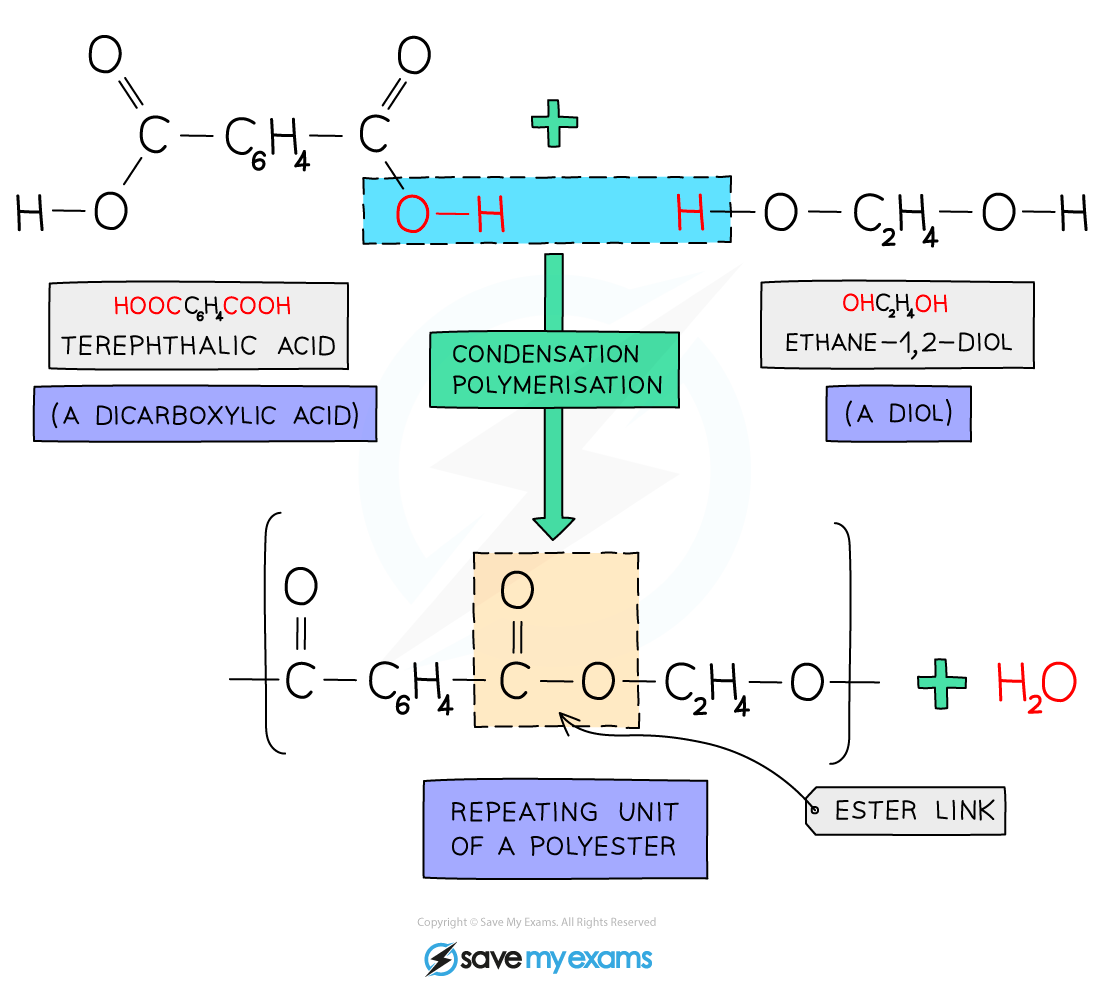
The condensation reaction in which the polyester terylene is produced
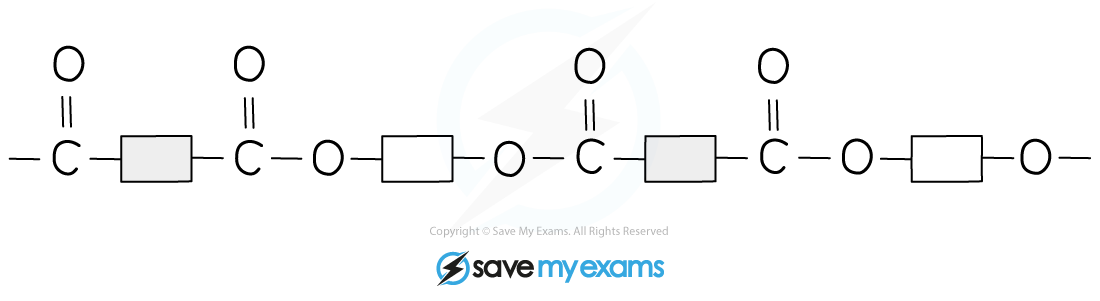
Diagram showing a section of the polyester terylene

Diagram showing a section of the polyester polybutylene terephthalate, PBT
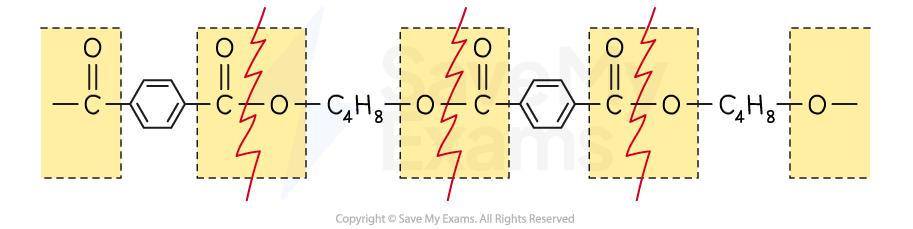
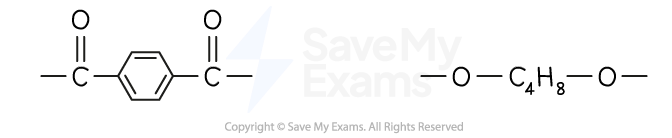
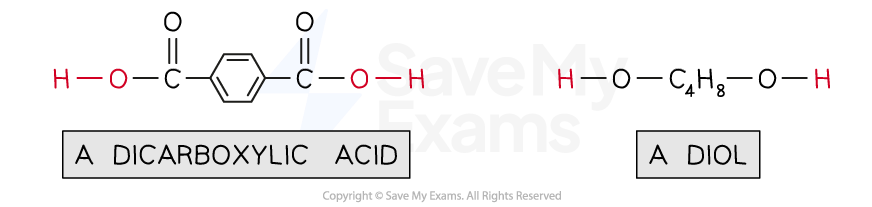
A diagram to show the two monomers used to form the polyester*** ***polybutylene terephthalate, PBT
Key points
- A dicarboxylic acid carries a -COOH group at either end.
- A diol carries an -OH group at either end.
- Terylene is a polyester made from a dicarboxylic acid and a diol.
- Each -COOH group reacts with an -OH group, forming an ester link and losing one water molecule.
- Hydrolysis adds water back to break the polyester into its monomers.
First pass
A dicarboxylic acid has -COOH at both ends and a diol has -OH at both ends; joined together they make a polyester such as terylene. Adding water back across the ester links, called hydrolysis, recovers the monomers.
Analogy — The ester link is a staple joining two sheets; hydrolysis is a staple remover that returns each sheet to its original desk.
Exam pointer — Remember which monomer loses what: the acid loses OH, the diol loses H, and reversing that rebuilds them.
Going deeper
Terylene forms as each -COOH of the dicarboxylic acid meets an -OH of the diol, creating an ester link with one water lost per link, its chain drawn with boxes for the carbon sections. Hydrolysis reverses the process: water is added, the C-O single bond of each ester link breaks, OH returns to the acid end and H returns to the alcohol end.
Analogy — Deducing monomers is unwrapping a parcel you once taped shut: cut the tape, the C-O bond, and the two original sheets fall apart, ready to be re-wetted into their old shapes.
Exam pointer — Break the C-O single bond only, never the C=O; the added water then completes both halves.
Checks
0 of 9 attempted · 0 correct
3.Biopolyesters
Not every polyester outlives the planet that made it. Biopolyesters are synthesised from sugars and plant oils with the help of micro-organisms, and their ester, amide and ether groups let them biodegrade once their job is done. This lesson closes the corpus with the greenest member of the family.
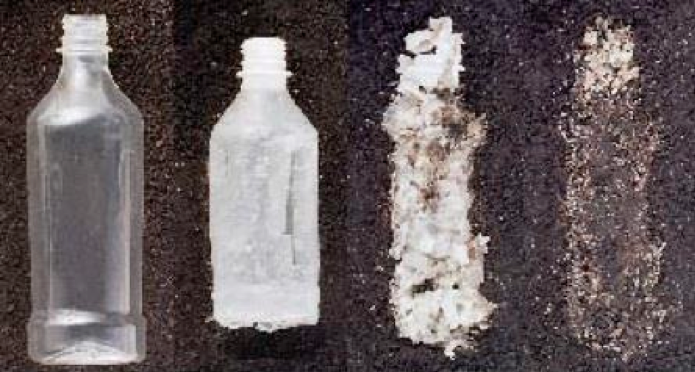
The biodegradation of a bottle made of biopolyesters
Key points
- Biopolyesters are synthesised from sugars and plant oils using micro-organisms.
- They biodegrade naturally in the environment once their job is done.
- Their chains contain ester, amide and ether functional groups.
- Those groups give the polymers their biodegradable character.
- Biopolyesters are still synthetically made, not harvested directly from nature.
First pass
Biopolyesters are made from sugars and plant oils with the help of micro-organisms. Their ester, amide and ether groups let them biodegrade naturally once their purpose is served.
Analogy — Where ordinary plastic is a stone, a biopolyester is a leaf: engineered by people, yet built to be reclaimed by the soil.
Exam pointer — Name the green closing point of the topic: some polyesters, the biopolyesters, are biodegradable.
Going deeper
These polymers are synthesised industrially from sugars and plant oils using micro-organisms, and their chains mix ester, amide and ether functional groups. That mix of groups is what grants their biodegradable character, letting them break down naturally after their intended purpose ends.
Analogy — A biopolyester bottle is written in two languages at once: synthetic enough to be manufactured, natural enough for microbes to read and dismantle it.
Exam pointer — Contrast with the previous note: addition polymers resist biodegrading, while biopolyesters are the designed exception.
Checks
0 of 9 attempted · 0 correct
Guided content from the SME authoring corpus — note rn_bGgYrQXP2tqrYwdV, pinned at 45d591243cae · promoted SyllabAI/syllabai-resources e967e75f1339