Explaining Rates
2 guided lessons · 18 checks · 3. Physical Chemistry → Rates of Reaction
Guided lessons for this note
Which concept don't you understand yet?
We'll explain it simply and check your understanding. Pick any lesson — any order works.
0 of 18 checks correct so far
Lesson 1 of 2
Collision theory for concentration and pressure
Reactions happen when particles collide, and only some collisions succeed. This lesson uses that rule to explain why crowding particles together, in solution or in gas, makes chemistry run faster.
What you know already
From Measuring Rates you already know the four levers that speed reactions up. This note goes underneath the lever names to particle collision theory, explaining each effect through the number and energy of collisions. One small temperature step turns out to matter far more than its size suggests.
Key points of understanding
- Increasing the number of successful collisions means a greater proportion of particles form products.
- A higher concentration puts more reactant particles into the same volume.
- More particles in a given volume cause more collisions per second, so the rate increases.
- Raising the pressure squeezes the same number of gas particles into a smaller volume.
- Doubling the number of particles doubles the collisions per second, so collisions are proportional to particle count.
Choose a confidence level to continue.
Prefer to read it all at once? Show the full lesson as a page
1.Collision theory for concentration and pressure
Reactions happen when particles collide, and only some collisions succeed. This lesson uses that rule to explain why crowding particles together, in solution or in gas, makes chemistry run faster.
Key points
- Increasing the number of successful collisions means a greater proportion of particles form products.
- A higher concentration puts more reactant particles into the same volume.
- More particles in a given volume cause more collisions per second, so the rate increases.
- Raising the pressure squeezes the same number of gas particles into a smaller volume.
- Doubling the number of particles doubles the collisions per second, so collisions are proportional to particle count.
First pass
Crowd more particles into the same space and they bump into each other more often, so more reactions happen every second. The same trick works for gases by squeezing them into less room.
Analogy — It is like shoppers in a busy market: pack more of them into one street and bumping into friends becomes far more likely.
Exam pointer — Answer with the chain: more particles in the same volume, more collisions, faster rate.
Going deeper
Higher concentration means more reactant particles in a given volume, causing more collisions per second and therefore more frequent successful collisions. Higher pressure does the same for gases by holding the same number of particles in a smaller volume.
Analogy — A crowded commuter train produces far more shoulder bumps per minute than a nearly empty one, even though the passengers are identical.
Exam pointer — Include the phrase more frequent and successful collisions per second when explaining the faster rate.
Checks
0 of 9 attempted · 0 correct
2.Collision theory for temperature and surface area
Heat does two jobs at once: particles move faster and collide more often, and each collision arrives with more energy. This lesson separates those jobs and adds the exposure effect of powdered solids.
Key points
- Increasing the temperature gives particles more kinetic energy, so collisions become more frequent and successful.
- A small rise in temperature causes a large increase in rate.
- For aqueous and gaseous systems, every 10 °C rise roughly doubles the rate of reaction.
- Increasing the surface area exposes more particles of a solid to the other reactant.
- Doubling the surface area doubles the number of collisions per second.
First pass
Warmer particles dash about faster, so they meet more often and hit harder, which lifts the rate steeply. Chopping a solid into smaller pieces uncovers more of its particles for the other reactant to strike.
Analogy — Heating a crowd makes everyone jog instead of stroll, so shoulders bump far more; powdering a sugar cube spreads its grains through the tea for faster dissolving.
Exam pointer — For temperature, mention both collision frequency and collision energy; for surface area, mention exposed particles.
Going deeper
Higher temperature raises the kinetic energy of particles, causing more collisions per second and more frequent successful collisions, so a 10 °C rise can roughly double the rate. Greater surface area places more solid particles where the other reactant can reach them, again raising the collision count.
Analogy — A hotter dance floor has dancers moving faster and colliding with more force, while a broken-up dance card lets twice as many partners meet.
Exam pointer — Quote the 10 °C doubling rule as a rule of thumb, and credit temperature as the more powerful of the two effects.
Checks
0 of 9 attempted · 0 correct
From the revision note
Diagrams on this note's page that are not tied to a specific lesson.
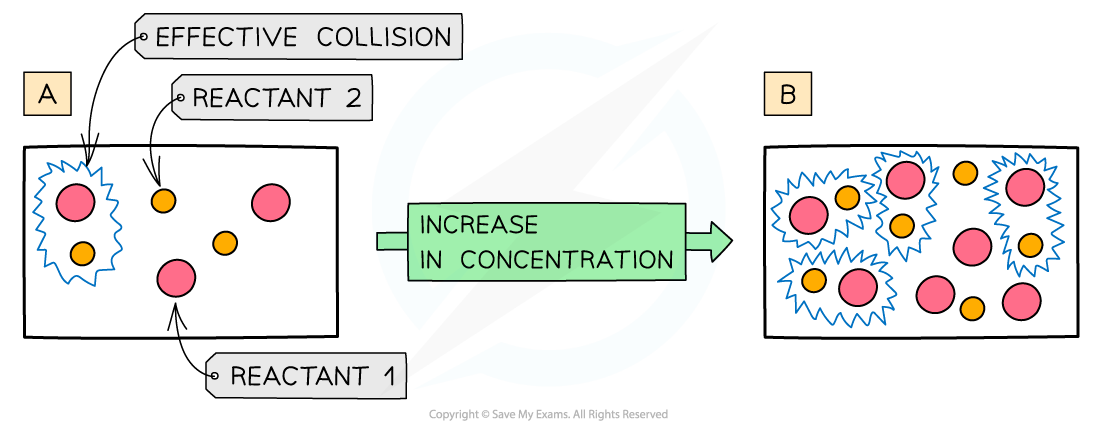
A higher concentration of particles in (b) means that there are more particles present in the same volume than (a) so the number of collisions and successful collisions between particles increases causing an increased rate of reaction
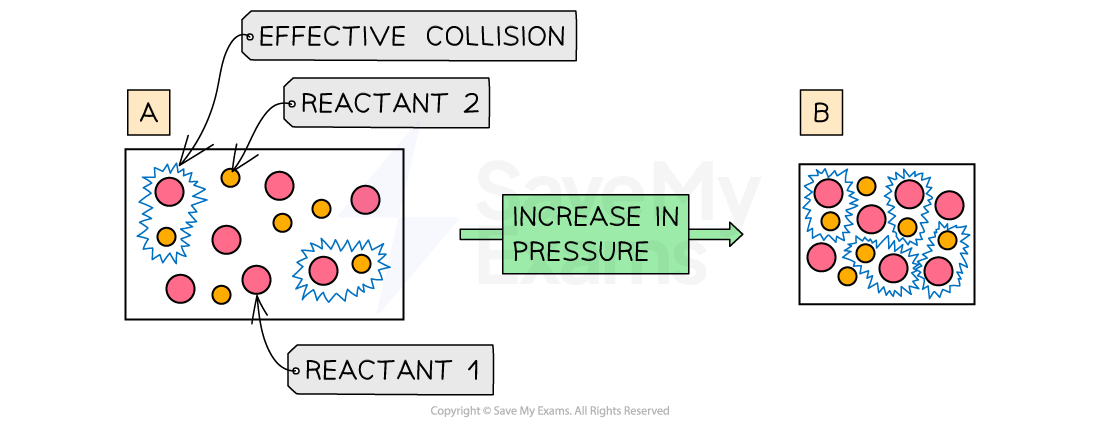
The higher pressure (b) means that there are the same number of particles present in a smaller volume than (a) so the number of collisions and successful collisions between particles increases causing an increased rate of reaction
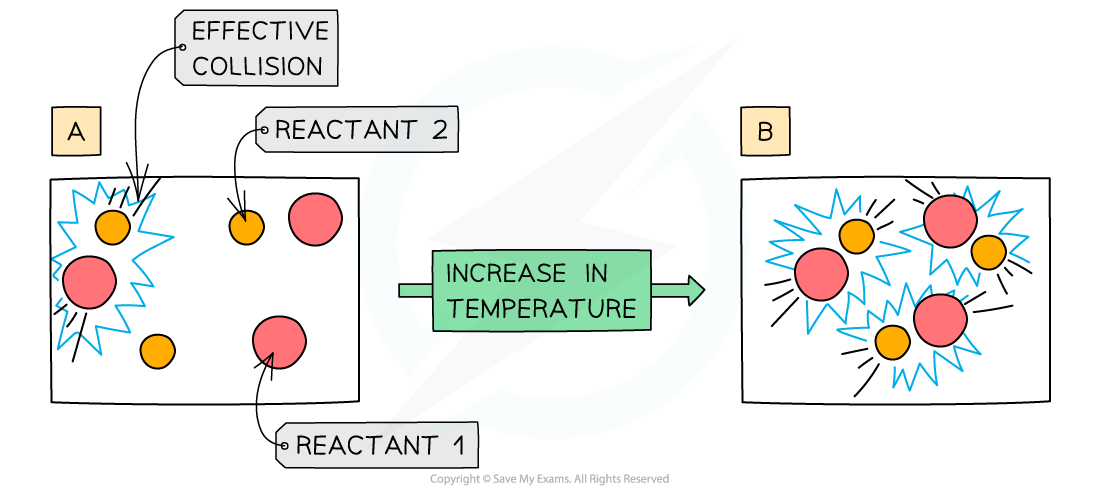
An increase in temperature causes an increase in the kinetic energy of the particles. The number of successful collisions increases
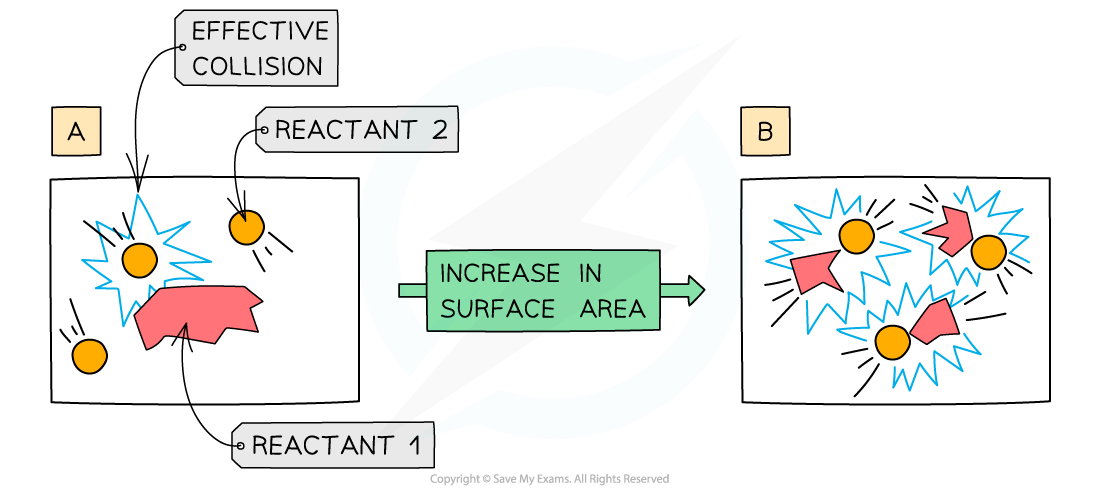
An increase in surface area means more collisions per second
Guided content from the SME authoring corpus — note rn_Zh6Pw56rjdMkPCD4, pinned at 51a6ed34e715 · promoted SyllabAI/syllabai-resources e967e75f1339