Calculate Volumes of Gases
2 guided lessons · 18 checks · 1. Principles of Chemistry → Chemical Formulae, Equations, Calculations
Guided lessons for this note
Which concept don't you understand yet?
We'll explain it simply and check your understanding. Pick any lesson — any order works.
0 of 18 checks correct so far
Lesson 1 of 2
Avogadro's Law and the Molar Gas Volume
One mole of any gas fills the same space at room temperature and pressure: 24 dm3, or 24,000 cm3. That molar gas volume turns any gas volume into moles and back again, whatever the gas is.
What you know already
Moles from mass and moles from solution working are both in hand; gases now take the same treatment. At room conditions every mole of gas fills the same 24 dm3, so a weighed mass of gas converts straight into a volume.
Key points of understanding
- At room temperature and pressure one mole of any gas occupies 24 dm3, or 24,000 cm3.
- RTP means 20 degrees Celsius and one atmosphere of pressure.
- Avogadro's law: equal amounts of gases at the same conditions occupy the same volume.
- Moles of gas equal volume divided by molar volume; volume equals moles times molar volume.
- Divide by 24,000 instead of 24 whenever the volume is given in cm3.
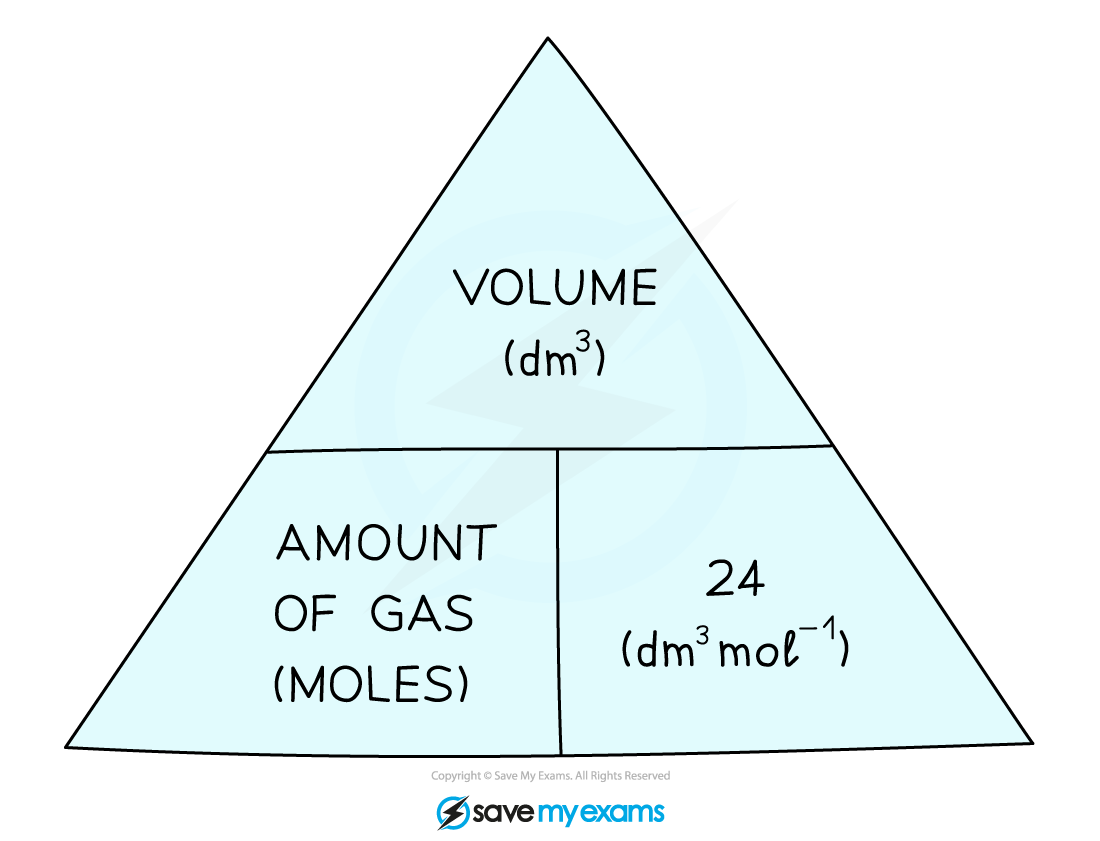
Formula triangle showing the relationship between moles of gas, volume in dm***<sup>***3***</sup>*** and the molar volume
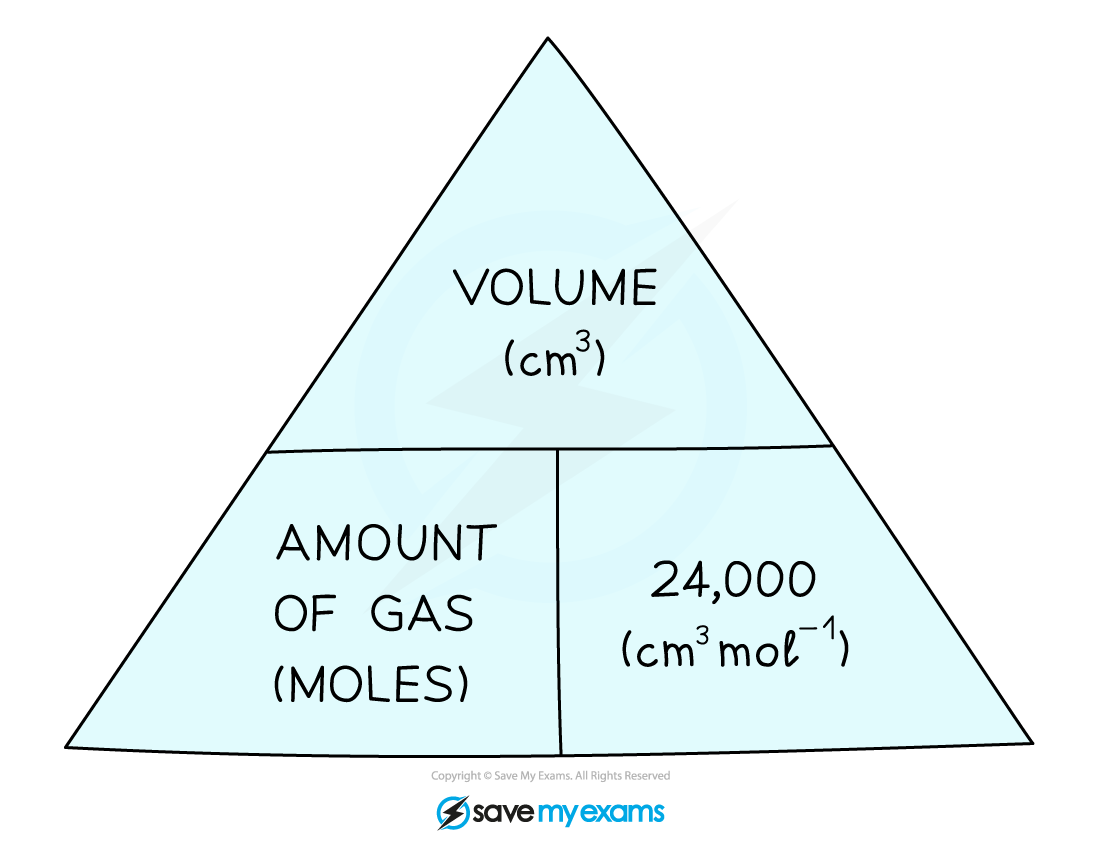
Formula triangle showing the relationship between moles of gas, volume in cm***<sup>***3 ***</sup>***and the molar volume
Choose a confidence level to continue.
Prefer to read it all at once? Show the full lesson as a page
1.Avogadro's Law and the Molar Gas Volume
One mole of any gas fills the same space at room temperature and pressure: 24 dm3, or 24,000 cm3. That molar gas volume turns any gas volume into moles and back again, whatever the gas is.
Formula triangle showing the relationship between moles of gas, volume in dm***<sup>***3***</sup>*** and the molar volume
Formula triangle showing the relationship between moles of gas, volume in cm***<sup>***3 ***</sup>***and the molar volume
Key points
- At room temperature and pressure one mole of any gas occupies 24 dm3, or 24,000 cm3.
- RTP means 20 degrees Celsius and one atmosphere of pressure.
- Avogadro's law: equal amounts of gases at the same conditions occupy the same volume.
- Moles of gas equal volume divided by molar volume; volume equals moles times molar volume.
- Divide by 24,000 instead of 24 whenever the volume is given in cm3.
First pass
At 20 degrees and one atmosphere, every mole of gas occupies 24 dm3 whatever its identity; 24,000 cm3 is the same figure in smaller units. Moles = volume / 24; volume = moles x 24.
Analogy — Identical suitcases hold identical clothes counts regardless of brand: one mole fills 24 dm3 whether hydrogen or carbon dioxide, so the gas's name never enters the sum.
Exam pointer — Table style: 3 mol of hydrogen gives (3 x 24) = 72 dm3; 1,200 cm3 of oxygen gives (1,200 / 24,000) = 0.05 mol - match the divisor to the unit.
Going deeper
The molar gas volume is a property of the conditions, not the gas: RTP fixes 24 dm3 per mole, so amounts of any gases compare by volume alone. The triangle hides nothing deeper - cover moles, volume or 24 and read the step.
Analogy — A standard pallet always holds the same box count whatever the goods; counting pallets counts boxes. Counting 24 dm3 units counts moles, whichever gas stacks them.
Exam pointer — Quoting RTP as 20 degrees Celsius and 1 atmosphere earns the mark; 0 degrees belongs to a different temperature's version of the value.
Checks
0 of 9 attempted · 0 correct
2.Finding Gas Volumes from Mass and Equations
Gas volumes do the reacting-mass trick without any Mr at all: under Avogadro's law the coefficients of the equation already are the volume ratio. Masses still convert through moles first, and the units the question names decide whether 24 or 24,000 does the dividing.
Key points
- Convert a gas mass to moles with Mr, then multiply moles by 24 for the volume.
- Coefficients in the balanced equation give the ratio of gas volumes directly under Avogadro's law.
- One volume of propane needs five volumes of oxygen when the coefficient ratio is 1 : 5.
- Total product volume adds the product coefficients first, then scales the given volume.
- Use the units the question asks for; 24 pairs with dm3 and 24,000 with cm3.
First pass
A mass of gas crosses to moles through Mr, then multiplies by 24 for its volume; 154 g of nitrogen does 154 / 28 = 5.5 moles and 5.5 x 24 = 132 dm3.
Analogy — Posting parcels: weigh a box, divide by the weight of one standard box to count boxes, multiply by the space each pallet slot takes. Grams to moles to volume is the same three-beat rhythm.
Exam pointer — The 154 g nitrogen question is two marks per step: Mr first, moles second, and only then does 24 appear.
Going deeper
Reacting gas volumes skip Mr entirely: under Avogadro's law the coefficient ratio is the volume ratio, so 150 cm3 of propane demands five times its volume of oxygen. Total product volume adds the product coefficients first, then scales.
Analogy — Dance partners: the equation pairs one propane with five oxygen molecules, and volumes pair identically - 150 cm3 of one needs 750 cm3 of the other, no weighing needed.
Exam pointer — Reacting-volume answers must quote the units the question used: 750 cm3 and 1,050 cm3 in cm3, not a surprise switch to dm3.
Checks
0 of 9 attempted · 0 correct
Guided content from the SME authoring corpus — note rn_T55t3HNsgyZcXZtN, pinned at da18433ed9e8 · promoted SyllabAI/syllabai-resources e967e75f1339