Pure Substance vs Mixture
2 guided lessons · 18 checks · 1. Principles of Chemistry → Elements, Compounds & Mixtures
Guided lessons for this note
Which concept don't you understand yet?
We'll explain it simply and check your understanding. Pick any lesson — any order works.
0 of 18 checks correct so far
Lesson 1 of 2
What Pure Means in Chemistry
In everyday talk, pure suggests something natural or untouched. Chemistry means something sharper: a pure substance is one single element or one single compound, with no other substances present. Pure water holds only water molecules; drinking water also carries dissolved ions and added chlorine, so it counts as a mixture even though it looks clean.
What you know already
You already know from Element, Compound or Mixture how to sort substances into the three classes. This note adds the chemistry sense of the word pure — a single element or a single compound, nothing else — and shows how melting and boiling points give the experimental evidence for it.
Key points of understanding
- Everyday language calls something pure when it seems natural or has nothing added.
- In chemistry, a pure substance is a single element or a single compound, and nothing else.
- Pure water contains only water molecules, with no other substances present.
- Drinking water counts as a mixture because it carries dissolved ions and chlorine as well.
- A pure substance must classify as an element or a compound, never as a mixture.
- Adding anything at all — even another pure substance — produces a mixture.
Choose a confidence level to continue.
Prefer to read it all at once? Show the full lesson as a page
1.What Pure Means in Chemistry
In everyday talk, pure suggests something natural or untouched. Chemistry means something sharper: a pure substance is one single element or one single compound, with no other substances present. Pure water holds only water molecules; drinking water also carries dissolved ions and added chlorine, so it counts as a mixture even though it looks clean.
Key points
- Everyday language calls something pure when it seems natural or has nothing added.
- In chemistry, a pure substance is a single element or a single compound, and nothing else.
- Pure water contains only water molecules, with no other substances present.
- Drinking water counts as a mixture because it carries dissolved ions and chlorine as well.
- A pure substance must classify as an element or a compound, never as a mixture.
- Adding anything at all — even another pure substance — produces a mixture.
First pass
Pure, in chemistry, means exactly one substance present: one element or one compound. The moment anything else rides along — ions, chlorine, another solid — the sample becomes a mixture. One sample, one substance: that is the whole test, no matter how clean the sample looks.
Analogy — A solo singer is a single voice; add a second singer and you have a duet — lovely, but no longer one voice.
Exam pointer — If a question says pure, answer in chemistry terms: one substance only, not merely natural or clean.
Going deeper
The chemical definition is strict: a pure substance is built from a single element or a single compound and nothing beyond it. Drinking water fails the test even though it looks clean, because dissolved ions and chlorine are additional substances mixed in with the water.
Analogy — Think of a recipe card that lists flour and nothing else: that is one pure ingredient. Write flour, sugar and eggs on the card and you hold a mixture of three.
Exam pointer — Questions often dress tap water, mineral water or sea water as pure water — answer that each is water plus dissolved extras, hence a mixture.
Checks
0 of 9 attempted · 0 correct
2.Melting and Boiling Point Evidence
Purity is not a guess — it shows up in the data. A pure substance melts and boils at one fixed, sharp temperature, while a mixture softens into a range: melting starts lower and boiling creeps higher than the pure values. Melting point analysis turns this into a routine laboratory test for purity, from drug testing to food production.
Key points
- A pure substance melts and boils at one specific, sharp temperature.
- A mixture melts and boils over a range of temperatures instead.
- Impure samples generally melt lower and boil higher than the pure substance.
- Melting and boiling data can therefore distinguish a pure substance from a mixture.
- Melting point analysis checks drug purity with an apparatus that heats a tiny sample slowly.
- The closer the measured point sits to the data-table value, the purer the sample.
First pass
Heat a pure substance and it melts at one sharp temperature; heat a mixture and the melting smears across a range. Impurities push the melting point down and the boiling point up. No reagents are needed — heat, watch, and compare the readings with the data tables.
Analogy — Pure ice melts at exactly 0 °C in a clean sweep; salty ice starts slumping well below zero and drips out lazily over several degrees.
Exam pointer — Learn both directions: an impurity lowers the melting point and raises the boiling point.
Going deeper
The experimental test compares measured values against known data: a sharp melting point matching the tables signals one substance present, while a spread signals a mixture. Impurities generally depress the melting point and raise the boiling point relative to the pure substance, and the nearer the reading to the accepted value, the purer the sample.
Analogy — A meeting that starts and ends exactly on time suggests one well-run team; one that drifts across an hour suggests several agendas in the room.
Exam pointer — Describe the technique in full: small sample, slow heating, comparison with data tables.
Checks
0 of 9 attempted · 0 correct
From the revision note
Diagrams on this note's page that are not tied to a specific lesson.
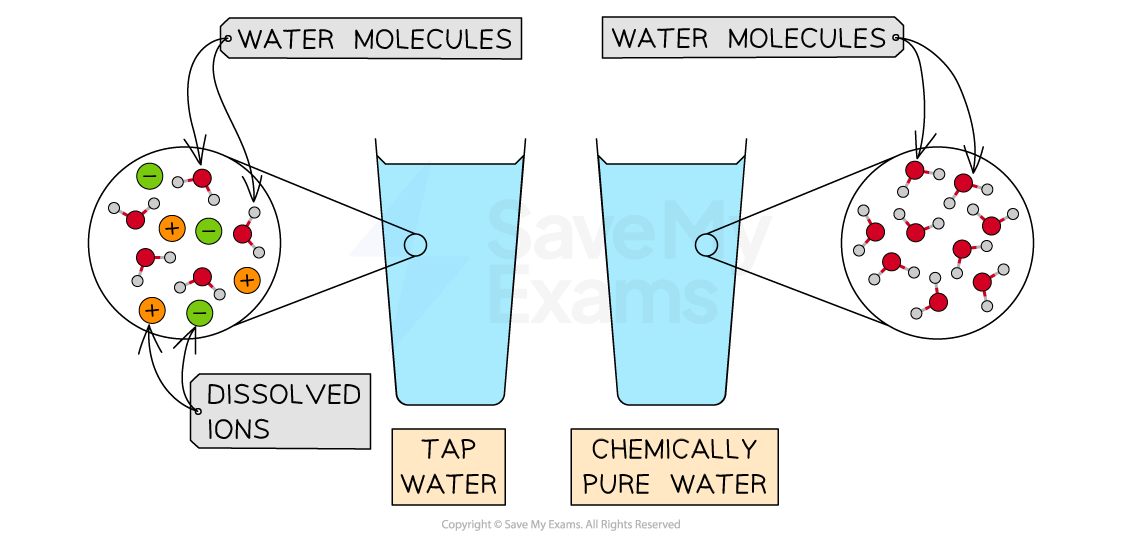
Pure water consists of only H***<sub>***2***</sub>***O molecules whereas tap water is a mixture
Guided content from the SME authoring corpus — note rn_RvgxXR36425BFMcx, pinned at 96c261a3a06e · promoted SyllabAI/syllabai-resources e967e75f1339