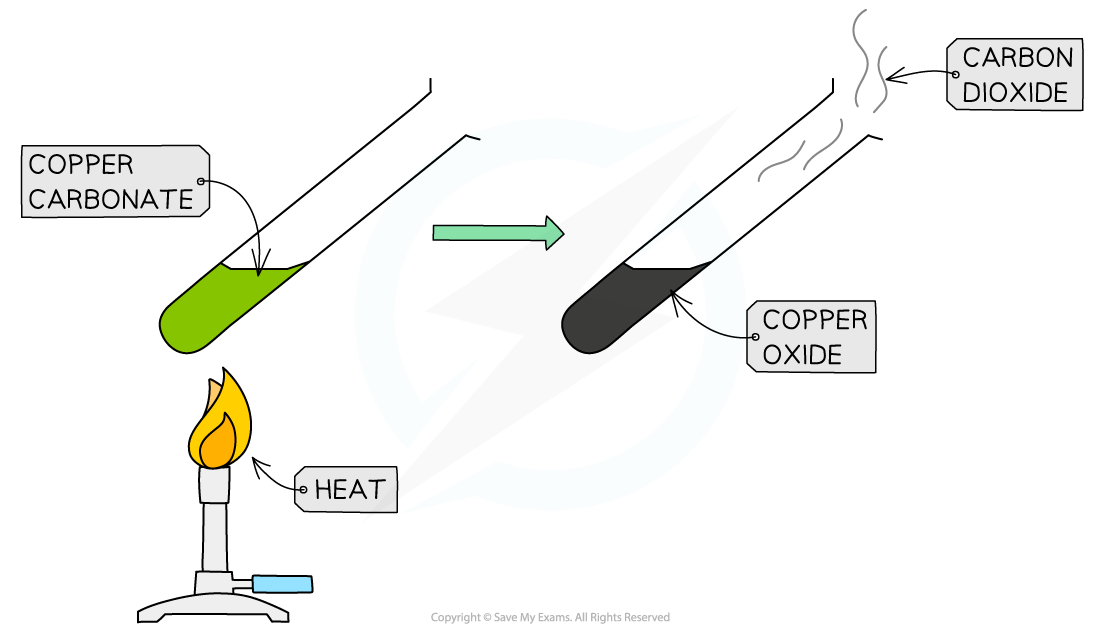
Carbon Dioxide from Thermal Decomposition
2 guided lessons · 18 checks · 2. Inorganic Chemistry → Gases in the Atmosphere
Guided lessons for this note
Which concept don't you understand yet?
We'll explain it simply and check your understanding. Pick any lesson — any order works.
0 of 18 checks correct so far
Lesson 1 of 2
What is thermal decomposition?
Thermal decomposition describes reactions in which a substance breaks down because of the action of heat. One important family belongs to the metal carbonates: for metals in the lower half of the series, heating breaks their carbonates apart. The breakdown leaves the metal oxide behind and gives off carbon dioxide gas.
What you know already
From Composition of Air you already know that carbon dioxide is one of the small components of air and the gas that limewater can identify. This note shows a second way the gas appears: heating metal carbonates until they break apart, leaving a metal oxide behind and releasing carbon dioxide, with copper(II) carbonate as the required example.
Key points of understanding
- Thermal decomposition is the breaking down of a substance due to the action of heat.
- Carbonates of the less reactive metals, those low in the series, break apart on heating.
- The general pattern is metal carbonate giving metal oxide plus carbon dioxide.
- The carbon dioxide released escapes as a gas, which is what makes the breakdown visible.
- Copper(II) carbonate is the example of this breakdown named by the specification.
Choose a confidence level to continue.
Prefer to read it all at once? Show the full lesson as a page
1.What is thermal decomposition?
Thermal decomposition describes reactions in which a substance breaks down because of the action of heat. One important family belongs to the metal carbonates: for metals in the lower half of the series, heating breaks their carbonates apart. The breakdown leaves the metal oxide behind and gives off carbon dioxide gas.
Key points
- Thermal decomposition is the breaking down of a substance due to the action of heat.
- Carbonates of the less reactive metals, those low in the series, break apart on heating.
- The general pattern is metal carbonate giving metal oxide plus carbon dioxide.
- The carbon dioxide released escapes as a gas, which is what makes the breakdown visible.
- Copper(II) carbonate is the example of this breakdown named by the specification.
Guided content from the SME authoring corpus — note rn_QzYRzzmwRxk2gKqV, pinned at 6fb25fc02d1a · promoted SyllabAI/syllabai-resources e967e75f1339