Practical: Investigate the Solubility of a Solid in Water at a Specific Temperature
2 guided lessons · 18 checks · 1. Principles of Chemistry → States of Matter
Guided lessons for this note
Which concept don't you understand yet?
We'll explain it simply and check your understanding. Pick any lesson — any order works.
0 of 18 checks correct so far
Lesson 1 of 2
Method
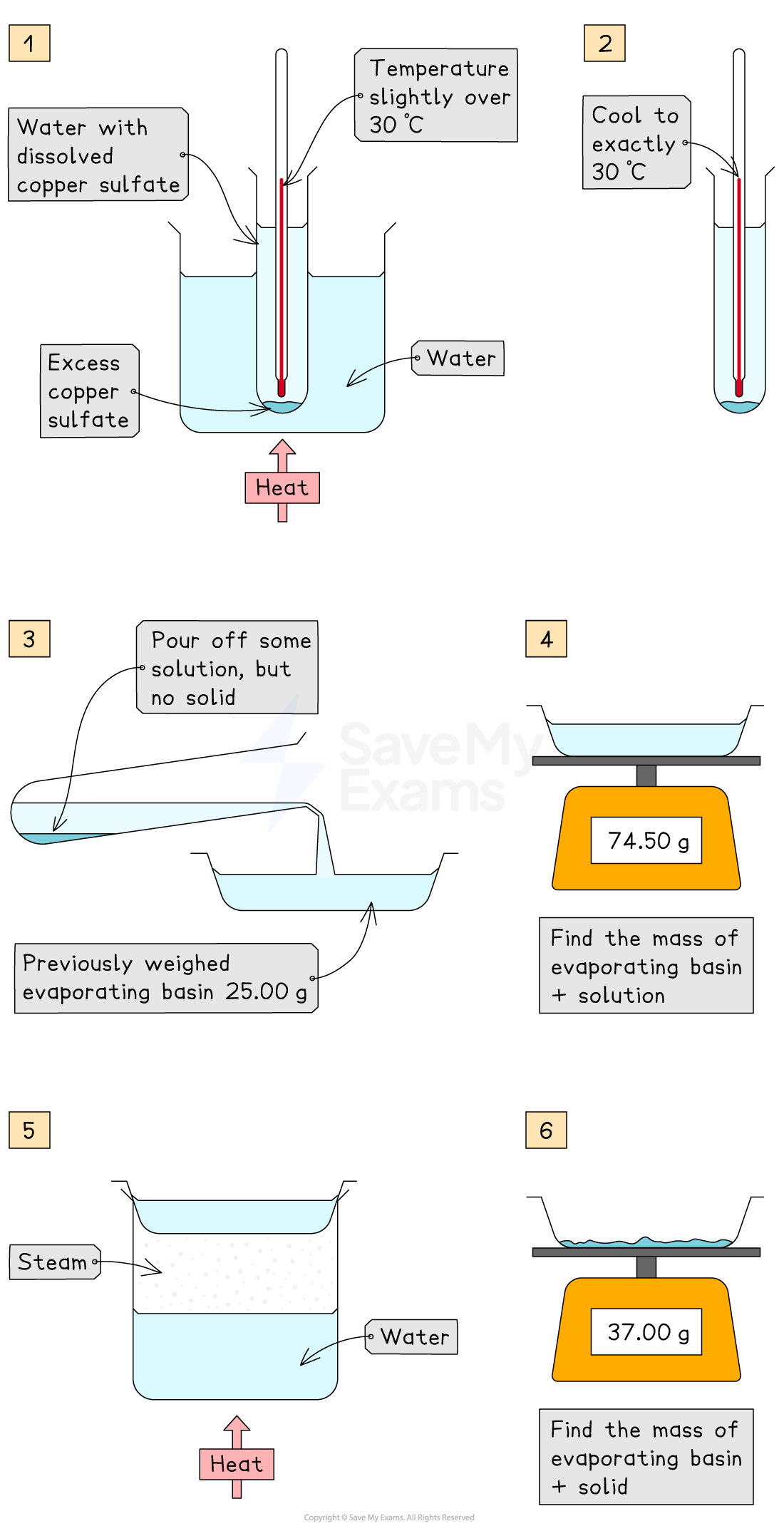
The aim is to find how much of a solid dissolves in water at one chosen temperature. Excess solid is stirred into warm water until no more will dissolve, the saturated solution cools to exactly 30 °C, and a portion of the clear liquid is weighed into an evaporating basin before all the water is evaporated away.
What you know already
You already know from States of Matter what a solution is, and from Solubility how it is measured in grams per 100 grams of solvent. This note makes that measurement hands-on: prepare a saturated solution at a fixed temperature, evaporate the water away, weigh the solid left behind, and calculate the solubility from the masses recorded.
Key points of understanding
- The practical measures a solid's solubility at one chosen temperature.
- Excess solid is added and stirred until some refuses to dissolve.
- Leftover undissolved solid is the guarantee that the solution is saturated.
- The saturated solution cools to the target temperature before any is poured off.
- Only clear solution may enter the pre-weighed evaporating basin.
- The basin is reheated, cooled and reweighed until two masses agree, confirming all water has gone.
Choose a confidence level to continue.
Prefer to read it all at once? Show the full lesson as a page
1.Method
The aim is to find how much of a solid dissolves in water at one chosen temperature. Excess solid is stirred into warm water until no more will dissolve, the saturated solution cools to exactly 30 °C, and a portion of the clear liquid is weighed into an evaporating basin before all the water is evaporated away.
Key points
- The practical measures a solid's solubility at one chosen temperature.
- Excess solid is added and stirred until some refuses to dissolve.
- Leftover undissolved solid is the guarantee that the solution is saturated.
- The saturated solution cools to the target temperature before any is poured off.
- Only clear solution may enter the pre-weighed evaporating basin.
- The basin is reheated, cooled and reweighed until two masses agree, confirming all water has gone.
First pass
Stir in more solid than the water can take, let it settle at the chosen temperature, pour off the clear liquid only, and weigh what remains once every trace of water is gone.
Analogy — It is like drying a wet cloth on a scale: keep weighing after more drying until the number stops changing, and that is the true dry mass.
Exam pointer — The phrase to quote is heating to constant mass: reheat, cool, reweigh, repeat until two readings match.
Going deeper
Excess solid guarantees a saturated solution; cooling to the exact target temperature fixes the conditions; leaving the undissolved solid behind keeps the measured mass honest; and heating to constant mass proves every trace of water has been driven off before the final weighing.
Analogy — The wet-cloth picture carries over: repeated dry-and-weigh cycles until two consecutive readings agree, at which point any further heating would change nothing.
Exam pointer — Method questions award marks for the guards: excess solid, no transferred crystals, the exact temperature, and constant mass; name all four.
Checks
0 of 9 attempted · 0 correct
2.Results
The weighed results tell the whole story in three numbers: the solution poured in, the solid recovered, and therefore the water that carried it. From those, the solubility comes out in the standard unit, grams per 100 grams of water, and the solute's share of the solution can be stated as a percentage.
Key points
- Mass of solution is the filled basin minus the empty basin.
- Mass of recovered solid is the dry basin minus the same empty basin.
- Mass of water is the solution mass minus the solid mass.
- Solubility is the solid mass scaled up to 100 grams of water.
- The recorded data gives 32.0 grams per 100 grams of water at 30 °C.
- Expressed as a share of the whole solution, the solute is 24.2 percent.
First pass
Subtract the empty basin's mass to get the solution mass, do the same for the dry solid, and the difference between those two is the water.
Analogy — Think of weighing a full lunchbox, then the food alone: subtract the box's own weight each time, and the masses of the contents appear on their own.
Exam pointer — State the unit with the answer: grams per 100 grams of water at the stated temperature.
Going deeper
Two subtractions recover the solute and solution masses, their difference gives the water mass, and scaling the solute to 100 grams of water converts the data into a solubility value that can be compared across temperatures.
Analogy — The lunchbox subtraction still works, with one extra step: after finding the food and total contents, the packaging itself is what remains to be counted.
Exam pointer — A follow-up part often asks for the solute's percentage of the solution; that divides by the solution mass, never by the water mass.
Checks
0 of 9 attempted · 0 correct
Guided content from the SME authoring corpus — note rn_QVmDs8X4szpds3cP, pinned at 96c261a3a06e · promoted SyllabAI/syllabai-resources e967e75f1339