Electrolysis Experiments
2 guided lessons · 18 checks · 1. Principles of Chemistry → Electrolysis
Guided lessons for this note
Which concept don't you understand yet?
We'll explain it simply and check your understanding. Pick any lesson — any order works.
0 of 18 checks correct so far
Lesson 1 of 2
Electrolysis of molten compounds
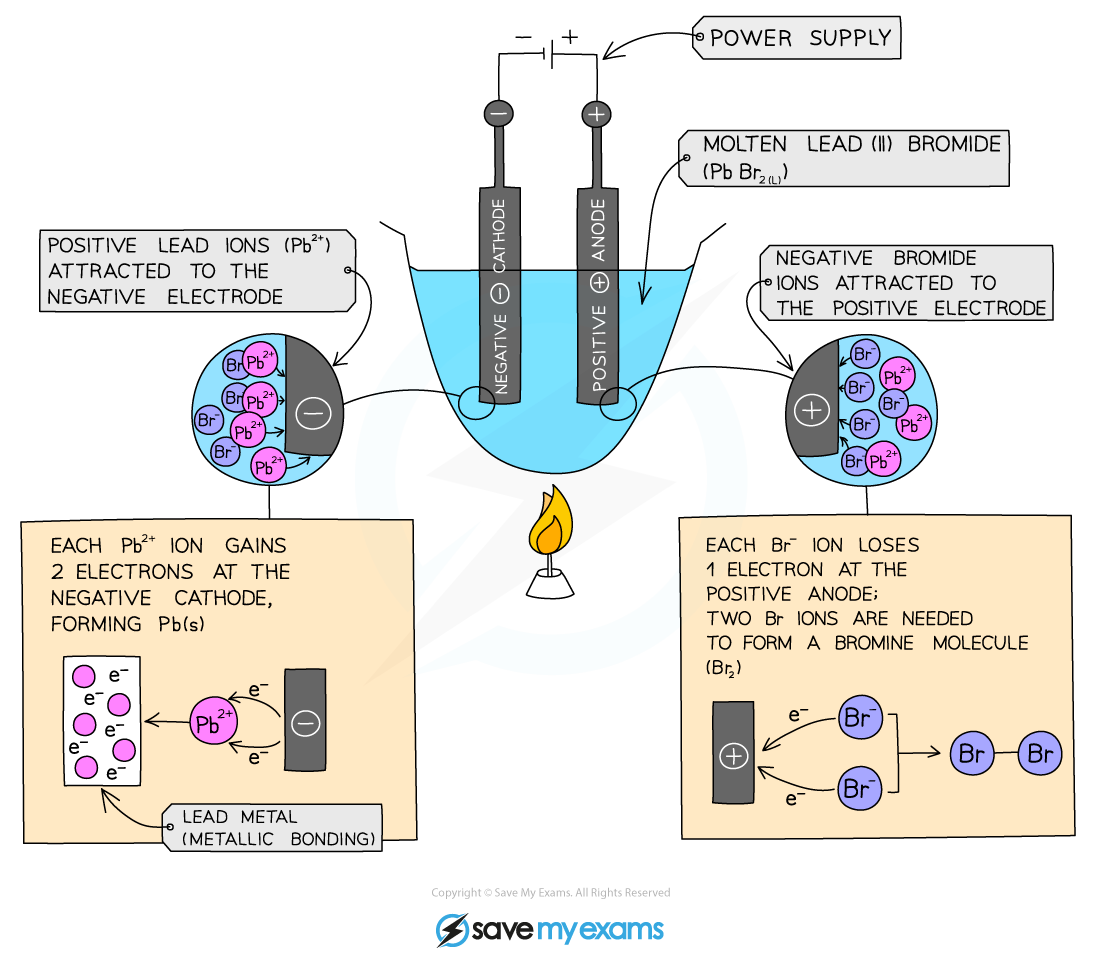
A binary ionic compound contains just two elements joined by ionic bonding, lead(II) bromide being the classic example. Heated past its melting point it becomes molten, its ions can move freely, and it conducts, which allows electrolysis to split it into its two elements. The positive ion always travels to the cathode and the negative ion to the anode, so the cathode product is the metal and the anode product the non-metal.
What you know already
From Explaining Conductivity you know that ionic compounds conduct only when molten or dissolved, and that their ions then migrate to the electrodes. This note turns that knowledge into laboratory experiments: electrolysis of molten compounds such as lead(II) bromide, electrolysis of aqueous solutions, and the rules that predict which product appears at each electrode.
Key points of understanding
- A binary ionic compound consists of just two elements joined by ionic bonding, such as lead(II) bromide.
- Heated beyond its melting point, the compound becomes molten and can conduct because its ions move freely.
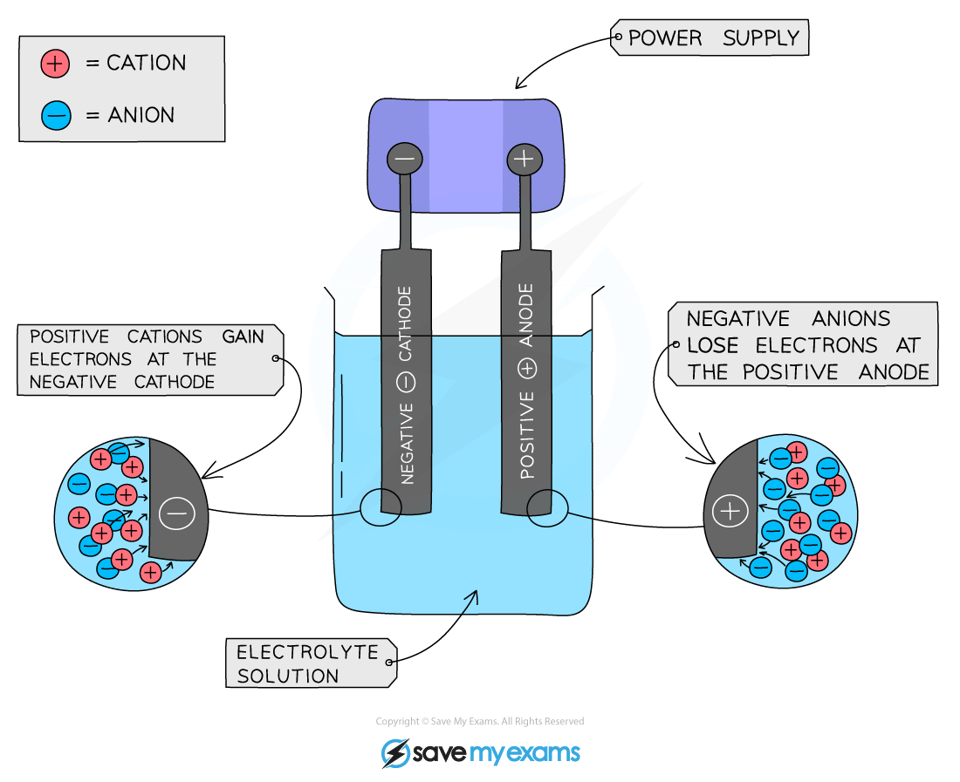
- The positive ion migrates to the cathode and the negative ion to the anode.
- The cathode product is always the metal, and the anode product is always the non-metal.
- In molten lead(II) bromide, brown bromine gas bubbles at the anode and grey lead deposits at the cathode.
Choose a confidence level to continue.
Prefer to read it all at once? Show the full lesson as a page
1.Electrolysis of molten compounds
A binary ionic compound contains just two elements joined by ionic bonding, lead(II) bromide being the classic example. Heated past its melting point it becomes molten, its ions can move freely, and it conducts, which allows electrolysis to split it into its two elements. The positive ion always travels to the cathode and the negative ion to the anode, so the cathode product is the metal and the anode product the non-metal.
Key points
- A binary ionic compound consists of just two elements joined by ionic bonding, such as lead(II) bromide.
- Heated beyond its melting point, the compound becomes molten and can conduct because its ions move freely.
- The positive ion migrates to the cathode and the negative ion to the anode.
Guided content from the SME authoring corpus — note rn_3YZNCXSQQqXTT6HR, pinned at fa1f302050ba · promoted SyllabAI/syllabai-resources e967e75f1339