Teddy bear - teacher support
Excerpt: Detailed notes for Teddy bear, produced as part of an ongoing research project in collaboration with teachers.
Outline
These notes are intended to be read in conjunction with the resource files for the main task, Teddy bear, including the teacher notes and solution.
About these notes
These notes have been produced as part of a research project in collaboration with colleagues at the University of Cambridge, Faculty of Education. We are researching how teacher notes and video clips can support teachers to use Underground Mathematics resources..
In these notes you will find
-
Suggestions of how the main task, Teddy bear, could be used, indications of mathematical behaviour to look out for and reflection questions to draw together ideas.
-
Details of opportunities for learning in the main task, including identifying big ideas, connections, common issues and misconceptions. We also suggest questions and prompts that you could use to raise awareness of these while students work on the main task.
-
Suggestions of preliminary and follow-up tasks for the main task.
-
Video of students tackling the task and reflecting on how they solved the problem
For more information on this project please e-mail us.
Resource outline
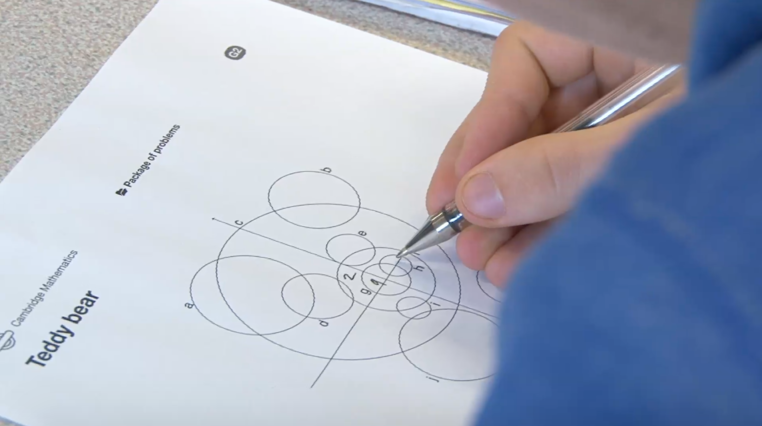
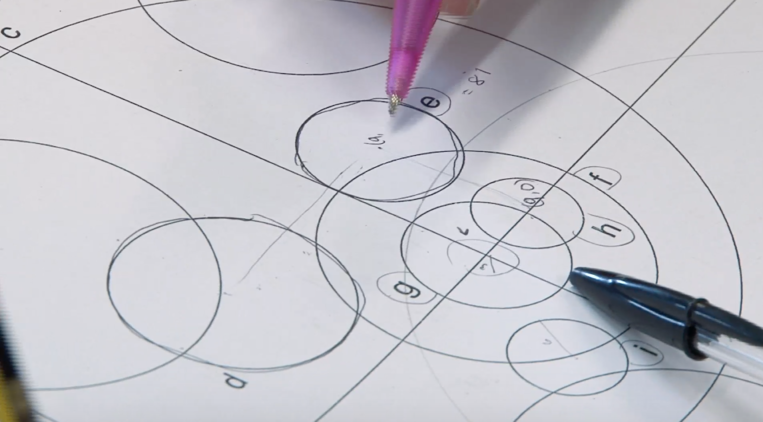
This is a low-threshold, high-ceiling activity where learners are “simply” invited to match some circles on a graph with their equations. The circles are drawn to scale, but the axes are not labelled. The resource can be used to consolidate learning shortly after the Cartesian equations of circles are introduced, or as a revision task.
Introducing the task and suggested ways of working
Students could work in pairs or small groups to encourage sharing ideas and justifying statements. Throughout the task encourage students to record their reasoning so that they can present or adapt their argument.
The circles diagram can be printed on A3. Students could be given 2 minutes to look at the diagram before they are given the problem sheet with the equations. Students should note what they see in the diagram (common centres, variation of radius or variation of the position of the centre) and share these ideas in pairs.
Part way through the task, invite all groups to share ideas. Students could suggest a circle that they have matched, make an observation, describe their strategy or ask a question.
Mathematical behaviour to look out for
-
Students categorising circles in some way.
-
Students building arguments, moving towards proofs.
-
“If this circle is … then this circle is…/could be….”. Awareness of how initial assumptions affect later deductions.
-
“If this is … then this is …, but then…”. Contradictions reveal false assumptions.
Reflection questions
-
What strategies have you used?
-
Could you have solved the problem more efficiently?
-
What features of the circles were helpful for the matching? What did this tell you about circles?
-
What features of circles have you not used to solve this problem?
-
Could you use your strategy for a similar problem about other curves?
-
Could you make up a similar problem? How could you make it more difficult? How could you make it easier?
-
What can you do well in this topic? What do you need to think about?
Prerequisites
Cartesian equations of circles, completing the square
Skills involved in this task
Relating equations of a circle to the position of its centre, completing the square, sketching curves, estimation, reasoning and deduction
Opportunities for learning
Here are some prompts and suggestions for questions you could use to raise awareness of the overarching ideas, connections, common issues and misconceptions in this resource.
Overarching ideas
| Overarching ideas in this resource | Questions teacher could ask |
|---|---|
| Multiple representations | When do an image and equation represent the same circle? |
| Visualising | What does the equation tell you about what the circle looks like? Can you estimate the values of the irrational numbers? |
| Organising, categorising and ordering objects | Do any circles or equations look particularly special? Can you break down the problem into some smaller problems? Can you work on small groups of circles/equations? What criteria could you use to group the circles? [radius; relative position of centres: left/right, up/down, quadrants] If you estimate the irrational numbers, what level of accuracy would be helpful? |
| Conjecturing, Logic, Proof | What have you assumed? How can you decide between various possibilities? Which circle or equation could be a good one to start with? (e.g. 2, 7 and 9) Which are the easiest to match? Hardest? Why? |
| Talking about mathematics | What are you sure about? What would you like to know? How did you approach the problem? Have you got the same matching as other students? Can you convince someone else that you’ve matched the circles correctly? |
Opportunities for making connections
| Making connections | Questions teacher could ask |
|---|---|
| Different forms of equation of a circle | Would it be helpful to have all the equations in the same form? What is a useful form for this problem? Why? |
| Linking geometry and algebra | How can we compare the size of the circles? How can we compare the positions of the centres of the circles? What aspects of this problem are specific to circles? Which relate more generally to equations and curves? |
Common issues and misconceptions
| Common issues or misconceptions | How might these be revealed? | Teacher input |
|---|---|---|
| No idea where to start | Suggest making table of centre and radius for each equation. | |
| Thinking that has centre at | Protesting that there is not a circle centred there. | |
| Not square rooting to get radius | Talking about very large circles. | Where do the squares in the standard equation come from? |
| Estimation/lack of scale | Students get a ruler out | |
| Circles always have to be represented as | Not realising 6,11 are circles | Think about expanding this form. What terms will/won’t you get? |
| The constant in the expanded form of the equation is the square of the radius | Not being able to find a circle of appropriate radius. Recognising there are too many circles that aren’t drawn. Commenting that rearranging the equation will give a negative | What is the constant term if you expand equation 1? Or suggest another circle from the preliminary tasks. |
| Difficulty with irrational numbers in this context | Not recognizing that is Discomfort with as a coordinate of the centre. |
Preliminary and follow-up tasks
Preliminary task
We have suggested alternative options for a preliminary task that could be used in a lesson a few days before the main task, or set as a homework. The purpose of the preliminary task is to
-
remind students of certain ideas or skills related to the main task so that they do not become an artificial barrier in the main task, and
-
help to inform the way you use the main task by assessing students’ familiarity or confidence with these ideas or skills.
Option 1 - Sketch or give an equation of…
These questions could be used in a mini-whiteboard session.
Sketch or give an equation of…
-
… a circle that does not cross the axes
-
… a circle whose centre lies on an axis
-
… a circle that lies completely inside the previous circle you drew
-
… a circle with the same centre as
-
… a circle with the same radius as
-
… a circle which has the -axis as a tangent
The option to sketch is suggested so that all students can start to give examples of circles satisfying the suggested conditions. Students may add equations to their previous sketches as ideas emerge through discussion.
Option 2 - Review question
Can we show that these two circles touch?
Show that the circles having equations and touch each other. Calculate the coordinates of the point at which they touch.
Follow-up task
We have also suggested options for a follow-up task, which could be used a few days after the main task. This provides an opportunity to revisit key ideas from the main task.
Option 1 - Modifying Teddy bear
Students add circles and equations to the original set in the Teddy bear resource
Add a circle or equation of a circle which
-
is tangent to an axis
-
is an enlargement of a circle already given
-
is contained within a circle already given
-
is a reflection of a given circle in the y-axis
-
is a reflection of a given circle in the line y=x
-
passes through the centre of a circle already given
-
has the same constant term as a circle already given
Option 2 - Review question
The distance between two non-intersecting circles: Prove that the points whose coordinates satisfy the equation lie on a circle. State the coordinates of the centre of the circle and the length of its radius. Prove that the circles and lie entirely outside each other, and find the length of the shortest distance from a point on one circle to a point on the other.
Option 3 - Pairs of circles
Pairs of circles is another problem that will reinforce links between the equation of a circle and its graphical representation. This problem presents a simple image that is surprisingly rich when considered in detail. Students can take an algebraic approach but they will find that a geometrical approach can make the problem much simpler.
We suggest these tasks as part of a sequence of teaching, but they can be used flexibly. For example, a preliminary task could be used as a follow-up, or vice versa.
Video clips
These video clips are from a lesson using Teddy bear and may help you prepare to use the resource. The clips are intended to give an indication of how students responded to the Teddy bear task and the type of mathematical thinking that helped them to tackle the problem.
This clip gives an overview of the resource and some student and teacher reflections on the process of tackling the Teddy bear problem. In particular, they discuss the process of getting started on the problem, how they coped with getting stuck and what mathematics they used to help them solve the problem.
This clip shows two particular episodes of students working on the problem. The first episode shows a group of students working through some initial confusions. The second episode shows some approaches that students tried help them to complete the task.
We are grateful to Julian Marshall for directing the filming, selecting and editing some video clips and for his guidance on the use of classroom video.