Can we show that (circle area)/(triangle area) ≥π?
Question
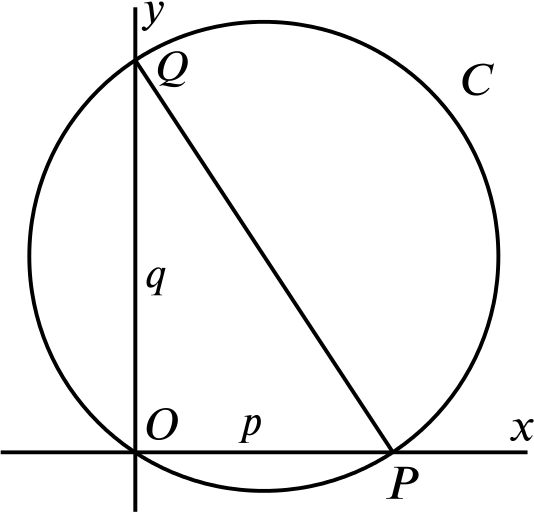
Let p and q be positive real numbers. Let P denote the point (p,0) and Q denote the point (0,q).
Show that the equation of the circle C which passes through P, Q and the origin O is x2−px+y2−qy=0. Find the centre and area of C.
Show that area of triangle OPQarea of circle C≥π.
Find the angles OPQ and OQP if area of triangle OPQarea of circle C=2π.
Suggestion
Download GeoGebra file
The areas of the circle and triangle are shown, as is their ratio.
Solution
Substituting in the coordinates (p,0), (0,q) and (0,0), we find that all three points satisfy the equation and so lie on the circle, so we are done.
Alternatively, we can deduce the equation from scratch once we know the centre of the circle.
The line PQ is a diameter of C, since the angle POQ is a right-angle, and we know that the angle in a semi-circle is a right-angle.
So the midpoint of PQ, which is M(2p,2q), is the centre of the circle. Thus the circle has equation (x−2p)2+(y−2q)2=r2, for some r. We can find r either by substituting the coordinates of a point on C, say (x,y)=(0,0), which gives r2=(2p)2+(2q)2=4p2+q2, or by finding the radius, which is OM=AM=BM, giving the same result.
Just using the given equation, we can complete the square to obtain (x−2p)2+(y−2q)2−4p2+q2=0 which is the equation of the circle with centre (2p,2q) and area π4p2+q2.
Alternatively, using the argument above, we already know the centre of the circle and r2, and the area is πr2=π4p2+q2.
The area of OPQ is 21pq, so area of triangle OPQarea of circle C=πpq/2(p2+q2)/4=π2pqp2+q2
Then we note that π2pqp2+q2≥π⟺p2+q2≥2pq⟺(p−q)2≥0 which always holds, and so the required inequality is true.
From our previous expression we have π2pqp2+q2=2π⟺p2+q2=4pq.
Then if we divide through by q2 (which we know is non-zero), we get (qp)2−4(qp)+1=0 which is a quadratic in qp with solution qp=24±16−4=2±3.
Now since triangle OPQ is right-angled, we have that qp=tanOQP and pq=tanOPQ.
Then since the solutions are reciprocals of each other, we have {tanOQP,tanOPQ}={2+3,2−3}, where the order depends on which of p and q is larger: if p>q, then tanOQP=2+3; if p<q, then tanOQP=2−3.
Thus {OQP,OPQ}={arctan(2+3),arctan(2−3} in some order, depending on whether p>q or p<q.
[Incidentally, it turns out that arctan(2−3)=12π and arctan(2+3)=512π, as we will learn at Trigonometry: Compound Angles.]