What can we deduce if the loci traced out by two points touch?
Question
A point P(x,y) moves so that OP2=λy, where O is the origin and λ is a constant. Show that the locus of P is a circle. State the coordinates of the centre of the circle and the length of its radius.
Using the same axes, find the locus of a point Q(x′,y′) which moves so that QR2=λ′y′, where R is the fixed point (α,0) and λ′ is a constant.
If the two loci touch each other, and α=0, prove that α2=λλ′.
Suggestion
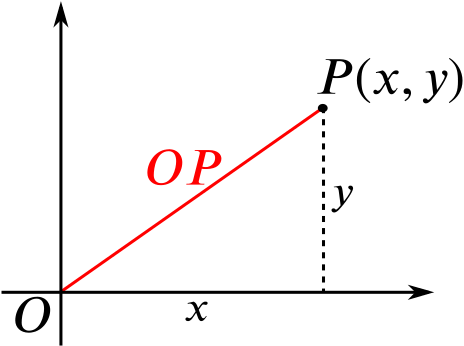
Could we sketch the point P(x,y) and the line OP?
What’s the formula for the distance between two points?
Could we rearrange this into the standard form for a circle?
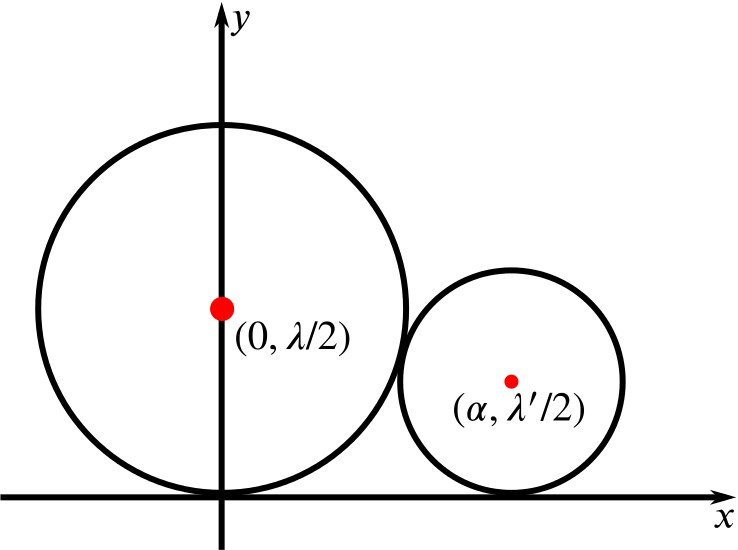
Could we draw a picture of this situation?
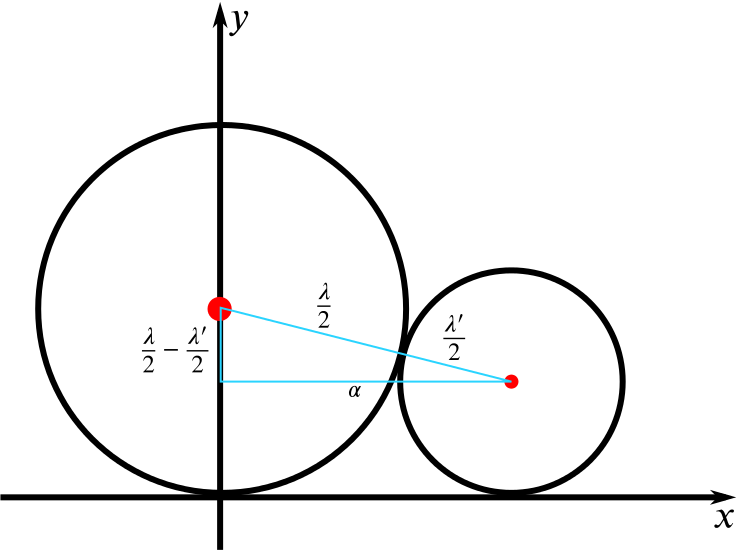
What’s the distance between the two centres here?
Interactive graph
Download GeoGebra file
The red circle here is x2+y2=λy, while the green circle is (x−α)2+y2=λ′y.
What happens as we vary λ,α and λ′? When do the circles touch?
Solution
We can apply Pythagoras’ Theorem to find the length
OP2
. We have
OP2=x2+y2.
Now we know that the length
OP2
must be equal to
λy
. We substitute this in and rearrange, giving
OP2=λy=x2+y2x2+y2−λy=0x2+(y−2λ)2−4λ2=0x2+(y−2λ)2=4λ2.
This tells us that points P(x,y) such that OP2=λy form a circle, and inspecting the equation above, we see that the circle has centre (0,2λ) and radius 2λ.
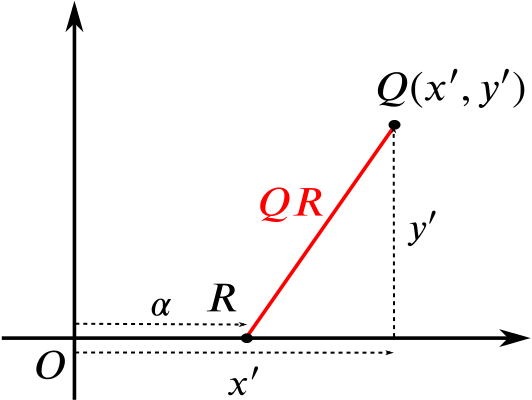
A point Q(x′,y′)
We see the length of the base of the triangle is x′−α, if x′>α, or α−x′ if x′<α.
As squaring both of these quantities gives the same result, we see that
λ′y′=QR2=(x′−α)2+y′2(x′−α)2+(y′−2λ′)2=4λ′2,
that is, such points lie on the circle with centre (α,2λ′), with radius 2λ′.
There is a right-angled triangle here with side lengths that we know.
Using Pythagoras’ theorem, we find
(2λ+2λ′)2=α2+(2λ−2λ′)2.
We could see this as finding (the distance between the centres of the circles)2, using the formula for the distance between two points, which was originally derived from Pythagoras’s theorem.
Expanding the brackets gives
4λ2+4λ′2+2λλ′=α2+4λ2+4λ′2−2λλ′.
Rearranging, we have that
α2=λλ′.